
Thoughts
The first time El Shaddai אֵל שַׁדַּי (debated but usually translated God Almighty or God the Nourisher or God Overpowers) appears in the Bible is in Genesis 17:1: “When Abram was ninety-nine years old, the Lord appeared to him and said, ‘I am El Shaddai; walk before me, and be blameless.’” But we see it again here in Genesis 28:3 from Isaac “God Almighty (El Shaddai) bless you and make you fruitful and multiply you, that you may become a company of peoples.”
Bethel (בֵּית אֵל) = “House of God”
Jacob’s response to God’s blessing is interesting…if God is with me…if He keeps me on this path…it sounds conditional
Jacob’s dream is similar to Jesus saying in John 1:51 Truly, truly, I say to you, you will see heaven opened, and the angels of God ascending and descending on the Son of Man.”
So at the start of chapter 29 – basically it was shepherd etiquette to wait until all flocks arrived before opening the well to insure fairness, but Jacob sees Rachel and tells them to go water them now. He then removes the stone by himself (to show his strength?)
I wonder how Rachel felt when a strange man came up to her, kissed her, and then started weeping loudly
Leah (לֵאָה) likely means “weary” or “wild cow,” while Rachel (רָחֵל) means “ewe”.
“The eyes of Leah were רַכּוֹת (rakot) = soft, tender, delicate, or weak”
Interesting contrast in Genesis 29 when Laban is saying he gave Leah to Jacob because they don’t elevate the younger (Rachel) over the older (Leah) with Jacob’s whole scheme to take the older (Esau)’s birthright
There is a lot more stories in the Bible where the narrator is showing ‘hey don’t do this’ vs ‘hey mimic this person’.
The Hebrew phrase Rachel says she wants Bilhah to bear a child “on her knees” – this could be a figure of speech but could also be intended literally during the delivering of the child
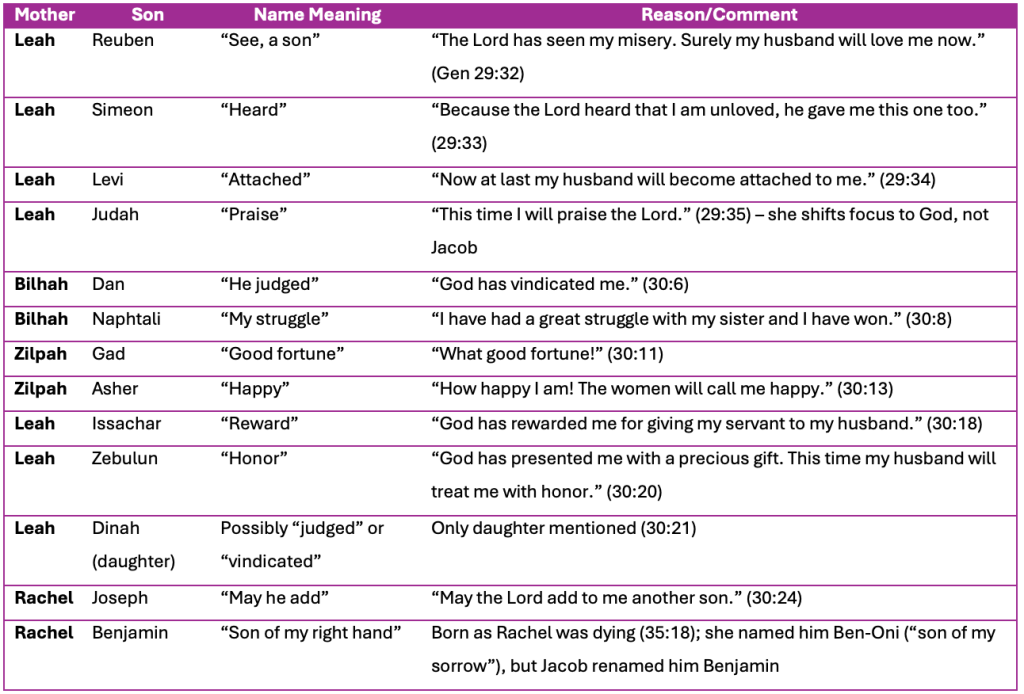
See below for table I made of the sons’ names and meanings
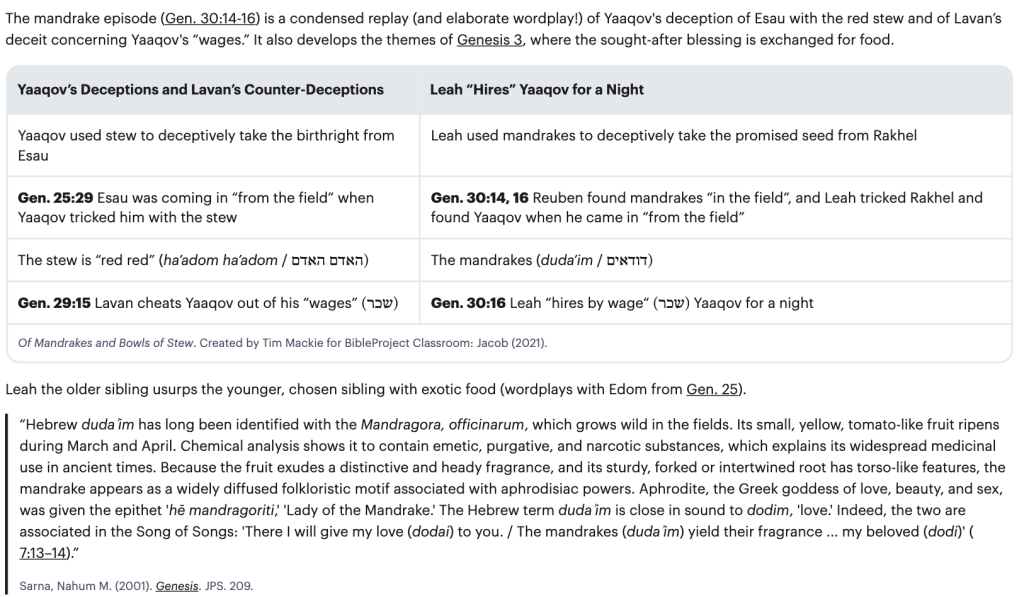
Such interesting wordplay with ‘mandrakes’. See below image from https://bibleproject.com/classroom/jacob/sessions/15
Jacob uses peeled sticks from trees, placing them at the watering troughs. These sticks were white inside which plays on the Hebrew word lavan (white), which is also Lab(v)an’s name
Some experts have suggested that Jacob used the poplar rods as fake phalluses and allowed the undesired animals to become aroused by the rods (so they wouldn’t mate), similar to how modern breeders use artificial mating devices and teaser animals to trigger heat. (Noegel, Scott B. (1997). “Sex, Sticks, and the Trickster in Gen. 30:31-43: A New Look at an Old Crux.” Journal of Ancient Near Eastern Society, vol. 25. 10)
Questions
Does Esau marrying in Ishmael’s clan show further division between his people and Jacob’s? (Isaac vs Ishmael, Jacob vs Esau, etc)
Is there something about God meeting people in the wilderness (Moses, Elijah, Hagar, Jesus etc)? It’s almost like a place of forced dependance where God is our only shelter
What is significance of angels going up and down stairway? Is the dream meant to just connect to Jesus saying He will be the ladder/stairway later on?
I would like to know what was going on with Leah’s eyes.
Was Leah happy with the deceit of Laban, like ‘yay I got a husband and won’ or was she embarrassed and forced by her father – either way so sad how the women were treated.
Application
These chapters are filled with deception and the repetition of broken patterns we’ve seen throughout Genesis, but what stands out to me is the image of God meeting people in the wilderness. I’ve experienced my own “dark night of the soul,” and when God met me in that place of emptiness, it changed everything. He didn’t wait for me to ‘finally get it right’ or be perfect. God’s plan will always conquer over our brokenness.

 Jo Reads The Bible
Leave a comment