
Thoughts
Numbers 25
Here we have Israel in Shittim – with Moabites and Midianites around them.
“Baal” (בַּעַל) in Hebrew simply means “lord” or “master” and any Canaanite gods were called “Baal” of something like “Baal of Peor” or “Baal-Zebub.” This Baal was a fertility god, which required sexual immorality and ritual prostitution with women.
God has Moses hang the leaders publicly
Zimri and Cozbi: this man and woman were (near?) the tabernacle and most likely engaging in some kind of sexual act, while people who stood by wept.
Aaron’s grandson, Phinehas threw a spear at them and impaled them both (again implying something sinful)
Because he did this, the plague stopped (the text doesn’t say when the plague started – probably after God’s anger was kindled)
God said to attack the Midianites
Numbers 26
God commands a second census:
See image below for the change in numbers from the first and second record (from https://inspiredscripture.com/bible-studies/numbers-26#gsc.tab=0)
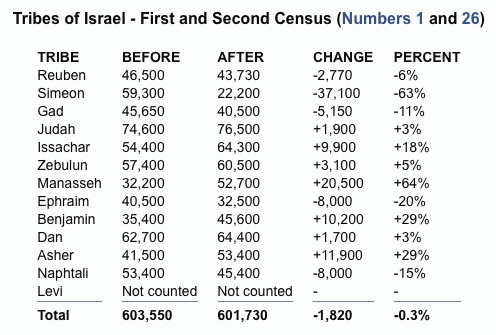
Looks like Manasseh had the most increase and Simeon had the most decrease in numbers.
Instructions for Dividing the Land
- God tells Moses the land will be divided by lot according to tribe size.
- Larger tribes get more land, smaller tribes get less.
- The land is assigned by family groupings.
Only Levite males 1 month and older are counted and do not get land.
The text emphasizes that none of the people counted here (except Joshua and Caleb) were in the first census.
Numbers 27
Here we meet Mahlah, Noah, Hoglah, Milcah, and Tirzah from the tribe of Manasseh whose father died
It says that Zelophehad died of his own sin – possibly from the group banned from wilderness.
God establishes a new inheritance law for Israel
- If a man has no son, his inheritance goes to his daughter.
- If no daughter, it goes to his brothers.
- If no brothers, it goes to his father’s brothers (uncles).
- If no uncles, it goes to the nearest relative in the clan.
God instructs Moses to climb Mount Abarim (often linked with Mount Nebo) to see the land Israel will inherit
“The LORD, the God of the spirits of all flesh” is an interesting phrase- God is the source and ruler of every living being
Joshua is then described as “Joshua the son of Nun, a man in whom is the Spirit”
” by the judgment of the Urim” – This refers to the Urim and Thummim worn by the High Priest
Questions
When did the plague start in Numbers 25?
Why did God wait to announce the rule of women receiving an inheritance until the daughters came forth?
If Zelophehad died from the Korah rebellion would they have removed his inheritance?
Why did they have to use the Urim if God was already talking to Moses?
Application
Holiness, faithfulness, and justness. From these chapters we see the disaster of rejecting holiness from the Moabites, God’s faithfulness of growing His nation, and how He is just and loving to the 5 daughters. One thing I’ve been working on in my prayer life is praising God more intentionally. Looking back at these chapters, I can use them as a guide. These stories remind me that every passage in Scripture gives me reasons to praise, if I slow down and look for what it reveals about Him.
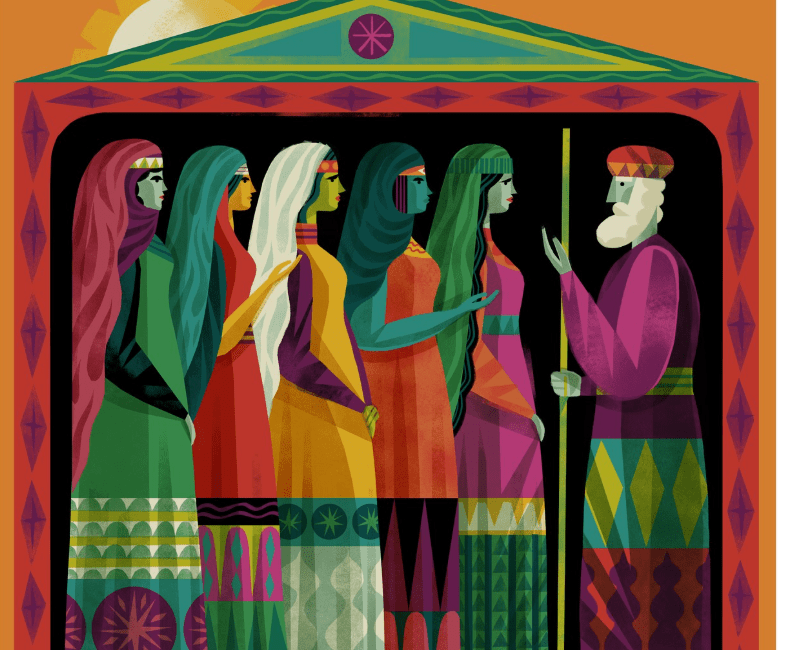
From The Biggest Story Bible Storybook
 Jo Reads The Bible
Leave a comment