
Thoughts
Numbers 31
God says to get 1000 men from each tribe =12, 000 men + Phinehas
They killed every male including the 5 kings of Midian (including Balaam)
They brought all the goods, women, and children to Moses
A difficult passage: Moses commands that every male child and woman who is not a virgin to be killed. The virgins are to ‘be kept for yourselves’. Obviously God does no wrong, which should always be on our minds during these difficult passages. But it’s still ok to be uncomfortable and ask “Why?”
- I understand that males would grow up to avenge their fathers and that this was a common practice to secure long-term safety.
- Midianite women were associated with idol worship practices (including ritual sex)
- Based on Deuteronomy 21:10–14, women captured in war had to undergo a month of mourning, ritual cleansing, and could only be married voluntarily so I don’t think (any many theologians) the phrase “be kept for yourselves” means for immediate sexual use.
Purification of soldiers and captives:
- Anyone who had killed or touched the dead must remain outside the camp for seven days.
- On the 3rd and 7th day, they had to purify themselves, their captives, and any items taken (clothing, leather, wood, metals).
- Metals were to be purified through fire, while other items were washed with water.
God instructs Moses and Eleazar to divide the spoils: half for the soldiers who fought and half for the rest of Israel.
A tribute tax was to be given from each share:
- From the soldiers’ half: 1 out of every 500 people or animals went to the priest Eleazar as an offering to the Lord.
- From Israel’s half: 1 out of every 50 people or animals went to the Levites.
The military officers realized not one soldier had died in the battle! Out of gratitude, they voluntarily gave a large offering of gold jewelry totaling 16,750 shekels (about 420 pounds). This was given to the Tabernacle as a memorial before the Lord.
Numbers 32
Reuban and Gad had large herds and saw that the lands of Jazer and Gilead (east of the Jordan) were ideal for livestock. so they ask Moses if they can settle there
Moses worries that they will discourage the rest of Israel and reminds them of their fathers’ wandering.
Reuben and Gad promise to build pens for their livestock and fortified towns for their families, but they will join the rest of Israel in battle until the land west of the Jordan is conquered.
Moses agrees and lets Eleazar and Joshua know.
The land of Sihon and Og (Gilead and Bashan) is given to Reuben, Gad, and half the tribe of Manasseh. (When the land east of the Jordan was divided, only part of Manasseh wanted to settle there.)
Reuben’s cities: Heshbon, Elealeh, Kiriathaim, Nebo, Baal Meon, Sibmah.
- They renamed some cities (especially ones linked to pagan worship, like Nebo and Baal Meon) to distance themselves from idolatry.
Gad’s cities: Dibon, Ataroth, Aroer, Atroth-Shophan, Jazer, Jogbehah, Beth Nimrah, Beth Haran.
- They built fortified towns and sheepfolds for their livestock.
Manasseh’s clans (Machir’s descendants):
- Conquered Gilead and Bashan, settled there, and rebuilt villages.
- Jair, another Manassite leader, captured additional towns and named them Havvoth-Jair (“villages of Jair”).
- Nobah captured Kenath and renamed it Nobah.
Numbers 33
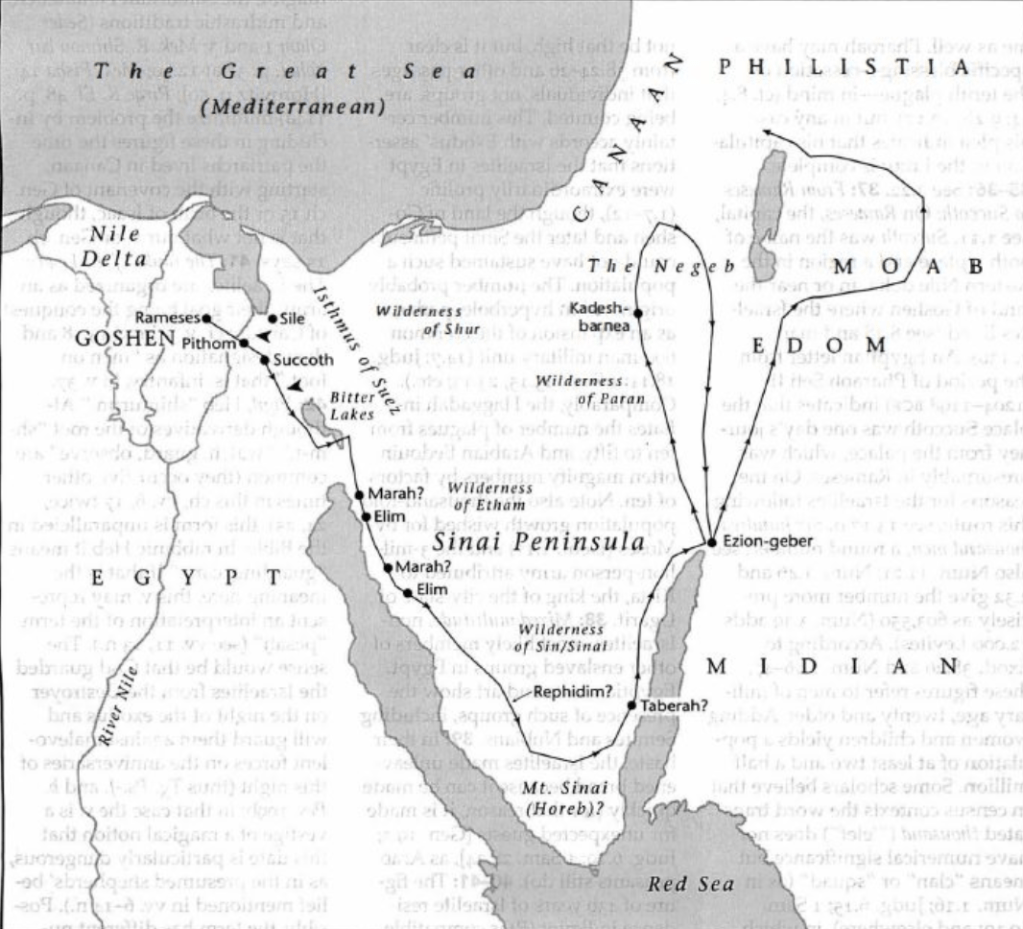
Moses records the stages of Israel’s journey, listing each place they camped from the time they left Egypt until they reached Moab.
- Israel leaves Rameses on the 15th day of the first month (the day after Passover).
- A long list of camping locations is given, from Succoth, Etham, Pi-hahiroth (near the Red Sea) all the way to Kadesh.
- Some notable stops:
- Marah (bitter water)
- Elim (12 springs, 70 palm trees)
- Rephidim (where there was no water, Exodus 17)
- Mount Sinai (where they received the law)
- Kibroth-hattaavah (“graves of craving,” where they complained about manna)
- Hazeroth, Rithmah, Rimmon-perez
- Finally, Kadesh, near the border of Canaan.
- They journey from Kadesh to Mount Hor, where Aaron dies.
- From there, they pass through Zalmonah, Punon, Oboth, Iye-abarim, Dibon-gad, Almon-diblathaim, and end at the plains of Moab by the Jordan River, across from Jericho.
God’s Instructions for Entering Canaan
- As they camp in Moab, God tells Moses to command the Israelites:
- Drive out all the inhabitants of Canaan.
- Destroy idols and high places.
- Divide the land by lot among the tribes.
- If they fail to drive out the people, those inhabitants will become “barbs in their eyes” and “thorns in their sides.”
God tells them to drive out the Canaanites (not mass murder them) due to sin. Israel will later see the same fate as God will drive them out due to sin. This is to fulfill God’s judgment on the Canaanites, whose sin had reached its full measure (Genesis 15:16).
Questions
What happened to the Midianite young girls (toddlers, babies) ?
Was it ok for Gad and Reuban to ask to stay behind for better land? Would they have been more blessed if they went into Canaan?
Application
I see a common theme through these chapters: the seriousness of sin. We see in Numbers 31 that God had Israel destroy Midian due to their sin. God calls His people to be set apart and not associate with individuals that have a strong negative influence on them (as intermarrying Midianites let do pagan worship and rituals). We also see through Numbers 33 the wandering that happened due to their unbelief and sin. How much faster could they have entered the Promised Land if they just obeyed and trusted God? But God is faithful even when we stumble – they will soon enter the land promised even though they messed up along the way. I see in the big picture of my life all the times I turned my back on God, but how He has been there with me through it all.
Jewish Study Bible
 Jo Reads The Bible
Leave a comment