
Thoughts
Judges 21
The men of Israel swore not to give their daughters in marriage to the Benjaminites after the civil war, however they do grieve because one of their tribes is almost wiped out.
They realize that no one from Jabesh-gilead had joined them, so they kill the people of Jabesh-gilead, sparing 400 virgin girls.
These girls are given as wives to the surviving Benjaminites, but there was not enough for all.
Still needing more wives, the elders suggest the Benjaminites hide during a festival at Shiloh. When the daughters come out to dance, they are to seize them as wives (!)
This way, Israel avoids technically breaking their oath (since the fathers aren’t “giving” their daughters, they’re being “taken”).
They did so and went home.
“In those days there was no king in Israel. Everyone did what was right in his own eyes.”
Ruth 1
We are ending the ‘judges’ period after 400 years.
A famine strikes Bethlehem. Elimelech, his wife Naomi, and their sons (Mahlon and Chilion) move to Moab.
Elimelech dies, and later the sons marry Moabite women, Orpah and Ruth. After about ten years, both sons die too, leaving Naomi and her daughters-in-law widowed.
Naomi hears that the famine is over in Judah and decides to return home.She tells her daughters-in-law to stay in Moab, remarry, and not follow her.
Orpah tearfully agrees and stays, but Ruth clings to Naomi. Jewish folk lore says that Orpah was Goliath’s mother.
Naomi urges Ruth again to return, but Ruth makes her famous vow:
“Where you go, I will go; where you lodge, I will lodge. Your people shall be my people, and your God my God.”
Naomi and Ruth arrive in Bethlehem at the start of the barley harvest.
The women of the town recognize Naomi, but she says, “Do not call me Naomi (נָעֳמִי ‘pleasant’); call me Mara (מָרָא ‘bitter’), for the Lord has dealt very bitterly with me.”
Ruth 2
Boaz is introduced as a relative of Elimelech and is described as a “gibbor ḥayil” (גִּבּוֹר חַיִל) → “a worthy man,”
Ruth asks Naomi’s permission to glean (pick up leftover grain) in the fields, as the law allowed for the poor and foreigners (Leviticus 19:9–10).
“As it happened,” she ends up in the field of Boaz
Boaz sees and asks about Ruth, and the workers explain who she is and how diligently she’s been working.
Boaz tells Ruth to stay in his fields. He promises safety, water, and a place to work.
He invites her to eat with them and instructs his workers to leave extra stalks for her to gather.
Ruth gathers about 30 pounds-Naomi is amazed and asks whose field she worked in.
Ruth tells her about Boaz, and Naomi praises God for his kindness.
Naomi recognizes Boaz as one of their “kinsman-redeemers” (go’el, גֹּאֵל)
Questions
Why wasn’t Boaz already married?
Was it wrong for Orpah to leave?
Application
While Judges left us feeling discouraged and seeing Israel fall into sin after sin, Ruth gives us a glimmer of hope. While Israel has turned away from God, God uses a Moabite woman who will eventually carry the line of the Messiah. God is always writing redemption stories, even in the midst of pain and sorrow. This book is only 4 chapters and reading it on the surface just seems like another love story, but really it is story of God’s redemption plan.
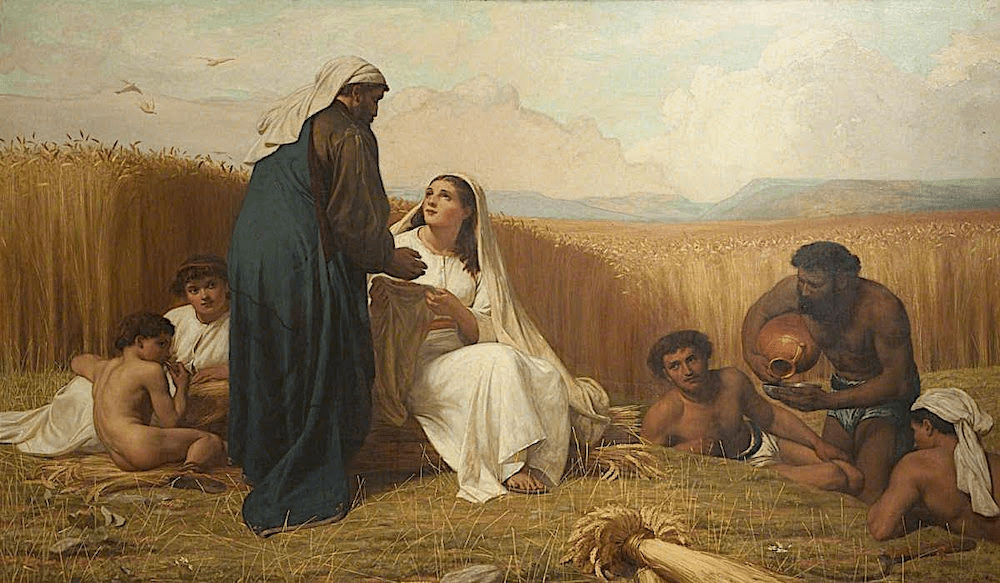
Ruth and Boaz, by David Wilkie Wynfield


Leave a Reply