
Thoughts
Samuel 7
David had settled into his palace, and the Lord had given him rest from his enemies.
David told the prophet Nathan he wanted to build a house (temple) for the ark of God, since he lived in a cedar palace while the ark was still in a tent.
That night, God spoke to Nathan with a different message for David:
- God reminded David that He had never asked for a permanent house; He had always moved with His people in a tent.
- Instead of David building a house for God, God would build David a “house”
- God promised to establish David’s line, give Israel peace, and raise up a son after him (ultimately Solomon) who would build the temple.
- This is often called the Davidic Covenant
David went in and sat before the Lord, overwhelmed by God’s promise. He acknowledged his unworthiness and praised God for His greatness.
Samuel 8
David defeated the Philistines, the Moabites, and Hadadezer (king of Zobah). The Arameans of Damascus came to help Hadadezer, but David defeated them too. David took large amounts of bronze, gold, and silver from these nations.
“The Lord gave David victory wherever he went.”
David dedicated the gold and silver he took from Edom, Moab, Ammon, the Philistines, and Amalek.
Abishai (David’s commander and nephew) struck down 18,000 Edomites in the Valley of Salt.
David also established garrisons in Edom, and they became subject to him.
David’s Team
- Joab son of Zeruiah: commander of army
- Jehoshaphat son of Ahilud: recorder (like a historian/secretary)
- Zadok and Ahimelek: priests
- Seraiah : secretary
- Benaiah: guard over the Kerethites and Pelethites
- David’s sons served as chief officials/advisors
Samuel 9
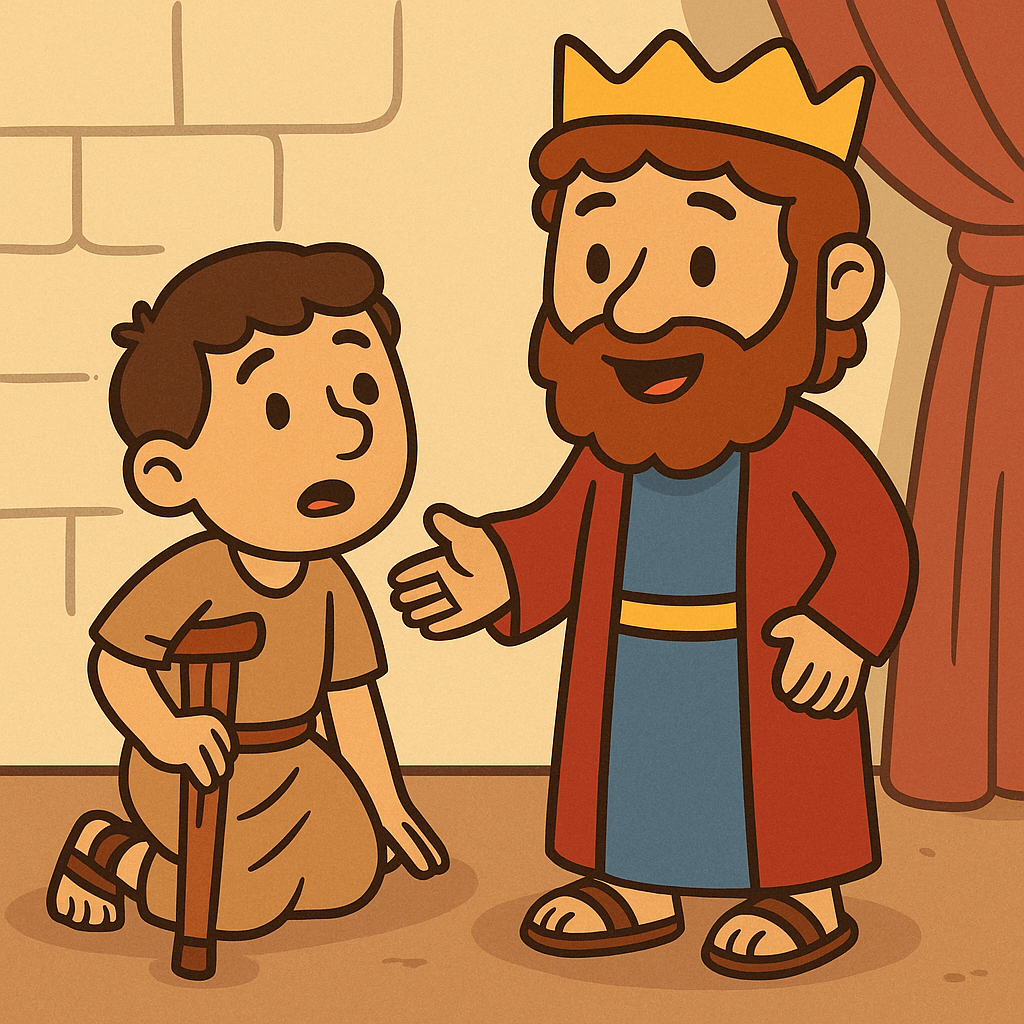
David asked if there was anyone left from Saul’s house to whom he could show kindness for Jonathan’s sake. A servant of Saul’s household, Ziba, told David about Mephibosheth, Jonathan’s son, who was lame in both feet (from 2 Sam 4:4).
Mephi- (from פִּי, pi) = “from the mouth of” or “utterance of.” and bosheth (from בֹּשֶׁת, boshet) = “shame, disgrace.” In 1 Chronicles 8:34; 9:40, Mephibosheth is actually called Merib-baal (מְרִיב־בַּעַל), meaning “Baal is my advocate” or “contender with Baal.” Some say Bosheth replaced Baal because it was shameful (nothing to do with his status as he was not disabled until he was 5).
David sent for Mephibosheth who bowed down before David. He was scared that David might destroy him as a rival heir. Instead, David reassured him, promising to show him kindness for Jonathan’s sake. David restored to him all the land that belonged to Saul.
David appointed Ziba and his sons and servants (15 total) to farm the land for Mephibosheth.
Mephibosheth called himself a “dead dog,” :(
The chapter ends by emphasizing that Mephibosheth lived in Jerusalem and always ate at the king’s table as if he was David’s son, though he remained disabled
Technically David was Mephibosheth’s uncle by marriage through Michal (Jonathan’s sister)
Questions
Why was Solomon the builder of the temple and not David?
Why was God’s plan to have battles instead of peace? (Or at least not His original plan, but why didn’t He have David establish peace by non-violent means)
What was it like back then to be both royalty and disabled?
Application
I think the unifying theme of these chapters is ‘undeserved grace’. In Chapter 7, David receives God’s gracious covenant, even though at this point David had made lots of errors and engaged in sin. David should be building God a house but instead, God chooses to build Him a house of generations. David’s victories recognize God’s grace as David could not have done it on his own. And my favorite David story, Chapter 9 shows David extending grace to Mephibosheth. He could have been killed as he was the son of David’s greatest enemy but David took him in as a son. I think we can use these chapters to learn how to accept God’s grace but also extend it to others even when it is difficult.


Leave a Reply