
Thoughts
Samuel 19
David mourns for Absalom, and Joab’s men feel ashamed. Joab tells David to get up and encourage his soldiers. He goes to the city gate to meet the people.
The tribes argue about bringing David back as king. David sends word to the elders of Judah through Zadok and Abiathar (the priests)
He speaks specifically to Amasa (Absalom’s former commander) to win over Judah. Judah decides to bring David back across the Jordan.
Shimei (who had cursed David and threw stones at him) begs for mercy. Abishai wants him executed, but David pardons him.
Mephibosheth meets David, unkempt, claiming Ziba deceived him. David divides the estate between Ziba and Mephibosheth, but Mephibosheth says he is content.
Barzillai, an elderly rich man, escorts David but declines to go to Jerusalem due to old age. He sends Chimham (most likely his son) in his place, and David blesses him.
The men of Israel complain that Judah took David back without consulting them. Judah defends its actions, leading to arguments between the tribes.
Samuel 20
Yet another new character, Sheba son of Bichri, from the tribe of Benjamin, says he will not follow David. Israel follows Sheba, but Judah stays loyal to David.
David arrives back at his house in Jerusalem. He places the ten concubines (who had been left behind) under guard. They were shut up and lived as widows until their death.
David orders Amasa (whom he had made commander over Joab) to summon Judah within three days. Amasa delays, so David commands Abishai to pursue Sheba.
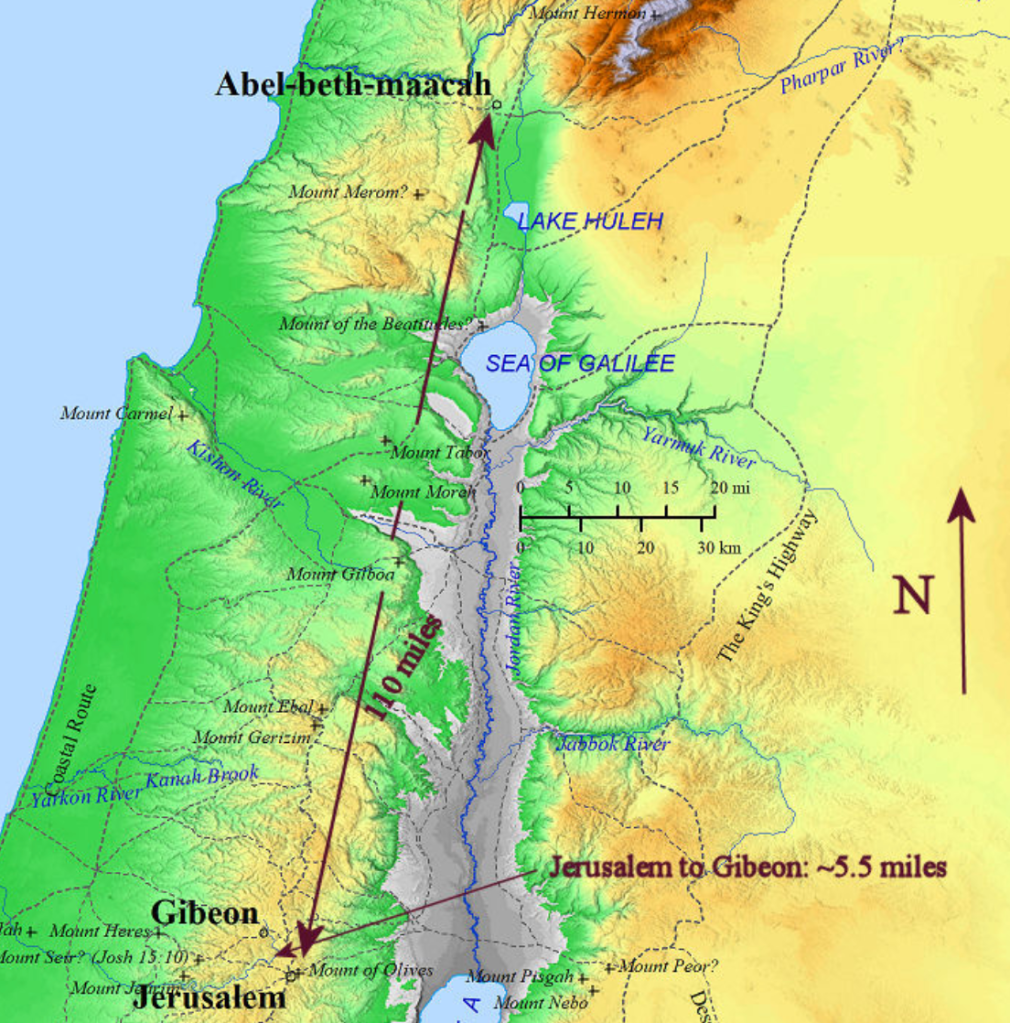
At Gibeon, Joab stabs Amosa. Amasa dies in the road and his body is moved aside to keep the army moving. Joab then takes command again.
- The text says “he took him by the beard” which is a sign of welcoming.
Sheba flees to Abel Beth Maacah and Joab’s army besieges the city. A “wise woman” negotiates with Joab not to destroy the city.
To save the city, the people kill Sheba and throw his head over the wall.
A list of David’s officials is recorded:
- Joab over the army
- Benaiah over the Cherethites and Pelethites
- Adoniram over forced labor
- Jehoshaphat as recorder
- Sheva as secretary
- Zadok and Abiathar as priests
- Ira the Jairite as David’s priest
Samuel 21
A famine lasts three years, and David seeks the Lord. God reveals it is because of Saul’s earlier slaughter of the Gibeonites (breaking Israel’s oath).
- We don’t have record of this slaughter – this is the only mention of it.
David asks the Gibeonites how he can make atonement. They refuse silver or gold, asking instead for the execution of seven of Saul’s descendants.David agrees but spares Mephibosheth (Jonathan’s son, due to his oath with Jonathan).
Seven of Saul’s sons are handed over and executed by the Gibeonites at Gibeah.
Rizpah (mother of two of the executed) mourns, guarding the bodies from birds and beasts until the rains fall.
David hears of her devotion and retrieves the bones of Saul and Jonathan from Jabesh Gilead.Saul, Jonathan, and the executed descendants are given a proper burial in the tomb of Kish, Saul’s father.
Afterward, God removes the famine.
David and his men battle the Philistines:
- Ishbi-benob (a giant) nearly kills David, but Abishai rescues him.
- David’s men insist he not go to battle anymore to preserve “the lamp of Israel.”
Other Philistine giants are slain by David’s warriors:
- Sibbecai kills Saph.
- Elhanan kills the brother of Goliath.
- Jonathan (David’s nephew) kills a six-fingered giant.
These giants are described as descendants of Rapha (could be a person or meaning Rephaim), all defeated by David and his men.
Questions
Why did it take 3 years for David to inquire of God during the famine?
Application
Reading these chapters, it just seems that battles and drama happen one after the other. Now that Absalom is out of the picture, a new enemy of David arises (Sheba). It seems like David constantly had struggles in his life. Sometimes I feel that way (obviously not as crazy as David…) but that there are constant challenges. Our struggles don’t pause, and probably won’t ever until Jesus comes back. Faithfulness means being ready for the next challenge.
 Jo Reads The Bible
Leave a comment