
Thoughts
Kings 12
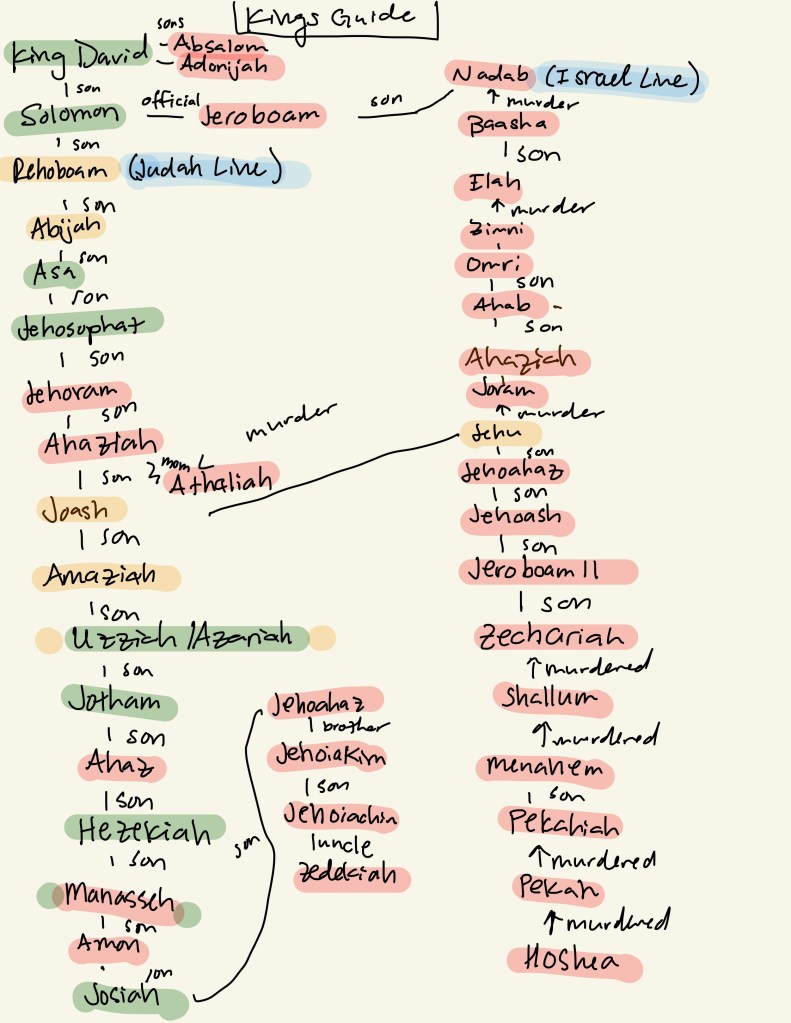
(Joash and Jehoash are same person/ different spelling of name)
Joash becomes king of Judah in the 7th year of Jehu’s reign over Israel and reigns 40 years in Jerusalem.
Joash does what is right in the eyes of the Lord, and is guided by the priest Jehoiada. However, the high places are not removed; the people still sacrifice and burn incense there.
Joash commands that money dedicated to the temple (from census, vows, freewill offerings) be used for temple repairs. But by the 23rd year of his reign, the priests have not repaired the temple.
Joash questions Jehoiada and the priests about this failure.He commands that no more money be taken by the priests for themselves and it must go directly toward repairs.
Jehoiada the priest sets up a chest with a hole in the lid near the altar for donations. When the chest fills, the king’s secretary and the high priest count the money. The money is used to pay carpenters, builders, masons, and stonecutters. It is also used for timber and dressed stone, but not for temple vessels or utensils.
However, money from guilt offerings and sin offerings is not used for repairs but left to the priests.
Hazael, king of Aram/Syria, threatens Jerusalem after capturing Gath. Joash uses all the sacred treasures from the temple and palace (dedicated by his forefathers and himself) to pay off Hazael.
Joash’s officials (Jozabad and Jehozabad) conspire and assassinate him. His son Amaziah then becomes king.
Kings 13
Moving over to Israel, Jehoahaz son of Jehu becomes king and reigns 17 years.
He does evil in the eyes of the Lord, continuing the sins of Jeroboam.As a result, the Lord allows Hazael king of Aram (Syria) and his son Ben-Hadad to oppress Israel continually.
Jehoahaz seeks the Lord’s favor, and God provides a savior (unnamed), but Israel still engages in idolatry. The army of Israel is reduced to almost nothing (50 horsemen, 10 chariots, 10,000 foot soldiers).
When Jehoahaz dies, his son Jehoash (Joash) succeeds him
- (NOT to be confused with the previous chapter’s Jehoash King of Judah). Confusing!
Jehoash reigns 16 years in Samaria and continues in the sins of Jeroboam. He is succeeded by his son Jeroboam II.
Meanwhile, Elisha becomes ill with the sickness that will kill him. King Jehoash (of Israel) visits him, weeping, and says: “My father, my father! The chariots and horsemen of Israel!”
- (same words Elisha once used of Elijah in 2 Kings 2).
Elisha tells him to take a bow and arrows, and shoot one eastward (symbolizing victory over Aram).Then Elisha instructs him to strike the ground with arrows, which the king does so only three times. Elisha rebukes him for stopping: if he had struck five or six times, he would have completely defeated Aram.
Elisha dies and is buried. A dead man is hastily thrown into Elisha’s tomb during a Moabite raid. When the body touches Elisha’s bones, the man comes back to life and stands on his feet.
Hazael king of Aram oppresses Israel all Jehoahaz’s days. Yet the Lord shows compassion because of His covenant with Abraham, Isaac, and Jacob.
When Hazael dies, his son Ben-Hadad takes over. Jehoash recaptures cities from Ben-Hadad in three victories, just as Elisha had prophesied.
Kings 14
Amaziah, son of Joash, becomes king of Judah at age 25 and reigns 29 years in Jerusalem. He does “what is right in the eyes of the Lord,” The text mentions but not like David, more like his father Joash as the high places remain.
He executes the officials who assassinated his father, but spares their children, obeying Deut 24:16.
He wins a victory over Edom in the Valley of Salt, killing 10,000 and captures Sela (Petra), renames it Joktheel.
Amaziah challenges Jehoash (Joash), king of Israel, to battle. Jehoash warns him with a parable about a thistle but Amaziah ignores the warning. They battle at Beth Shemesh and Judah is defeated. Amaziah is captured. Jehoash breaks down 600 feet of Jerusalem’s wall and takes treasures from the temple and palace.
Amaziah reigns 15 years after the death of Jehoash of Israel. Men form a conspiracy against him and Amaziah flees to Lachish, but assassins kill him there. His son Azariah (Uzziah) is made king at age 16.
Jeroboam II, son of Jehoash, becomes king in Israel. He reigns 41 years and does evil, continuing Jeroboam’s sins.
He restores Israel’s boundaries from Lebo Hamath to the Sea of the Arabah, fulfilling prophecy spoken by Jonah son of Amittai (yes, the Jonah of the Book of Jonah!). Jeroboam recaptures Damascus and Hamath for Israel.
After Jeroboam dies, his son Zechariah succeeds him.
Questions
Why do so many ‘good’ kings refuse to remove the high places?
Who was the ‘savior’ in chapter 13?
Why did King Jehoash (Israel) get in trouble for not striking the ground 5-6 times? How was that a lack of faith for not knowing?
Why did the man come to life after touching Elisha’s bones? Why is it such a quick mention?
Application
At this point in history, Israel had persisted in idolatry, ignored the warnings of prophets and had almost lost their entire army. “But the Lord was gracious to them and had compassion on them and turned toward them, because of His covenant with Abraham, Isaac, and Jacob, and would not destroy them, nor has He cast them from His presence until now.” Even while clinging to their sin, God did not break the covenant with Israel. He disciplines but does not abandon.
 Jo Reads The Bible
Leave a comment