
Lamentations 4
Structure
- 22 verses
- Acrostic again
- Pe/Ayin still reversed (פ before ע)
“How the gold has grown dim…”
- Gold = temple splendor
- Stones scattered = temple desecrated
- “Precious sons of Zion” now compared to clay pots
Deprivation
- Mothers compared to ostriches (neglect imagery)
- Infants faint in streets
- The punishment is said to exceed Sodom
This is covenant language again: Deuteronomy 28 fulfilled.
Her Nazirites were brighter than snow: noblemen were radiant, now black as soot and unrecognizable.
Those slain by the sword are better off.
“The LORD gave full vent to his wrath.”
- Prophets and priests are blamed.
- Bloodshed in the sanctuary.
False Alliances
- They waited for help from Egypt.
- “Our eyes failed.”
- Political trust replaced covenant trust.
Zedekiah is described as: “The LORD’s anointed” (v. 20)
Edom is warned: You will drink the cup too.
“The punishment of your iniquity, O daughter of Zion, is accomplished.”
- This is the first explicit hint that judgment has an end.
- Exile will not be forever.
| Verse | Letter | Hebrew | Transliteration | English |
| 1 | א | אֵיכָה | eikhah | How |
| 2 | ב | בְּנֵי | bene | The sons of |
| 3 | ג | גַּם־תַּנִּים | gam tannim | Even jackals |
| 4 | ד | דָּבַק | davaq | Clings |
| 5 | ה | הָאֹכְלִים | ha’okhelim | Those who ate |
| 6 | ו | וַיִּגְדַּל | vayyigdal | Greater |
| 7 | ז | זַכּוּ | zakku | Were purer |
| 8 | ח | חָשַׁךְ | chashakh | Has grown dark |
| 9 | ט | טוֹבִים | tovim | Happier |
| 10 | י | יְדֵי | yede | The hands of |
| 11 | כ | כִּלָּה | killah | Has spent |
| 12 | ל | לֹא | lo | Not |
| 13 | מ | מֵחַטֹּאת | mechatot | From the sins of |
| 14 | נ | נָעוּ | na‘u | Wandered |
| 15 | ס | סוּרוּ | suru | Depart! |
| 16 | פ | פְּנֵי | penei | The face of |
| 17 | ע | עוֹדֵינָה | odeinah | Still |
| 18 | צ | צָדוּ | tsadu | They hunted |
| 19 | ק | קַלִּים | qallim | Swifter |
| 20 | ר | רוּחַ | ruach | The breath of |
| 21 | ש | שִׂישִׂי | sisi | Rejoice |
| 22 | ת | תַּם | tam | Is finished |
Lamentations 5
Structure
- 22 verses
- BUT no acrostic
“Remember, O LORD…”
- Inheritance lost
- Orphans and widows
- Slaves rule over them
- Food at risk of life
- Women violated
- Elders silenced
- Young men grinding
- Music ceased
“The joy of our hearts has ceased.”
- Mount Zion is desolate -foxes roam it.
- Crown has fallen from our head
Restoration
“But you, O LORD, reign forever.” God still reigns.
Plea: “Restore us to yourself, O LORD, that we may be restored.”
- Restoration begins with return to God not rebuilding walls.
Tension Ending
Restore us to yourself, O Lord, that we may be restored!
Renew our days as of old—
unless you have utterly rejected us,
and you remain exceedingly angry with us.
Once again it seems Israel did not listen as Jeremiah said “I will restore you to this place.” (Jer 29:14)
Ezekiel 1
יְחֶזְקֵאל (Yechezqel / Yĕḥezqēl)
- חזק (ḥazaq) “to strengthen,” “to make firm,” “to make strong”
- אֵל (El) “God”
“In the thirtieth year… among the exiles by the Chebar canal”
- Likely Ezekiel’s 30th year which is the age priests began ministry (Num 4:3).
- Instead of serving in the temple, he receives a vision in exile.
- Location: Babylonian territory by the Chebar canal.
“The heavens were opened, and I saw visions of God.”
- Word of the LORD came to Ezekiel
- Dual identity: priest and prophet.
- “The hand of the LORD was upon him”
The Four Living Creatures (Cherubim)
- A storm wind from the north.
- North often associated with judgment (Babylon comes from north)
- Fire flashing forth continually.
- “Something like four living creatures.”
Their form:
- Human likeness.
- Four faces:
- Man
- Lion
- Ox
- Eagle
- Four wings.
- Two for flight, two to cover feet
- Straight legs
- feet like a calf’s hoof.
- Sparkling like burnished bronze.
Their movement:
- They move straight forward.
- “Wherever the spirit would go, they went.”
- No turning as they moved.
- Appearance like burning coals or torches.
About Cherubim from https://enduringword.com/bible-commentary/ezekiel-1/
i. Some try to emphasize the connection between what Ezekiel described and the artistic images of half-beast, half-human monsters of ancient cultures. Yet the Biblical idea of cherubim goes back much further.
· Cherubim first appear in the garden of Eden, those who guarded the way to the tree of life with a flaming sword (Genesis 3:24).
· Artistic designs of cherubim were prominent on the lid to the ark of the covenant, the mercy seat (Exodus 25:18-20).
· Since the ark of the covenant represented the presence of God among Israel, Yahweh was sometimes called He who dwells between the cherubim (1 Samuel 4:4, 2 Samuel 6:2; 1 Chronicles 13:6; Psalm 80:1, 99:1; Isaiah 37:16). This was an earthly artistic expression of a heavenly reality (Hebrews 8:5). Sometimes the phrase speaks of the earthly picture, and sometimes the heavenly reality.
· The interior of the tabernacle was decorated with designs of cherubim, giving the impression to anyone in the tabernacle that they were surrounded by cherubim (Exodus 26:1).
· The veil separating the most holy place of the tabernacle was decorated with cherubim, adding to the sense of their presence (Exodus 26:31).
· The designs of cherubim were prominent in Solomon’s temple (1 Kings 6:23-35).
· The four creatures mentioned by John surrounding the throne of God are rightly thought to be cherubim (Revelation 4:6-8).
· Before his fall, Satan was [[probably]] among the cherubim covering God’s throne (Ezekiel 28:14-16).
ii. “Certainly Ezekiel was acquainted with cherubim from his training in the temple, with its many representations of these creatures (Exodus 25–26; 36–37; 1 Kings 6; 2 Chronicles 3).” (Alexander)
The Wheels Within Wheels
- One wheel beside each creature.
- “Appearance of the wheels… like gleaming beryl.”
- “A wheel within a wheel.”
- Multidirectional movement.
- Rims full of eyes all around.
- When creatures move, wheels move.
- “The spirit of the living creatures was in the wheels.”
The Expanse Above
- Over their heads: an expanse “like awe-inspiring crystal.”
- Wings stretched out.
- Sound like:
- Many waters
- The voice of the Almighty
- Tumult like an army
When they stand still, they let down their wings.
The Throne
- Above the expanse: “something like a throne.”
- Appearance like sapphire.
- On the throne: “a likeness with a human appearance.”
From waist up:
- Appearance like gleaming metal and fire.
From waist down:
- Appearance of fire.
Brightness all around like a rainbow in a cloud.
This is “the appearance of the likeness of the glory of the LORD.”
“When I saw it, I fell on my face.”
Application
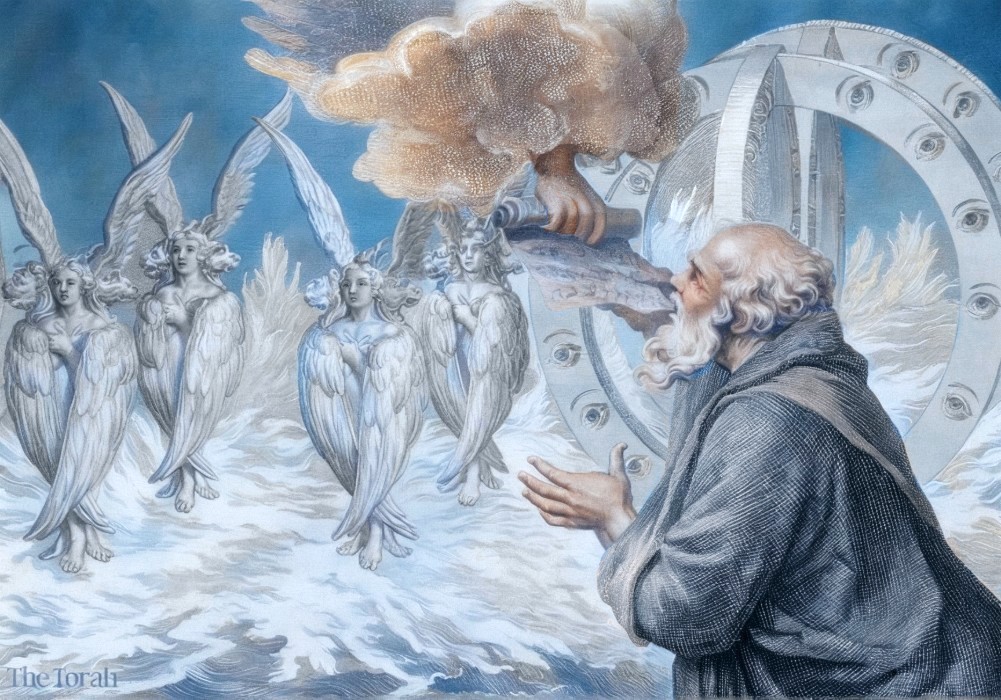
Ezekiel’s Vision (detail & colorized), Bernard Picart, 1693 – 1783. Rijksmuseum.nl


Leave a Reply