
PLEASE NOTE I AM NOT A SCHOLAR IN THIS AREA – PLEASE READ THESE CHAPTERS WITH CAUTION- THEY ARE MY PERSONAL NOTES FROM WHAT I HAVE STUDIED. I DO NOT TAKE A STANCE ON WHAT THESE VISIONS MEAN
Daniel 8
(About 2 years after Daniel 7)
Vision of the Ram
- Occurs in the reign of Belshazzar
- Daniel sees a ram with two horns:
- One higher than the other (later rising)
- The ram charges:
- West, north, south
- No one can stand against it
- “The principle theatre of their wars, says Calmet, was against the SCYTHIANS, northward; against the GREEKS, westward; and against the EGYPTIANS, southward.” (Clarke)
Interpretation (given later):
- The ram = Medo-Persian Empire
- Two horns → Medes and Persians
- Higher horn → Persia becoming dominant
The Goat from the West
- A male goat moves swiftly without touching the ground
- Has a prominent horn
- Defeats the ram violently
- At peak power:
- The large horn is broken
- Four horns arise
Historical Fulfillment:
- Goat = Greece
- Large horn = Alexander the Great
- Four horns = division of empire after his death
- Into four kingdoms (generals)
The Little Horn and Desecration
- A smaller horn grows powerful
- Extends toward:
- South, east, “glorious land” (Israel)
- Attacks:
- The host of heaven
- Removes regular burnt offering
- Throws down the sanctuary
- Question asked:
- “How long?” → answer: 2,300 evenings and mornings
Historical Background:
- Commonly linked to Antiochus IV Epiphanes who desecrated the temple (~167 BC)
- Stopped sacrifices
- Set up pagan altar
Daniel seeks understanding
- Gabriel is commanded to explain
- Daniel overwhelmed and falls down
Interpretation Explained
- Ram = Medo-Persia
- Goat = Greece
- Broken horn = Alexander
- Four kingdoms arise
- A later king:
- Fierce
- Skilled in deception
- Destroys many
Connection:
- Blends:
- Antiochus (historical)
- With patterns of future opposition to God
Daniel’s Response
- Daniel is exhausted and sick
- Continues serving the king
- Vision remains troubling
The 2,300 “Evenings and Mornings”
“…For how long is the vision…? …For 2,300 evenings and mornings. Then the sanctuary shall be restored…”
Different ways to understand it:
| Option | Interpretation | Calculation | Time Length | What It Aligns With |
|---|---|---|---|---|
| A | 2,300 literal days | “Evening and morning” = full day (Genesis 1 pattern) | ~2,300 days (~6.3 years) | Broader period of Antiochus IV’s oppression (including buildup + aftermath) |
| B | 2,300 sacrifices (half-days) | 2 sacrifices/day → 2,300 ÷ 2 | 1,150 days (~3.2 years) | Period when temple sacrifices were stopped (167–164 BC) |
| C | 2,300 years (day-year view) | 1 day = 1 year (Num 14:34; Ezek 4:6) | 2,300 years | Long prophetic timeline (often 457 BC → ~1844 AD; “sanctuary cleansing” interpretation) |
OR WE DON’T KNOW SINCE IT DOES NOT SAY!
What event could this be referring to?
Most directly tied to:
- Antiochus IV Epiphanes
He:
- Stopped temple sacrifices (~167 BC)
- Desecrated the temple
- Set up pagan worship
The timeline roughly matches:
- Option B: Desecration of temple to restoration under the Maccabees (~164 BC) About 3 years of disruption
This aligns closely with:
- The 1,150-day (sacrifice-based) interpretation, but 2300 days could include from time oppression started (~170 BC)
What happens at the end of the 2,300?
“…then the sanctuary shall be restored…”
This refers to:
- Cleansing and rededication of the temple
- Hanukkah (Feast of Dedication)
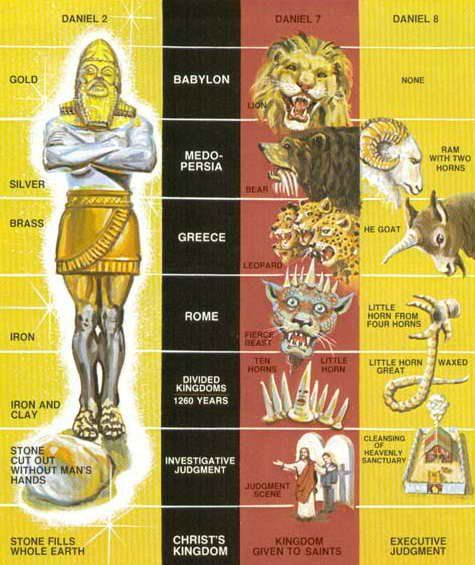
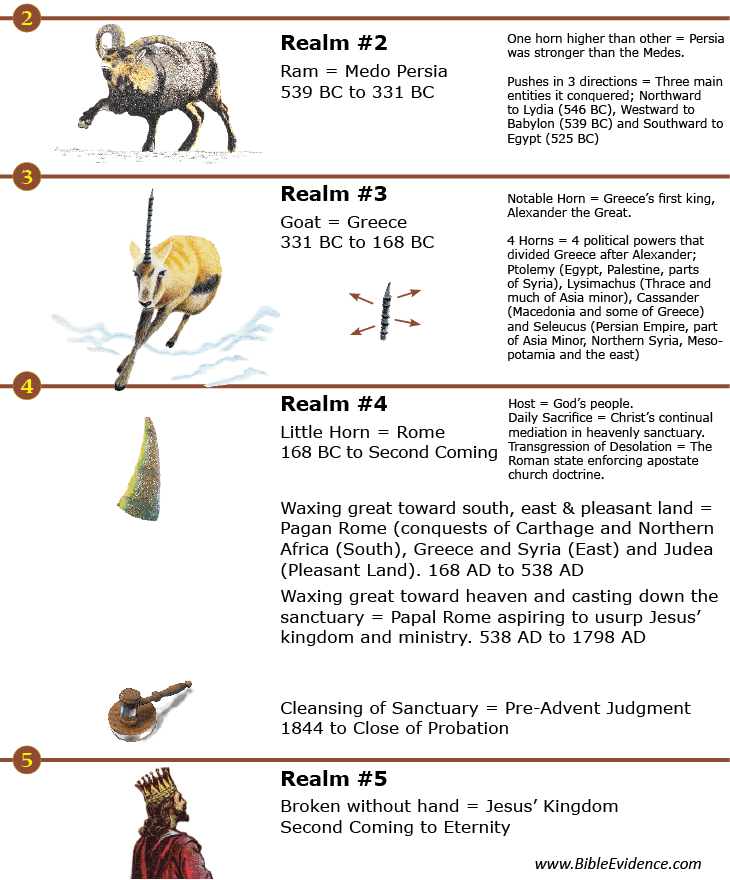
Interesting pic showing comparisons of the 3 visions, but follows 1260 year view (option C from above)
Daniel 9
Under Darius the Mede, Daniel reads:
- Jeremiah 25:11–12; 29:10
- Realizes exile is nearing completion (70 literal years)
Daniel’s Prayer of Confession
- Daniel prays, fasts, confesses
- Identifies with Israel’s sin:
- Rebellion
- Ignoring prophets
- Appeals to: God’s mercy and God’s name
- Similar to Ezra 9 and Nehemiah 1
Gabriel Appears
- Gabriel comes “in swift flight”
- Says Daniel is greatly loved
- Gives 70 week prophecy
The Seventy Weeks Prophecy
- 70 “weeks” (sevens) = 490 units
- Weeks: Hebrew: שָׁבֻעִים (shavuʿim) = “sevens”
- Not necessarily 7 days…just a unit of seven
- 7 weeks + 62 weeks + 1 week
- Anderson, using a 360-day year (which Israel used in Daniel’s day), calculated 173,880 days from the decree to the triumphal entry, fulfilling the prophecy to the day. “It is customary for the Jews to have twelve months of 360 days each and then to insert a thirteenth month occasionally when necessary to correct the calendar.” (Walvoord)
The First 7 Weeks (49 years)
- “…from the going out of the word to restore and build Jerusalem…”
- Starts with a decree to rebuild Jerusalem
- Commonly linked to: Artaxerxes I (457 BC)
- Ezra/Nehemiah times
The Next 62 Weeks (434 years)
- Leads up to coming of Jesus
- ~AD 27–30 depending on calculation
After the 62 weeks…” (Daniel 9:26)
- “An anointed one shall be cut off”
- “The people of the prince…shall destroy the city and sanctuary”
- Destruction of Jerusalem (AD 70) by Rome
The Final Week (70th week = 7 years)
Daniel 9:27:
- A covenant is made
- In the middle of the week (3.5 years):
- Sacrifices stop
- Desolation occurs
| View | Who is the central figure? | Timing of 70th Week | Key Events in the Week | How “middle of the week” is understood | Challenges |
| Messiah / Continuous (Christ-centered) | Jesus Christ | Immediately follows the 69th week (no gap) | Jesus confirms covenant; His death brings true end to sacrifice; gospel goes to many | 3.5 years → Jesus’ ministry, crucifixion in the middle | Harder to explain exact 7-year structure; Jerusalem’s destruction (AD 70) occurs later |
| Futurist/Dispensational | Future Antichrist figure | Gap after 69th week; 70th week still future | Covenant with many; rebuilt temple; tribulation period; final rebellion | 3.5 years → Antichrist breaks covenant; stops sacrifices | Requires a gap not explicitly stated; shifts focus away from first-century fulfillment |
| Historical / Antiochus-type | Antiochus IV Epiphanes (or similar ruler) | Fulfilled around 2nd century BC or blended with AD 70 | Temple desecration; persecution; stopping sacrifices | ~3.5 years → period of temple defilement | Doesn’t fully explain Messiah language; timeline less precise |
| Mixed / Typological | Both Jesus and a future ruler (pattern fulfillment) | Partial fulfillment in past, ultimate fulfillment future | Jesus fulfills covenant; later figure repeats pattern of opposition | Dual meaning (near + far fulfillment) | Less precise; can feel less concrete |
Daniel 10
Daniel mourns for 3 weeks and fasts for 21 days.
Daniel sees a glorious man on the Tigris river:
- Linen clothing
- Gold on waist
- Face like lightning
- Eyes like fire
- Others don’t see, but feel terror and flee
- Daniel becomes frail and falls into deep sleep
- Similar imagery to Revelation 1 (vision of Christ)
A messenger speaks (Gabriel? Does not say):
- Prayer was heard from day one
- Delayed 21 days by ‘prince of Persia’
- Michael helps
***Think about all the unseen battles in our world!*****
Daniel overwhelmed physically
- Messenger strengthens him:
- “Fear not…you are greatly loved”
Messenger speaks of:
- Returning to fight the prince of Persia
- Prince of Greece
- Michael stands for Israel
Application
There is so much to take in reading these chapters. Something that really stands out is all the spiritual battles that go on without us knowing. God is sovereign over all, the earthy and the spiritual. His Kingdom will be the one that reigns forever, not “Persia” or “Greece”. We also see that prayer is heard, as Daniel’s voice was heard.


Leave a Reply