
Genesis 2 causes some confusion
- Order seems different
- Genesis 1: Plants -> Animals -> Humanity (male and female together)
- Genesis 2: Man -> Garden -> Animals -> Woman
- Some argue it is an expanded version of day 6, but verse 5 says no bush of the field was yet in the land and no small plant of the field had yet sprung up- although these were created in day 3.
- Universal vs localized creation?
- Focusing in on How God prepared Eden (Genesis 2) vs the World (Genesis 1)
- Ideal vs reality?
- Genesis 1 as God’s ideal vs Genesis 2 as why reality no longer looks like Genesis 1
- Bible project tackles the above https://bibleproject.com/classroom/adam-to-noah/sessions/8 and https://bibleproject.com/classroom/adam-to-noah/sessions/9
The Seventh Day, God Rests
Thus the heavens and the earth were finished, and all the host of them. 2 And on the seventh day God finished his work that he had done, and he rested on the seventh day from all his work that he had done. 3 So God blessed the seventh day and made it holy, because on it God rested from all his work that he had done in creation.
The Creation of Man and Woman
4 These are the generations
of the heavens and the earth when they were created,
in the day that the Lord God made the earth and the heavens.
- first use of YHWH יְהוָה (Genesis 1 uses Elohim)
5 When no bush of the field was yet in the land and no small plant of the field had yet sprung up—for the Lord God had not caused it to rain on the land, and there was no man to work the ground,
- Here is the confusing part, but some say this is not describing the entire earth lacking vegetation. Instead, it describes one particular piece of land (Eden) that has not yet been cultivated because there was no rain, and there was no human to work the ground.
6 and a mist was going up from the land and was watering the whole face of the ground 7 then the Lord God formed the man of dust from the ground and breathed into his nostrils the breath of life, and the man became a living creature. 8 And the Lord God planted a garden in Eden, in the east, and there he put the man whom he had formed.
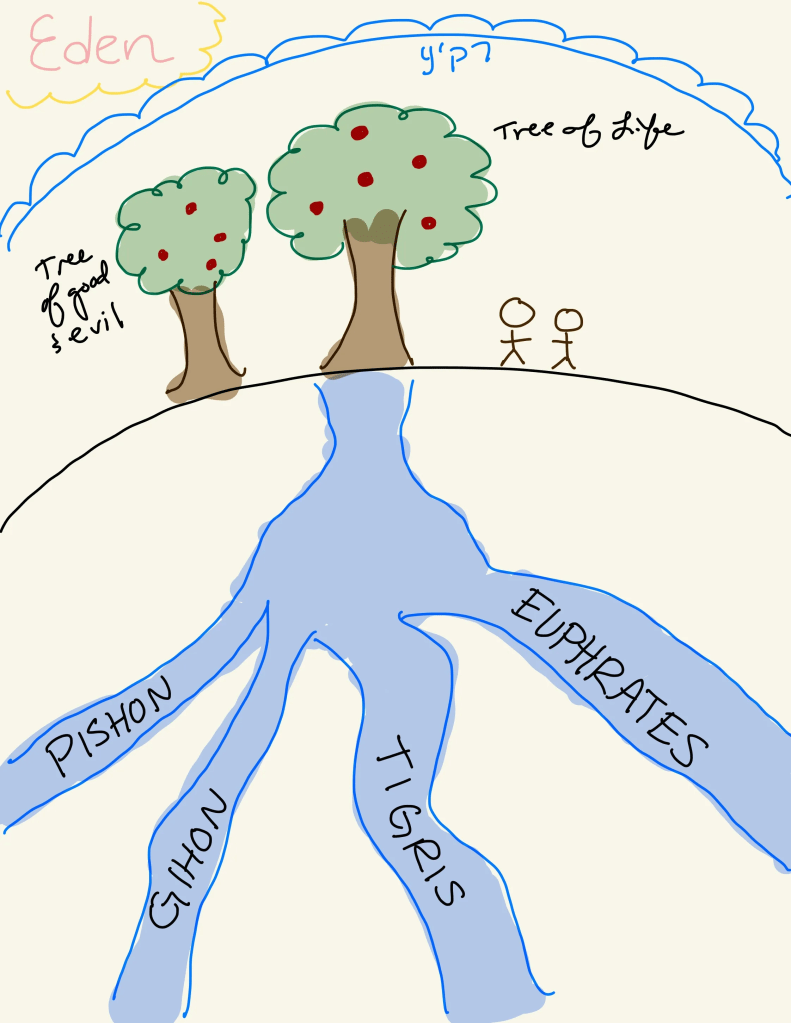
- Keep in mind that Eden is the larger region and The Garden is the specific place planted by God.
- Moving east has been seen as a motif of moving away from God’s presence.
- After the fall: Adam and Eve are driven eastward from Eden.
- Genesis 3:24 God places the cherubim at the east of the Garden
- Genesis 4:16 Cain settles east of Eden.
- Genesis 11:2 People migrate from the east before building Babel.
- Genesis 13:11 Lot travels east toward Sodom.
- Genesis 25:6 Abraham sends the sons of his concubines eastward, away from Isaac.
- Ezekiel 10-11 In Ezekiel’s vision, the glory of the Lord departs from the Temple and pauses on the mountain east of Jerusalem
9 And out of the ground the Lord God made to spring up every tree that is pleasant to the sight and good for food. The tree of life was in the midst of the garden, and the tree of the knowledge of good and evil.
10 A river flowed out of Eden to water the garden, and there it divided and became four rivers. 11 The name of the first is the Pishon. It is the one that flowed around the whole land of Havilah, where there is gold. 12 And the gold of that land is good; bdellium and onyx stone are there. 13 The name of the second river is the Gihon. It is the one that flowed around the whole land of Cush. 14 And the name of the third river is the Tigris, which flows east of Assyria. And the fourth river is the Euphrates.
- As the river beings in Eden then flows outwards, it shows Eden is the source of life. Could be seen as the first temple.
- 1. The Pishon
- Flows around the whole land of Havilah (unknown).
- Uncertain origins today
- Havilah is known for:
- Good gold
- Used extensively in the Tabernacle and Temple.
- Fills the New Jerusalem (Revelation 21).
- Bdellium
- Mentioned in Numbers 11:7 describing the appearance of manna.
- Onyx stone
- Used on the high priest’s ephod (Exodus 28:9–12).
- Represents the twelve tribes before God.
- Good gold
- 2. The Gihon
- Flows around the whole land of Cush usually associated with Nubia (modern Sudan/Ethiopia).
- Uncertain origins today
- 3. The Tigris
- Flows east of Assyria.
- One of the best-known rivers of Mesopotamia.
- Still exists today.
- 4. The Euphrates
- No description
- One of the greatest rivers of the ancient Near East.
- Frequently marks Israel’s ideal northeastern boundary (Genesis 15:18).
15 The Lord God took the man and put him in the garden of Eden to work it and keep it. 16 And the Lord God commanded the man, saying, “You may surely eat of every tree of the garden, 17 but of the tree of the knowledge of good and evil you shall not eat, for in the day that you eat of it you shall surely die.”
- What happened when they ate from Tree of Life (only Tree of Knowledge of Good and Evil was banned) compared to the other trees?
18 Then the Lord God said, “It is not good that the man should be alone; I will make him a helper fit for him.”
- עֵזֶר (ʿēzer) helper. God is called ezer in multiple verses
- Exodus 18:4 God is Moses’ ezer
- Deuteronomy 33:7 Moses prays that the LORD would be Judah’s ezer against his enemies.
- Deuteronomy 33:26, 29 There is no one like God, who rides through the heavens as Israel’s ezer. Israel is blessed because the LORD is the shield and ezer of His people.
- Psalm 20:2 David prays that God would send ezer from His sanctuary in times of trouble.
- Psalm 33:20 The LORD Himself is our ezer and our shield.
- Psalm 70:5 David calls God his ezer and deliverer.
- Psalm 115:9-11 Israel, the house of Aaron, and all who fear the LORD are reminded that He is their ezer and shield.
- Psalm 121:1-2 The psalmist declares that his ezer comes from the LORD
- כְּנֶגְדּוֹ (kenegdo) opposite/corresponding as him
19 Now out of the ground the Lord God had formed every beast of the field and every bird of the heavens and brought them to the man to see what he would call them. And whatever the man called every living creature, that was its name. 20 The man gave names to all livestock and to the birds of the heavens and to every beast of the field. But for Adam there was not found a helper fit for him.
21 So the Lord God caused a deep sleep to fall upon the man, and while he slept took one of his ribs and closed up its place with flesh. 22 And the rib that the Lord God had taken from the man he made into a woman and brought her to the man.
- צֵלָע (sela) for rib – some say it might more commonly mean “side”. This is the only verse that sela is used for rib. See other uses of sela here:
- Exodus 25-38 “…two rings on the one side of it, and two rings on the other side of it…” “…on the north side…” “…for the frames on the one side of the tabernacle…”
- 1 Kings 6-7 “Thus he made side chambers all around.”
- 2 Samuel 2:16 “…thrust his sword into his opponent’s side...”
- 2 Samuel 16:13 “…Shimei went along on the hillside opposite him…”
- Ezekiel 41 side chambers
23 Then the man said,
“This at last is bone of my bones
and flesh of my flesh;
she shall be called Woman,
because she was taken out of Man.”
24 Therefore a man shall leave his father and his mother and hold fast to his wife, and they shall become one flesh. 25 And the man and his wife were both naked and were not ashamed.


Leave a Reply