
Abraham’s Death and His Descendants
Abraham took another wife, whose name was Keturah.
- We don’t hear much about Abraham’s other wife Keturah!
- Here Keturah is called ‘wife’ but 1 Chronicles 1:32 refers to her as Abraham’s concubine. Were they married when Sarah was alive? Or was it because Isaac was to receive the inheritance (vs. 5), so she was dubbed ‘secondary’?
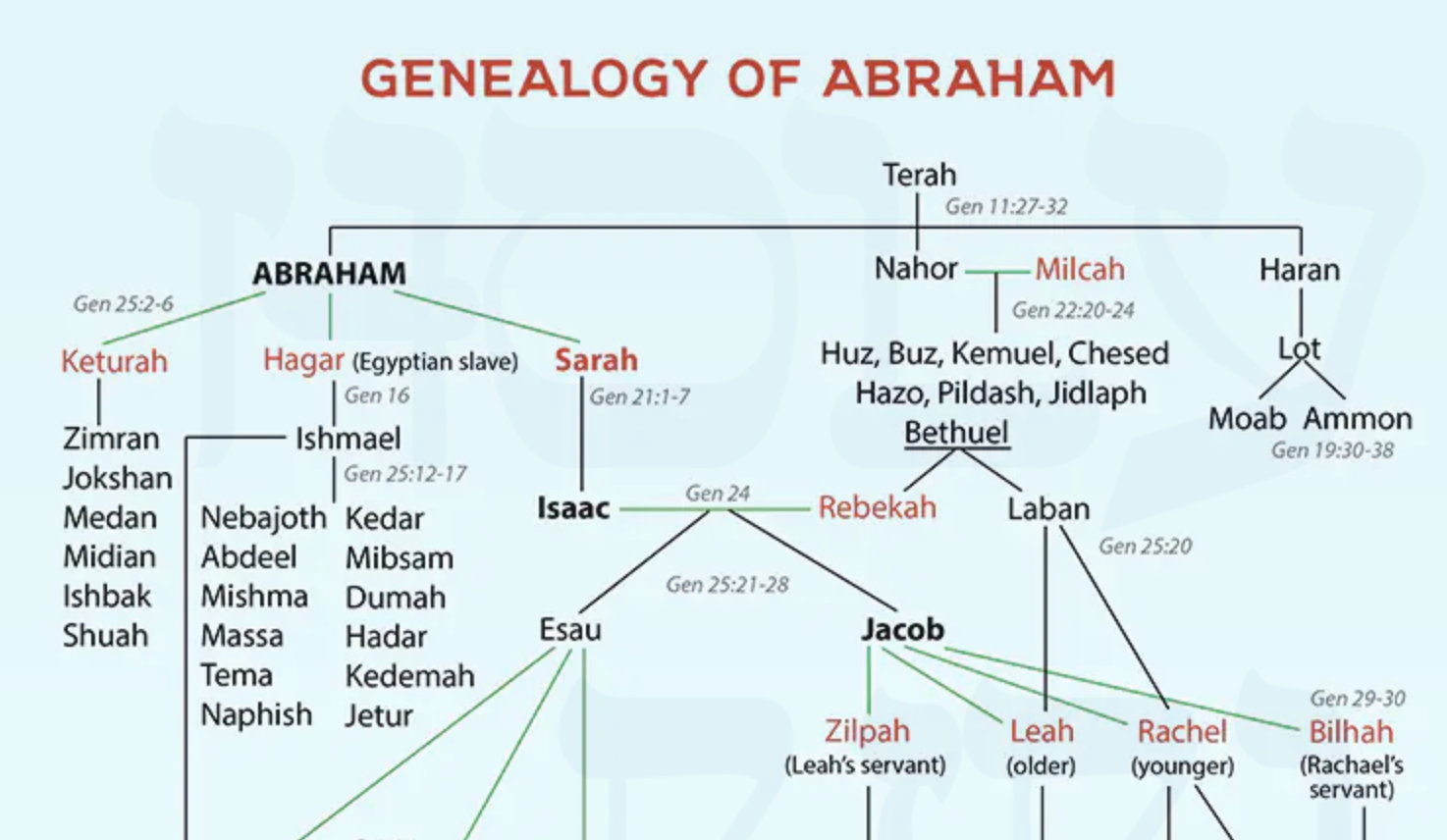
2 She bore him Zimran, Jokshan, Medan, Midian, Ishbak, and Shuah. 3 Jokshan fathered Sheba and Dedan. The sons of Dedan were Asshurim, Letushim, and Leummim.
- Midian is the father of the Midianites
- Joseph was sold to Midianite traders (Genesis 37:28, 36)
- Moses fled to Midian and married Zipporah, the daughter of Jethro, priest of Midian
- Midianites became enemies of Israel during the period of the Judges (Judges 6-8), when God used Gideon to defeat them.
- Sheba could be associated with the Queen of Sheba, who visited Solomon (1 Kings 10).
- Dedan could be related to the Dedan mentioned in the prophets as a well-known trading nation (Isaiah 21:13; Ezekiel 27:15, 20).
4 The sons of Midian were Ephah, Epher, Hanoch, Abida, and Eldaah. All these were the children of Keturah.
- Ephah is mentioned in Isaiah 60:6 along with Midian. Refers to them as having lots of camels.
5 Abraham gave all he had to Isaac. 6 But to the sons of his concubines Abraham gave gifts, and while he was still living he sent them away from his son Isaac, eastward to the east country.
7 These are the days of the years of Abraham’s life, 175 years. 8 Abraham breathed his last and died in a good old age, an old man and full of years, and was gathered to his people. 9 Isaac and Ishmael his sons buried him in the cave of Machpelah, in the field of Ephron the son of Zohar the Hittite, east of Mamre, 10 the field that Abraham purchased from the Hittites.
- This shows the sons still saw each other
There Abraham was buried, with Sarah his wife. 11 After the death of Abraham, God blessed Isaac his son. And Isaac settled at Beer-lahai-roi.
- This was the place Hagar first encountered God in Genesis 16
12 These are the generations of Ishmael, Abraham’s son, whom Hagar the Egyptian, Sarah’s servant, bore to Abraham.
13 These are the names of the sons of Ishmael, named in the order of their birth: Nebaioth, the firstborn of Ishmael; and Kedar, Adbeel, Mibsam, 14 Mishma, Dumah, Massa, 15 Hadad, Tema, Jetur, Naphish, and Kedemah.

- Just as God promised, Ishmael bore 12 princes. “I have blessed him… He shall father twelve princes, and I will make him into a great nation.” (Genesis 17:20)
- Kedar and Nebaioth are mentioned in Isaiah 60:7. Kedar is mentioned frequently in the prophets (Isaiah 21:16-17; 42:11; Jeremiah 49:28-29; Ezekiel 27:21).
- Isaiah 21:11 contains the “oracle concerning Dumah.”
- Tema appears in Job 6:19 , Isaiah 21:14, Jeremiah 25:23 as a well known oasis city
- Jetur became the ancestor of the Itureans (Luke 3:1)
16 These are the sons of Ishmael and these are their names, by their villages and by their encampments, twelve princes according to their tribes.
17 (These are the years of the life of Ishmael: 137 years. He breathed his last and died, and was gathered to his people.) 18 They settled from Havilah to Shur, which is opposite Egypt in the direction of Assyria. He settled over against all his kinsmen.
The Birth of Esau and Jacob
19 These are the generations of Isaac, Abraham’s son: Abraham fathered Isaac, 20 and Isaac was forty years old when he took Rebekah, the daughter of Bethuel the Aramean of Paddan-aram, the sister of Laban the Aramean, to be his wife. 21 And Isaac prayed to the Lord for his wife, because she was barren. And the Lord granted his prayer, and Rebekah his wife conceived.
- “And Isaac prayed to the Lord for his wife, because she was barren. And the Lord granted his prayer, and Rebekah his wife conceived.” One of the earliest examples of intercessory prayer in a family setting.
- They were married 20 years before having kids (Isaac being 40 when married and 60 when twins are born)
22 The children struggled together within her, and she said, “If it is thus, why is this happening to me?” So she went to inquire of the Lord.
- And then the next few verses talk about how Rebekah went straight to the Lord and He answered her! I love the image of the husband praying for his wife and also the verses showing that she had a direct personal relationship with God.
23 And the Lord said to her,
“Two nations are in your womb,
and two peoples from within you shall be divided;
the one shall be stronger than the other,
the older shall serve the younger.”
24 When her days to give birth were completed, behold, there were twins in her womb. 25 The first came out red, all his body like a hairy cloak, so they called his name Esau. 26 Afterward his brother came out with his hand holding Esau’s heel, so his name was called Jacob. Isaac was sixty years old when she bore them.
- Jacob (Hebrew: יַעֲקֹב , Yaʿaqov) means ‘heel’ or ‘to grab’ or ‘to deceive’ (wow!!)
- The name Esau is associated with being hairy, but it doesn’t literally mean “hair.”The Hebrew word for hair is שֵׂעָר (seʿar), which sounds similar to Esav (עֵשָׂו).
27 When the boys grew up, Esau was a skillful hunter, a man of the field, while Jacob was a quiet man, dwelling in tents. 28 Isaac loved Esau because he ate of his game, but Rebekah loved Jacob.
“A woman once said to Mr. Spurgeon, ‘I cannot understand why God should say that He hated Esau.’ ‘That,’ Spurgeon replied, ‘is not my difficulty, madam. My trouble is to understand how God could love Jacob.’” (Newell in Romans, Verse by Verse)
pulled from https://enduringword.com/bible-commentary/genesis-25/
Esau Sells His Birthright
29 Once when Jacob was cooking stew, Esau came in from the field, and he was exhausted. 30 And Esau said to Jacob, “Let me eat some of that red stew, for I am exhausted!” (Therefore his name was called Edom.) 31 Jacob said, “Sell me your birthright now.” 32 Esau said, “I am about to die; of what use is a birthright to me?”
- Was Esau about to die or was he being dramatic?
- Edom (אֱדוֹם), means “red” which is another name for him.
33 Jacob said, “Swear to me now.” So he swore to him and sold his birthright to Jacob. 34 Then Jacob gave Esau bread and lentil stew, and he ate and drank and rose and went his way. Thus Esau despised his birthright.
Here is an up-to-date genealogy of where we are:


Leave a Reply