
Joseph Brings His Family to Egypt
So Israel took his journey with all that he had and came to Beersheba, and offered sacrifices to the God of his father Isaac.
- Remember that Beersheba plays a significant spiritual role in the lives of Abraham, Isaac, and Jacob. Abraham names the place “Beersheba” after making a treaty with Abimelech and calls on the name of the Lord there (Genesis 21:31-33). Later, Isaac also settles in Beersheba, where God appears to him and reaffirms the covenant made with Abraham(Genesis 26:23-25). Here we see Jacob stopping in Beersheba to offer sacrifices, and God appears to him in a vision.
2 And God spoke to Israel in visions of the night and said, “Jacob, Jacob.” And he said, “Here I am.”
- Why is God calling Jacob ‘Jacob’ and not ‘Israel’?
3 Then he said, “I am God, the God of your father. Do not be afraid to go down to Egypt, for there I will make you into a great nation. 4 I myself will go down with you to Egypt, and I will also bring you up again, and Joseph’s hand shall close your eyes.”
- God promises to Jacob that going to Egypt is the right thing to do and he will indeed see Joseph once more.
- This is the last recorded time God talks to Jacob/Israel
- “I myself will go down with you to Egypt, and I will also bring you up again, and Joseph’s hand shall close your eyes.” How much peace Jacob must have felt!
5 Then Jacob set out from Beersheba. The sons of Israel carried Jacob their father, their little ones, and their wives, in the wagons that Pharaoh had sent to carry him. 6 They also took their livestock and their goods, which they had gained in the land of Canaan, and came into Egypt, Jacob and all his offspring with him, 7 his sons, and his sons’ sons with him, his daughters, and his sons’ daughters. All his offspring he brought with him into Egypt.
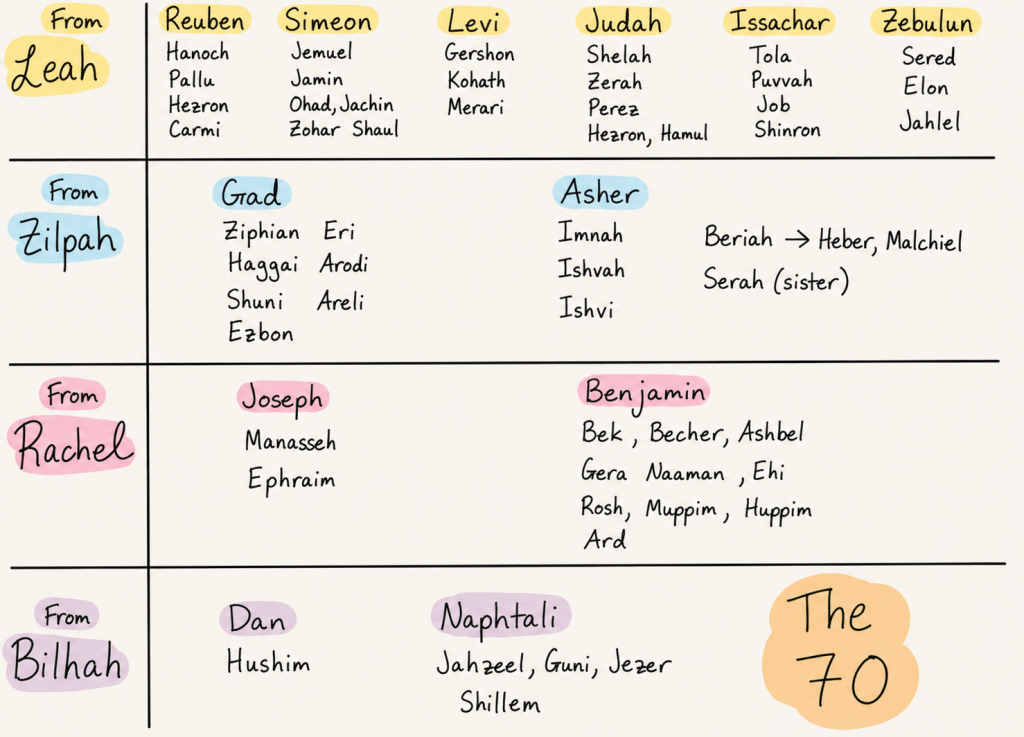
- I included visual of the family tree below
- 70 are listed, which represents completeness (7 x 10), but see note below on Stephen’s observation of 75.
8 Now these are the names of the descendants of Israel, who came into Egypt, Jacob and his sons. Reuben, Jacob’s firstborn, 9 and the sons of Reuben: Hanoch, Pallu, Hezron, and Carmi. 10 The sons of Simeon: Jemuel, Jamin, Ohad, Jachin, Zohar, and Shaul, the son of a Canaanite woman. 11 The sons of Levi: Gershon, Kohath, and Merari.
- Kohath is Moses’ grandfather
- Interesting call out of Shaul – were none of the other 70 from a Canaanite woman? Was Tamar from Canaan?
12 The sons of Judah: Er, Onan, Shelah, Perez, and Zerah (but Er and Onan died in the land of Canaan); and the sons of Perez were Hezron and Hamul.
- Hezron (of Perez) is the current son holding the lineage of Jesus.
13 The sons of Issachar: Tola, Puvah, Yob, and Shimron. 14 The sons of Zebulun: Sered, Elon, and Jahleel. 15 These are the sons of Leah, whom she bore to Jacob in Paddan-aram, together with his daughter Dinah; altogether his sons and his daughters numbered thirty-three.
16 The sons of Gad: Ziphion, Haggi, Shuni, Ezbon, Eri, Arodi, and Areli. 17 The sons of Asher: Imnah, Ishvah, Ishvi, Beriah, with Serah their sister. And the sons of Beriah: Heber and Malchiel. 18 These are the sons of Zilpah, whom Laban gave to Leah his daughter; and these she bore to Jacob—sixteen persons.
- Serah is mentioned among the 70, which is surprising because women are rarely listed in genealogies
19 The sons of Rachel, Jacob’s wife: Joseph and Benjamin. 20 And to Joseph in the land of Egypt were born Manasseh and Ephraim, whom Asenath, the daughter of Potiphera the priest of On, bore to him. 21 And the sons of Benjamin: Bela, Becher, Ashbel, Gera, Naaman, Ehi, Rosh, Muppim, Huppim, and Ard. 22 These are the sons of Rachel, who were born to Jacob—fourteen persons in all.
23 The son of Dan: Hushim. 24 The sons of Naphtali: Jahzeel, Guni, Jezer, and Shillem. 25 These are the sons of Bilhah, whom Laban gave to Rachel his daughter, and these she bore to Jacob—seven persons in all.
26 All the persons belonging to Jacob who came into Egypt, who were his own descendants, not including Jacob’s sons’ wives, were sixty-six persons in all. 27 And the sons of Joseph, who were born to him in Egypt, were two. All the persons of the house of Jacob who came into Egypt were seventy.
- In Acts 7:14 Stephen says there are 75 – he is probably including more of Joseph’s sons or grandsons (Septuagint says 75)
“The list of names in these verses appears to have been selected to total ‘seventy’ (46:27). It can hardly go without notice that the number of nations in Genesis 10 is also ‘seventy.’ Just as the ‘seventy nations’ represent all the descendants of Adam, so now the ‘seventy sons’ represent all the descendants of Abraham, Isaac, and Jacob—the children of Israel. Here in narrative form is a demonstration of the theme in Deuteronomy 32:8 that God apportioned the boundaries of the nations (Gen. 10) according to the number of the children of Israel. Thus the writer has gone to great lengths to portray the new nation of Israel as a new humanity and Abraham as a second Adam. The blessing that is to come through Abraham and his seed is a restoration of the original blessing of Adam, a blessing which was lost in the Fall. The picture of God that emerges from these pages is not merely a God who works with his own chosen people for their good alone, but also a God who works with the nations to bring about his plan of salvation and blessing.” (Sailhamer, John H. (1995). The Pentateuch as Narrative: A Biblical-Theological Commentary. Zondervan Academic. 225)
Jacob and Joseph Reunited
28 He had sent Judah ahead of him to Joseph to show the way before him in Goshen, and they came into the land of Goshen.
- Judah continues his leadership role, preparing the way for the Messianic line
29 Then Joseph prepared his chariot and went up to meet Israel his father in Goshen. He presented himself to him and fell on his neck and wept on his neck a good while. 30 Israel said to Joseph, “Now let me die, since I have seen your face and know that you are still alive.” 31 Joseph said to his brothers and to his father’s household, “I will go up and tell Pharaoh and will say to him, ‘My brothers and my father’s household, who were in the land of Canaan, have come to me. 32 And the men are shepherds, for they have been keepers of livestock, and they have brought their flocks and their herds and all that they have.’ 33 When Pharaoh calls you and says, ‘What is your occupation?’ 34 you shall say, ‘Your servants have been keepers of livestock from our youth even until now, both we and our fathers,’ in order that you may dwell in the land of Goshen, for every shepherd is an abomination to the Egyptians.”
- “For every shepherd is an abomination to Egyptians” – Sheep were considered unclean in Egypt for some reason. This could be due to dietary restrictions, religion, or hatred of the Hebrews. See here for more reading:


Leave a Reply