
Jacob Blesses Ephraim and Manasseh
After this, Joseph was told, “Behold, your father is ill.” So he took with him his two sons, Manasseh and Ephraim. 2 And it was told to Jacob, “Your son Joseph has come to you.” Then Israel summoned his strength and sat up in bed. 3 And Jacob said to Joseph, “God Almighty appeared to me at Luz in the land of Canaan and blessed me,
- See Genesis 35 and 28 – Bethel is also known as Luz
4 and said to me, ‘Behold, I will make you fruitful and multiply you, and I will make of you a company of peoples and will give this land to your offspring after you for an everlasting possession.’ 5 And now your two sons, who were born to you in the land of Egypt before I came to you in Egypt, are mine; Ephraim and Manasseh shall be mine, as Reuben and Simeon are.
- Jacob ‘adopting’ Manasseh and Ephraim is why we have 12/13 tribes and Joseph is usually not named (although we do see his name in Revelation 7). 12 is preserved when allotting land because Levi does not get land.
- See 1 Chronicles 5:2 and though Judah was the strongest of his brothers and a ruler came from him, the rights of the firstborn belonged to Joseph
- Also remember these two are half Egyptian!
6 And the children that you fathered after them shall be yours. They shall be called by the name of their brothers in their inheritance. 7 As for me, when I came from Paddan, to my sorrow Rachel died in the land of Canaan on the way, when there was still some distance to go to Ephrath, and I buried her there on the way to Ephrath (that is, Bethlehem).”
- Rachel died before she could bear additional sons so by adopting Joseph’s two sons, Jacob gives Rachel’s branch of the family an additional place among Israel
- Joseph becomes represented through Ephraim and Manasseh.
- Rachel now has three tribal representatives: Benjamin, Ephraim, and Manasseh.
8 When Israel saw Joseph’s sons, he said, “Who are these?”
- We assume he ‘knew’ them since he lived with them for 17 years – perhaps he couldn’t see them or it was part of the formal process.
9 Joseph said to his father, “They are my sons, whom God has given me here.” And he said, “Bring them to me, please, that I may bless them.” 10 Now the eyes of Israel were dim with age, so that he could not see. So Joseph brought them near him, and he kissed them and embraced them. 11 And Israel said to Joseph, “I never expected to see your face; and behold, God has let me see your offspring also.”
- Although this statement also reads as if he was seeing them for the first time, so it is a bit confusing.
12 Then Joseph removed them from his knees, and he bowed himself with his face to the earth. 13 And Joseph took them both, Ephraim in his right hand toward Israel’s left hand, and Manasseh in his left hand toward Israel’s right hand, and brought them near him.
- The right hand is associated with God’s strength (Exodus 15:6), favor (Psalm 16:11), and help (Psalm 20:6). This is why Jesus is described as sitting at the right hand of God the Father (Mark 14:62). The right hand was the position of favor and exaltation. (from https://enduringword.com/bible-commentary/genesis-48/)
14 And Israel stretched out his right hand and laid it on the head of Ephraim, who was the younger, and his left hand on the head of Manasseh, crossing his hands (for Manasseh was the firstborn).
- Manasseh (מְנַשֶּׁה) means “God made me forget,” reflecting healing from the past, while Ephraim (אֶפְרָיִם) means “God made me fruitful,” symbolizing blessing in the midst of affliction.
15 And he blessed Joseph and said,
“The God before whom my fathers Abraham and Isaac walked,
the God who has been my shepherd all my life long to this day,
16 the angel who has redeemed me from all evil, bless the boys;
and in them let my name be carried on, and the name of my fathers Abraham and Isaac;
and let them grow into a multitude in the midst of the earth.”
- This is the first mention of God as our shepherd, which we will see multiple more times throughout the Bible.
17 When Joseph saw that his father laid his right hand on the head of Ephraim, it displeased him, and he took his father’s hand to move it from Ephraim’s head to Manasseh’s head. 18 And Joseph said to his father, “Not this way, my father; since this one is the firstborn, put your right hand on his head.” 19 But his father refused and said, “I know, my son, I know. He also shall become a people, and he also shall be great. Nevertheless, his younger brother shall be greater than he, and his offspring shall become a multitude of nations.”
- Jacob crosses his arms which reflects a recurring theme where the younger is favored over the older: like Abel over Cain, Jacob over Esau, Isaac over Ishmael, Joseph over his older brothers, etc.
20 So he blessed them that day, saying,
“By you Israel will pronounce blessings, saying,
‘God make you as Ephraim and as Manasseh.’”
- “God make you as Ephraim and as Manasseh” is a traditional Jewish blessing to this day said to sons.
Thus he put Ephraim before Manasseh.
- Did God tell Jacob to bless Ephraim over Manasseh?
- Did Jacob bless any other grandchildren?
- Ephraim becomes the dominant tribe in the Northern Kingdom after the nation splits, and “Ephraim” is often used as a symbolic name for all of Israel in books like Hosea and Isaiah. Ephraim also held central territory in the land of Israel, including Shiloh where the Tabernacle was first established.
- Joshua will come from the tribe of Ephraim
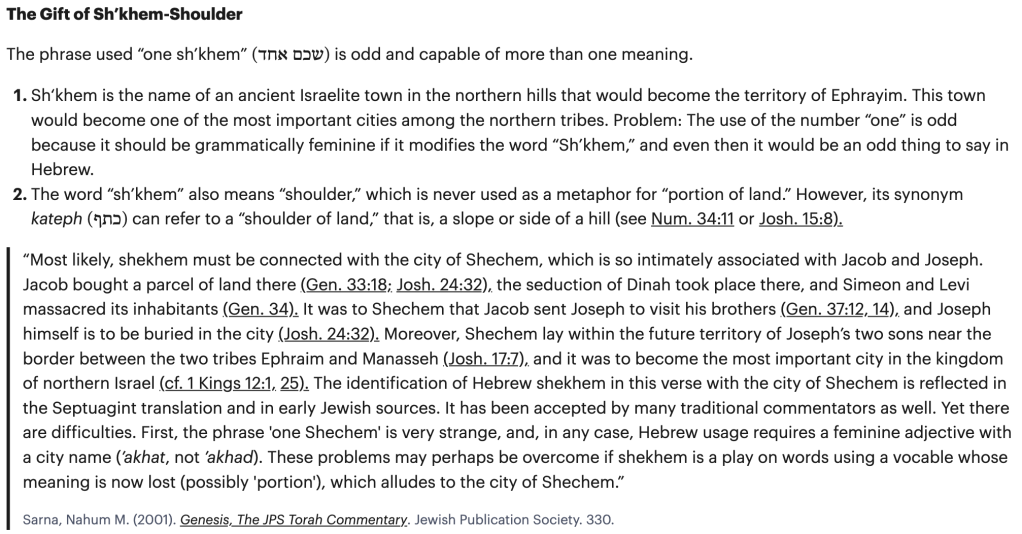
21 Then Israel said to Joseph, “Behold, I am about to die, but God will be with you and will bring you again to the land of your fathers. 22 Moreover, I have given to you rather than to your brothers one mountain slope that I took from the hand of the Amorites with my sword and with my bow.”
- I included the interesting verse Genesis 48:22 word use below from https://bibleproject.com/classroom/joseph/sessions/22 and Sarna, Nahum M. (2001). Genesis, The JPS Torah Commentary Jewish Publication Society. 330.
 Jo Reads The Bible
Leave a comment