
God Promises Deliverance
But the Lord said to Moses, “Now you shall see what I will do to Pharaoh; for with a strong hand he will send them out, and with a strong hand he will drive them out of his land.”
- The previous chapter ended with Moses frustrated and confused. After coming to God, he gets his answer.
2 God spoke to Moses and said to him, “I am the Lord.
- This is repeated 4x this chapter.
3 I appeared to Abraham, to Isaac, and to Jacob, as God Almighty, but by my name the Lord I did not make myself known to them.
- I talked about this a little bit but this is a bit confusing. Since YHWH is used in Genesis, it could be it was retrospectively put in and they did not know the name YHWH, or it could be that they did not KNOW the name YHWH and the full impact/meaning of His name.
4 I also established my covenant with them to give them the land of Canaan, the land in which they lived as sojourners. 5 Moreover, I have heard the groaning of the people of Israel whom the Egyptians hold as slaves, and I have remembered my covenant. 6 Say therefore to the people of Israel, ‘I am the Lord, and I will bring you out from under the burdens of the Egyptians, and I will deliver you from slavery to them, and I will redeem you with an outstretched arm and with great acts of judgment. 7 I will take you to be my people, and I will be your God, and you shall know that I am the Lord your God, who has brought you out from under the burdens of the Egyptians. 8 I will bring you into the land that I swore to give to Abraham, to Isaac, and to Jacob. I will give it to you for a possession. I am the Lord.’” 9 Moses spoke thus to the people of Israel, but they did not listen to Moses, because of their broken spirit and harsh slavery.
- God makes seven “I will” covenant promises to the Israelites, saying:
- “I will bring you out from under the burdens of the Egyptians
- I will deliver you from slavery to them
- I will redeem you with an outstretched arm and with great acts of judgment
- the phrase “outstretched arm” appears several times in Exodus and Deuteronomy to show God’s power and deliverance of Israel
- I will take you to be my people
- I will be your God, and you shall know that I am the Lord your God who has brought you out from under the burdens of the Egyptians.
- I will bring you into the land that I swore to give to Abraham, to Isaac, and to Jacob;
- I will give it to you for a possession. I am the Lord.”
- INTERESTING: While English translations translate these in the future tense, the original Hebrew uses the perfect verb tense or the form reserved for completed actions
- Cool insight from Guzik: There is a strong contrast with the later five I will statements of Satan in Isaiah 14:13-15. The great difference is that Satan was powerless to make any of his “I wills” come to pass. God is more than able to fulfill each of His promises. https://enduringword.com/bible-commentary/exodus-6/
10 So the Lord said to Moses, 11 “Go in, tell Pharaoh king of Egypt to let the people of Israel go out of his land.” 12 But Moses said to the Lord, “Behold, the people of Israel have not listened to me. How then shall Pharaoh listen to me, for I am of uncircumcised lips?”
- “uncircumcised lips” is quite the odd expression, but not unheard of in the Bible.
- Jeremiah 6:10 states “Behold, their ears are uncircumcised, they cannot listen” referring to their ears being spiritually closed.
- Deuteronomy 10:16 states “Circumcise therefore the foreskin of your heart…” meaning to remove stubbornness.
- But still, I wonder what Moses really thought about his speech, or what was going on there.
13 But the Lord spoke to Moses and Aaron and gave them a charge about the people of Israel and about Pharaoh king of Egypt: to bring the people of Israel out of the land of Egypt.
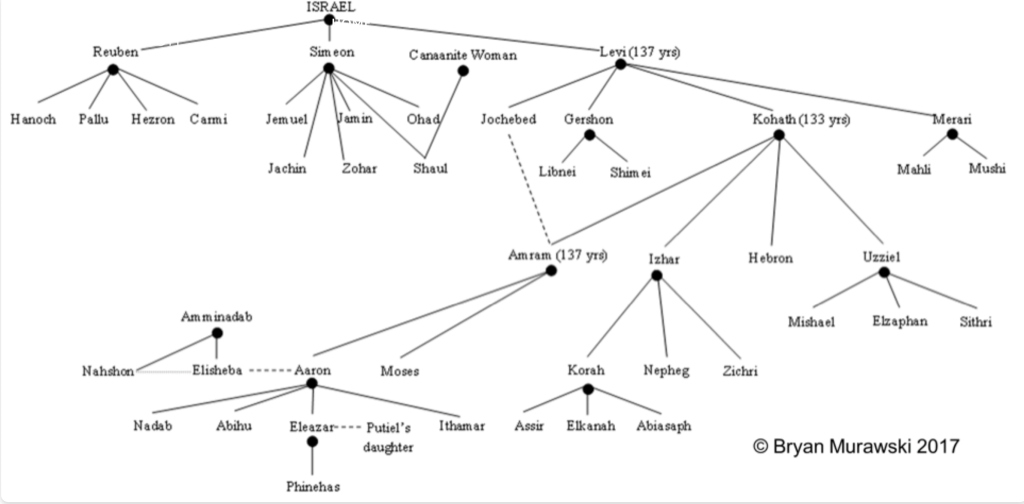
The Genealogy of Moses and Aaron
14 These are the heads of their fathers’ houses: the sons of Reuben, the firstborn of Israel: Hanoch, Pallu, Hezron, and Carmi; these are the clans of Reuben. 15 The sons of Simeon: Jemuel, Jamin, Ohad, Jachin, Zohar, and Shaul, the son of a Canaanite woman; these are the clans of Simeon. 16 These are the names of the sons of Levi according to their generations: Gershon, Kohath, and Merari, the years of the life of Levi being 137 years. 17 The sons of Gershon: Libni and Shimei, by their clans. 18 The sons of Kohath: Amram, Izhar, Hebron, and Uzziel, the years of the life of Kohath being 133 years. 19 The sons of Merari: Mahli and Mushi. These are the clans of the Levites according to their generations. 20 Amram took as his wife Jochebed his father’s sister, and she bore him Aaron and Moses, the years of the life of Amram being 137 years. 21 The sons of Izhar: Korah, Nepheg, and Zichri. 22 The sons of Uzziel: Mishael, Elzaphan, and Sithri. 23 Aaron took as his wife Elisheba, the daughter of Amminadab and the sister of Nahshon, and she bore him Nadab, Abihu, Eleazar, and Ithamar. 24 The sons of Korah: Assir, Elkanah, and Abiasaph; these are the clans of the Korahites. 25 Eleazar, Aaron’s son, took as his wife one of the daughters of Putiel, and she bore him Phinehas. These are the heads of the fathers’ houses of the Levites by their clans.
- The genealogy of the Levites highlights some foundational figures of Israel’s priestly line.
- Aaron’s sons Nadab and Abihu would later die for offering unauthorized fire
- Eleazar would go on to succeed Aaron as high priest
- Eleazar’s son, Phinehas becomes notable for defending God’s holiness and receives a lasting covenant of peace (Numbers 25).
- Nashon becomes the leader of the tribe of Judah
- Korah leads a rebellion against Moses and Aaron in Numbers 16.
- Yet the sons of Korah do not perish (Numbers 26:11).They become Temple musicians and write several Psalms
- Why is the genealogy limited to first 3 tribes? Why not just mention Levi then?
- Why isn’t Moses’ wife mentioned? Because she wasn’t Hebrew? Because he ‘sent her home’?
26 These are the Aaron and Moses to whom the Lord said: “Bring out the people of Israel from the land of Egypt by their hosts.” 27 It was they who spoke to Pharaoh king of Egypt about bringing out the people of Israel from Egypt, this Moses and this Aaron.
28 On the day when the Lord spoke to Moses in the land of Egypt, 29 the Lord said to Moses, “I am the Lord; tell Pharaoh king of Egypt all that I say to you.” 30 But Moses said to the Lord, “Behold, I am of uncircumcised lips. How will Pharaoh listen to me?”
- another mention of the lips


Leave a Reply