
The Song of Moses
- Exodus 15 is a prophetic song and the first song recorded in the Bible. It may be called the ‘Song of Moses’ but it is all about God’s glory.
Then Moses and the people of Israel sang this song to the Lord, saying,
“I will sing to the Lord, for he has triumphed gloriously;
the horse and his rider he has thrown into the sea.
- “I will sing to the Lord”- David and other authors will also use this to start their praise to God. (Psalm 104:33, Psalm 13:6)
2 The Lord is my strength and my song,
and he has become my salvation;
this is my God, and I will praise him,
my father’s God, and I will exalt him.
- This is the first mention as God as salvation. Genesis 49:18 proclaims the waiting of God’s salvation, and Exodus 14:13 says to watch for God’s salvation. Here we have the LORD as our salvation.
3 The Lord is a man of war;
the Lord is his name.
- Finally Israel feels safe- there is no threat of slavery. God has triumphed over the seemingly impossible.
- YHWH is his name!
4 “Pharaoh’s chariots and his host he cast into the sea,
and his chosen officers were sunk in the Red Sea.
5 The floods covered them;
they went down into the depths like a stone.
6 Your right hand, O Lord, glorious in power,
your right hand, O Lord, shatters the enemy.
- “right hand” symbolizes strength and authority. Pharaoh needed chariots and armies, God needed nothing. His right hand alone shattered the enemy.
- There is a lot of hand imagery in Exodus
- Exodus 3:20 “So I will stretch out my hand and strike Egypt…”
- Exodus 6:1 “with a strong hand he will send them out…”
- Exodus 13:3 “for by a strong hand the LORD brought you out…”
- Exodus 14:31 Israel sees the “mighty hand” YHWH used against Egypt.
7 In the greatness of your majesty you overthrow your adversaries;
you send out your fury; it consumes them like stubble.
8 At the blast of your nostrils the waters piled up;
the floods stood up in a heap;
the deeps congealed in the heart of the sea.
9 The enemy said, ‘I will pursue, I will overtake,
I will divide the spoil, my desire shall have its fill of them.
I will draw my sword; my hand shall destroy them.’
10 You blew with your wind; the sea covered them;
they sank like lead in the mighty waters.
11 “Who is like you, O Lord, among the gods?
Who is like you, majestic in holiness,
awesome in glorious deeds, doing wonders?
12 You stretched out your right hand;
the earth swallowed them.
- There truly is no one else like YHWH. Look how God humbled the ‘gods’ of Egypt, or Pharaoh and his ‘mighty’ army. They were no match for His glory and power.
13 “You have led in your steadfast love the people whom you have redeemed;
you have guided them by your strength to your holy abode.
- חֶסֶד (chesed, “steadfast love”) first appears in Genesis 19:19 and is first explicitly associated with YHWH’s steadfast love in Genesis 24. Here in Exodus 15:13, Israel describes the Exodus itself as an act of God’s chesed
14 The peoples have heard; they tremble;
pangs have seized the inhabitants of Philistia.
15 Now are the chiefs of Edom dismayed;
trembling seizes the leaders of Moab;
all the inhabitants of Canaan have melted away.
- Communication of God’s power has spread up through Canaan.
- Rahab confirms this in Joshua.
“I know that the LORD has given you the land, and that the fear of you has fallen upon us, and that all the inhabitants of the land melt away before you. For we have heard how the LORD dried up the water of the Red Sea before you when you came out of Egypt…” (Joshua 2:10)
- Rahab confirms this in Joshua.
16 Terror and dread fall upon them;
because of the greatness of your arm, they are still as a stone,
till your people, O Lord, pass by,
till the people pass by whom you have purchased.
17 You will bring them in and plant them on your own mountain,
the place, O Lord, which you have made for your abode,
the sanctuary, O Lord, which your hands have established.
18 The Lord will reign forever and ever.”
- Revelation 15:3 calls back to the Song of Moses, now the song of the Lamb. The chapter is loaded with Exodus imagery.
| Exodus | Revelation 15 |
|---|---|
| God’s people are oppressed by Pharaoh | God’s people are oppressed by the beast |
| God sends plagues upon Egypt | God sends plagues through the seven bowls |
| God’s people escape their oppressor | God’s people conquer the beast |
| Pharaoh and his forces are defeated | The beast and its power are defeated |
| Israel stands safely on the other side of the sea | The victorious saints stand safely beside the sea of glass |
| Israel sings the Song of Moses | They sing the Song of Moses and the Lamb |
| The song praises YHWH’s mighty victory | The song praises God’s great and amazing deeds |
19 For when the horses of Pharaoh with his chariots and his horsemen went into the sea, the Lord brought back the waters of the sea upon them, but the people of Israel walked on dry ground in the midst of the sea. 20 Then Miriam the prophetess, the sister of Aaron, took a tambourine in her hand, and all the women went out after her with tambourines and dancing. 21 And Miriam sang to them:
- Here we see the first woman mentioned as prophet: Miriam
- The name Mary in the New Testament comes from the Hebrew name מִרְיָם (Miryam).
“Sing to the Lord, for he has triumphed gloriously;
the horse and his rider he has thrown into the sea.”
- And yes, that Hebrew part in Prince of Egypt’s song is from this chapter.
- אָשִׁירָה לַיהוָה כִּי־גָאֹה גָּאָה
Ashirah al Adonai (la-YHWH), ki ga’oh ga’ah
“I will sing to the LORD, for he has triumphed gloriously.” verse 1 - מִי־כָמֹכָה בָּאֵלִם יְהוָה
Mi khamokha ba’elim Adonai (YHWH)
“Who is like you, O LORD, among the gods?” verse 11 - מִי כָּמֹכָה נֶאְדָּר בַּקֹּדֶשׁ
Mi kamocha ne’dar ba-kodesh
“Who is like you, majestic in holiness?” verse 11 - נָחִיתָ בְחַסְדְּךָ עַם־זוּ גָּאָלְתָּ
Nachita vechasdecha am-zu ga’alta
“You have led in your steadfast love the people whom you have redeemed.” verse 13
- אָשִׁירָה לַיהוָה כִּי־גָאֹה גָּאָה
Bitter Water Made Sweet
22 Then Moses made Israel set out from the Red Sea, and they went into the wilderness of Shur. They went three days in the wilderness and found no water. 23 When they came to Marah, they could not drink the water of Marah because it was bitter; therefore it was named Marah. 24 And the people grumbled against Moses, saying, “What shall we drink?” 25 And he cried to the Lord, and the Lord showed him a log, and he threw it into the water, and the water became sweet.
- Did Moses throw a whole tree into the water? The Hebrew word עֵץ (etz) means tree but can mean wood/log.
- מָרִים (marim) = bitter
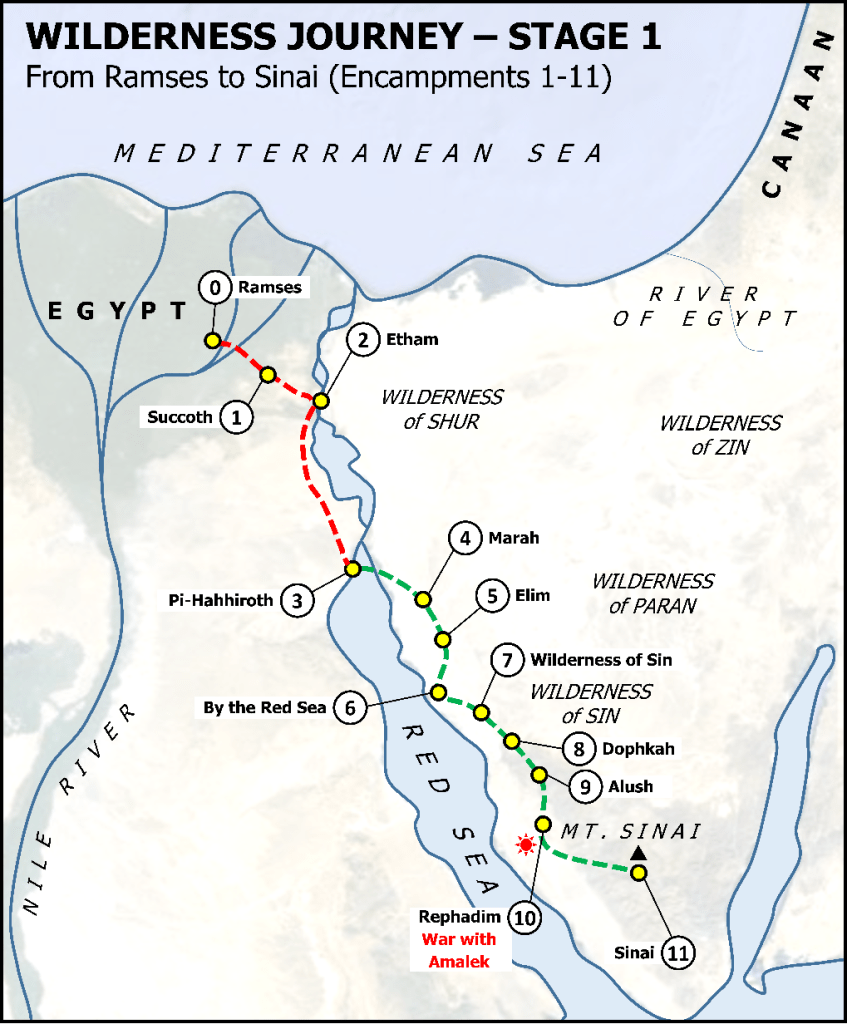
- See map below for location
There the Lord made for them a statute and a rule, and there he tested them, 26 saying, “If you will diligently listen to the voice of the Lord your God, and do that which is right in his eyes, and give ear to his commandments and keep all his statutes, I will put none of the diseases on you that I put on the Egyptians, for I am the Lord, your healer.”
- from https://enduringword.com/bible-commentary/exodus-15/
- Dr. S.I. McMillen in his book None of These Diseases noted that many of God’s laws to Israel had a direct impact on hygiene and health. Practices such as circumcision, quarantine, washing in running water, and eating kosher made a real medical difference in keeping Israel free from disease.
27 Then they came to Elim, where there were twelve springs of water and seventy palm trees, and they encamped there by the water.


Leave a Reply