
Laws About Slaves
- A lot of the slave laws attract negative attention in the Bible. This session does a great job of going into depth on how we can navigate these passages https://bibleproject.com/classroom/exodus-overview-carmen-imes/sessions/20. Some of these laws are meant to prevent exploitation.
“Now these are the rules that you shall set before them. 2 When you buy a Hebrew slave, he shall serve six years, and in the seventh he shall go out free, for nothing. 3 If he comes in single, he shall go out single; if he comes in married, then his wife shall go out with him. 4 If his master gives him a wife and she bears him sons or daughters, the wife and her children shall be her master’s, and he shall go out alone. 5 But if the slave plainly says, ‘I love my master, my wife, and my children; I will not go out free,’ 6 then his master shall bring him to God, and he shall bring him to the door or the doorpost. And his master shall bore his ear through with an awl, and he shall be his slave forever.
- From Carmen Imes (from the Bible Project Session) : She suggests not using the word “slave” or “servant” in these passages, but intead the Hebrew word ʿebed עֶבֶד, so that we don’t come in to this passage with any preconceived notions. From the passage above we see the rules for a male ‘ebed. Notice what we learn about them (bullets taken from the session directly).
- Voluntary hired worker
- Limited term of service
- Free to leave and to marry
- Permanent service is voluntary
- The goal of these laws was to protect the vulnerable from exploitation by the powerful.
7 “When a man sells his daughter as a slave, she shall not go out as the male slaves do. 8 If she does not please her master, who has designated her[b] for himself, then he shall let her be redeemed. He shall have no right to sell her to a foreign people, since he has broken faith with her. 9 If he designates her for his son, he shall deal with her as with a daughter. 10 If he takes another wife to himself, he shall not diminish her food, her clothing, or her marital rights. 11 And if he does not do these three things for her, she shall go out for nothing, without payment of money.
- Here we have the female אָמָה ‘amah. The bullets again are from the Bible Project Session from above. These bullets are also pulled from the session notes directly.
- An ʾamah marries into the household
- Fathers always arranged marriages for their daughters
- “Bride price” is expected for the bride’s family
12 “Whoever strikes a man so that he dies shall be put to death. 13 But if he did not lie in wait for him, but God let him fall into his hand, then I will appoint for you a place to which he may flee. 14 But if a man willfully attacks another to kill him by cunning, you shall take him from my altar, that he may die.
- Exodus 21:12-14 distinguishes between reactive aggression (unplanned killing, which allows for mercy through refuge) and proactive aggression (premeditated murder, which results in judgment and death).
15 “Whoever strikes his father or his mother shall be put to death.
- We assume that “strikes” results in death, as verse 12 mentions.
16 “Whoever steals a man and sells him, and anyone found in possession of him, shall be put to death.
- No kidnapping allowed.
17 “Whoever curses his father or his mother shall be put to death.
- Alan Cole suggests “curses” as almost a death threat. “Since to curse was to will and pray the downfall of the other with all one’s heart, it represented the attitude from which sprang acts like striking or murder.”
- Cole, R. Alan Exodus, An Introduction and Commentary (London: Inter-Varsity Press, 1973)
18 “When men quarrel and one strikes the other with a stone or with his fist and the man does not die but takes to his bed, 19 then if the man rises again and walks outdoors with his staff, he who struck him shall be clear; only he shall pay for the loss of his time, and shall have him thoroughly healed.
- We already know from verse 12 that if a man strikes another and he dies, he shall be put to death.
- However, if he does not die and can get up, then the attacker is still financially responsible for the harm caused, including lost time worked and healing expenses.
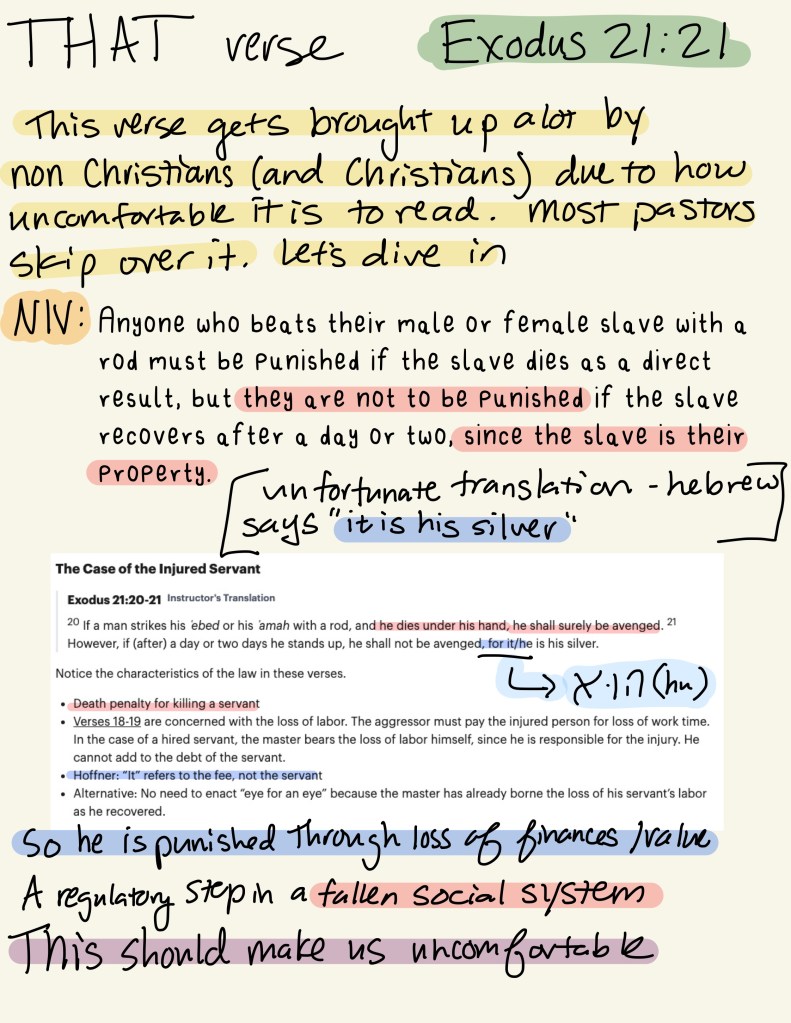
20 “When a man strikes his slave, male or female, with a rod and the slave dies under his hand, he shall be avenged. 21 But if the slave survives a day or two, he is not to be avenged, for the slave is his money.
- Exodus 21:21 is a verse that makes a lot of Christians anxious and one that pastors usually skip – I included a visual below!
- It is an interesting interpretation from Carmen Imes/BibleProject: The Hebrew of Exodus 21:21 is כִּי כַסְפּוֹ הוּא (ki kaspo hu), literally “for/because his silver/money he/it is.” הוּא (hu) can mean “he” or “it.”
- Most translations understand “he” as the servant “he is his money/property.”
- Imes instead argues from the law before about compensation for lost labor (21:18-19) that “it” refers to the master’s financial loss: because the master injured his own servant, the resulting loss of the servant’s labor is already the master’s own financial loss.
22 “When men strive together and hit a pregnant woman, so that her children come out, but there is no harm, the one who hit her shall surely be fined, as the woman’s husband shall impose on him, and he shall pay as the judges determine. 23 But if there is harm, then you shall pay life for life, 24 eye for eye, tooth for tooth, hand for hand, foot for foot, 25 burn for burn, wound for wound, stripe for stripe.
- This is a very specific example of premature birth as a result of violence.
26 “When a man strikes the eye of his slave, male or female, and destroys it, he shall let the slave go free because of his eye. 27 If he knocks out the tooth of his slave, male or female, he shall let the slave go free because of his tooth.
- Why only eyes and teeth?
28 “When an ox gores a man or a woman to death, the ox shall be stoned, and its flesh shall not be eaten, but the owner of the ox shall not be liable. 29 But if the ox has been accustomed to gore in the past, and its owner has been warned but has not kept it in, and it kills a man or a woman, the ox shall be stoned, and its owner also shall be put to death. 30 If a ransom is imposed on him, then he shall give for the redemption of his life whatever is imposed on him. 31 If it gores a man’s son or daughter, he shall be dealt with according to this same rule. 32 If the ox gores a slave, male or female, the owner shall give to their master thirty shekels of silver, and the ox shall be stoned.
- What about other animals that gore? “When an ox gores a man or a woman to death….”
Laws About Restitution
33 “When a man opens a pit, or when a man digs a pit and does not cover it, and an ox or a donkey falls into it, 34 the owner of the pit shall make restoration. He shall give money to its owner, and the dead beast shall be his.
- These laws can be summed up as making sure you pay the consequences of your actions.
35 “When one man’s ox butts another’s, so that it dies, then they shall sell the live ox and share its price, and the dead beast also they shall share. 36 Or if it is known that the ox has been accustomed to gore in the past, and its owner has not kept it in, he shall repay ox for ox, and the dead beast shall be his.


Leave a Reply