
The Death of Miriam
And the people of Israel, the whole congregation, came into the wilderness of Zin in the first month, and the people stayed in Kadesh. And Miriam died there and was buried there.
- This jumps to the end of the 40 years as Aaron dies and Numbers 33 says: “At the Lord’s command Aaron the priest went up Mount Hor, where he died on the first day of the fifth month of the fortieth year”
- Moses is now about 120 years old.
The Waters of Meribah
- This story probably seems familiar! This is a DIFFERENT story about the waters of Meribah that Moses brings water out of a rock ( See Exodus 17)
- Also not to be confused between the waters of Marah in Exodus 15
- See table below for comparisons between the stories
2 Now there was no water for the congregation. And they assembled themselves together against Moses and against Aaron.
- Where did the water go?
- Jewish tradition associates Miriam’s death with water going missing.
3 And the people quarreled with Moses and said, “Would that we had perished when our brothers perished before the Lord! 4 Why have you brought the assembly of the Lord into this wilderness, that we should die here, both we and our cattle? 5 And why have you made us come up out of Egypt to bring us to this evil place? It is no place for grain or figs or vines or pomegranates, and there is no water to drink.”
- Once again the Israelites jump to anger and frustration instead of going to God
6 Then Moses and Aaron went from the presence of the assembly to the entrance of the tent of meeting and fell on their faces. And the glory of the Lord appeared to them, 7 and the Lord spoke to Moses, saying, 8 “Take the staff, and assemble the congregation, you and Aaron your brother, and tell the rock before their eyes to yield its water. So you shall bring water out of the rock for them and give drink to the congregation and their cattle.” 9 And Moses took the staff from before the Lord, as he commanded him.
- Why did God tell Moses to take his staff?
Moses Strikes the Rock
10 Then Moses and Aaron gathered the assembly together before the rock, and he said to them, “Hear now, you rebels: shall we bring water for you out of this rock?” 11 And Moses lifted up his hand and struck the rock with his staff twice, and water came out abundantly, and the congregation drank, and their livestock.
- God did not tell Moses to hit the rock, but told him to speak to it.
12 And the Lord said to Moses and Aaron, “Because you did not believe in me, to uphold me as holy in the eyes of the people of Israel, therefore you shall not bring this assembly into the land that I have given them.” 13 These are the waters of Meribah, where the people of Israel quarreled with the Lord, and through them he showed himself holy.
- I do feel bad for Moses, and how frustrated he must be as a leader. I’m sure I also would have had a bit of a breakdown.
- But also, I am surprised that he did not believe God (as God says in verse 12) after all he has seen and done.
- Interesting use of “we” said by Moses instead of acknowledging God: “Hear now, you rebels: shall we bring water for you out of this rock?”
- Psalm 106:32-33 says: “They angered him at the waters of Meribah, and it went ill with Moses on their account, for they made his spirit bitter, and he spoke rashly with his lips.“
- Meribah: מְרִיבָה (Merivah) = “quarreling,”
| Event | Exodus 15 | Exodus 17 | Numbers 20 |
|---|---|---|---|
| Location | Marah, wilderness of Shur | Rephidim | Kadesh, wilderness of Zin |
| Time | Immediately after crossing the Red Sea | Early in the wilderness journey | Near the end of the wilderness years |
| Problem | Water is available, but it is bitter and undrinkable | There is no water to drink | Again, there is no water to drink |
| God’s Command | Shows Moses a log/tree to throw into the water | Strike the rock with his staff | Speak to the rock |
| Moses’ Action | Obeys: Throws the log/tree into the water | Obeys: Strikes the rock as commanded | Strikes the rock twice, disobeying God’s command |
| Outcome | Bitter water becomes sweet/drinkable | Water flows; place called Massah and Meribah | Water flows; called waters of Meribah; Moses and Aaron are judged |
Edom Refuses Passage
- We are now near the end of the 40 years of wandering (we don’t get many stories in the Bible about those 40 years). We are now entering a new generation of people getting ready for the Promised Land.
14 Moses sent messengers from Kadesh to the king of Edom: “Thus says your brother Israel: You know all the hardship that we have met: 15 how our fathers went down to Egypt, and we lived in Egypt a long time. And the Egyptians dealt harshly with us and our fathers.
- Remember Edom comes from Esau. Edom and Israel were brothers.
16 And when we cried to the Lord, he heard our voice and sent an angel and brought us out of Egypt. And here we are in Kadesh, a city on the edge of your territory. 17 Please let us pass through your land. We will not pass through field or vineyard, or drink water from a well. We will go along the King’s Highway. We will not turn aside to the right hand or to the left until we have passed through your territory.” 18 But Edom said to him, “You shall not pass through, lest I come out with the sword against you.” 19 And the people of Israel said to him, “We will go up by the highway, and if we drink of your water, I and my livestock, then I will pay for it. Let me only pass through on foot, nothing more.” 20 But he said, “You shall not pass through.” And Edom came out against them with a large army and with a strong force. 21 Thus Edom refused to give Israel passage through his territory, so Israel turned away from him.
- Edom does not let Israel travel through their land, and instead they have to go up north around it. (See map below, traveling from #1 to #2)
- From Adrian R Reynolds: If Edom had allowed passage, however, two things would have taken place. First, the route to the Promised Land would have been considerably shortened (entering from the east) and Moses would not have been allowed his gracious look at the Promised Land from a high vantage point (Deut 32:48–52; 34:1–8). Second, the blessing of Balaam, a key part of the narrative (Num 22–24) would have been impossible. In some sense, then, this short story forms part of Israel’s leadership story also.
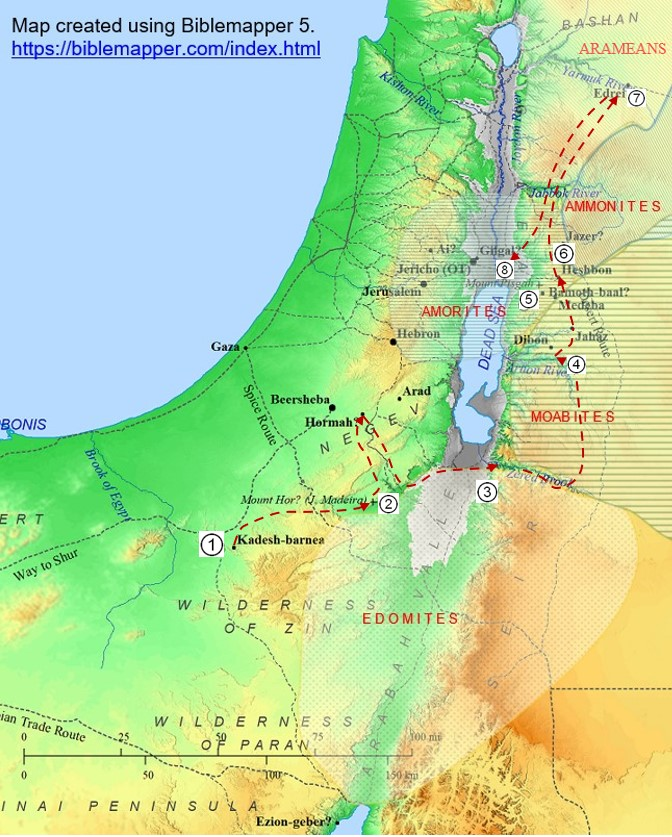
The Death of Aaron
22 And they journeyed from Kadesh, and the people of Israel, the whole congregation, came to Mount Hor. 23 And the Lord said to Moses and Aaron at Mount Hor, on the border of the land of Edom, 24 “Let Aaron be gathered to his people, for he shall not enter the land that I have given to the people of Israel, because you rebelled against my command at the waters of Meribah. 25 Take Aaron and Eleazar his son and bring them up to Mount Hor. 26 And strip Aaron of his garments and put them on Eleazar his son. And Aaron shall be gathered to his people and shall die there.” 27 Moses did as the Lord commanded. And they went up Mount Hor in the sight of all the congregation. 28 And Moses stripped Aaron of his garments and put them on Eleazar his son. And Aaron died there on the top of the mountain. Then Moses and Eleazar came down from the mountain. 29 And when all the congregation saw that Aaron had perished, all the house of Israel wept for Aaron thirty days.
- Sad that Aaron, the High Priest of Israel, would not see the Promised Land. Verse 12 says that both he and Moses did not believe.
- Eleazar is now the High Priest
- Numbers 33 shows this as the final 40th year of wandering.


Leave a Reply