
The Cities of Refuge
Then the Lord said to Joshua, 2 “Say to the people of Israel, ‘Appoint the cities of refuge, of which I spoke to you through Moses, 3 that the manslayer who strikes any person without intent or unknowingly may flee there.
- The Lord tells Joshua to appoint the cities of refuge as commanded through Moses (Numbers 35 and Deuteronomy 19).
- Reminder: the purpose is so anyone who kills a person unintentionally or without premeditation may flee there and be protected from ‘avengers of blood’.
They shall be for you a refuge from the avenger of blood. 4 He shall flee to one of these cities and shall stand at the entrance of the gate of the city and explain his case to the elders of that city. Then they shall take him into the city and give him a place, and he shall remain with them. 5 And if the avenger of blood pursues him, they shall not give up the manslayer into his hand, because he struck his neighbor unknowingly, and did not hate him in the past. 6 And he shall remain in that city until he has stood before the congregation for judgment, until the death of him who is high priest at the time. Then the manslayer may return to his own town and his own home, to the town from which he fled.’”
- The fugitive must:
- Flee to one of the cities of refuge.
- Stand at the city gate and state their case before the elders.
- In Israel, city gates were important locations
- In Ruth 4:1-12, Boaz goes to the city gate to settle the matter of redemption before the elders.
- In Deuteronomy 21:18-21, itdescribes elders handling a legal matter at the city gate.
- In Israel, city gates were important locations
- Be admitted into the city and given a place to live.
- The fugitive was initially protected while awaiting judgment. If the people determined that the killing was unintentional, the person was returned to the city of refuge and required to remain there until the death of the high priest.
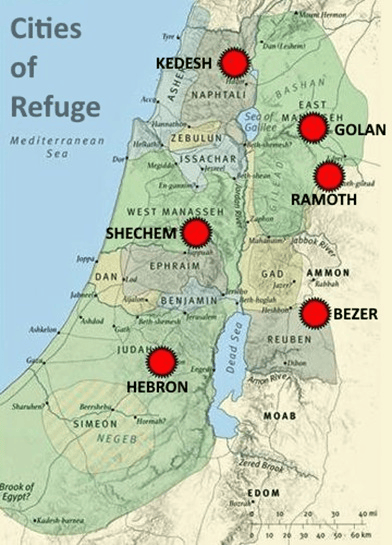
7 So they set apart Kedesh in Galilee in the hill country of Naphtali, and Shechem in the hill country of Ephraim, and Kiriath-arba (that is, Hebron) in the hill country of Judah. 8 And beyond the Jordan east of Jericho, they appointed Bezer in the wilderness on the tableland, from the tribe of Reuben, and Ramoth in Gilead, from the tribe of Gad, and Golan in Bashan, from the tribe of Manasseh. 9 These were the cities designated for all the people of Israel and for the stranger sojourning among them, that anyone who killed a person without intent could flee there, so that he might not die by the hand of the avenger of blood, till he stood before the congregation.
- The Appointed Cities (see map below)
- West of the Jordan:
- Naphtali: Kedesh in Galilee
- Ephraim: Shechem
- Abraham built an altar here after God promised the land to his descendants (Genesis 12:6-7).
- Jacob later settled near Shechem (Genesis 33:18-20).
- Judah: Kiriath Arba (Hebron)
- Abraham lived near Hebron, and his family was buried there (Genesis 23)
- East of the Jordan:
- Reuben: Bezer in the wilderness
- Gad: Ramoth in Gilead
- Manasseh: Golan in Bashan
- West of the Jordan:
- Israelites and foreigners among them free to use these cities.
- What happens if the high priest dies right when someone flees to a city of refuge?


Leave a Reply