Genesis 31-33 Jacob Leaves

Thoughts

Jacob seems to omit his involvement in the mating scheme and present it as God was completely intervening (which I am not denying) but there was a lot that Jacob seemed to carefully plan that he did not talk about. He seems to say he is just accepting a blessing given to him instead of having any involvement. Maybe it could have been both.

Laban called it Jegar-sahadutha, but Jacob called it Galeed (both mean ‘heap of witness’ but one is Aramaic and one is Hebrew)

Only two times this name is used for God is in chapter 31: 42 If the God of my father, the God of Abraham and the Fear of Isaac, had not been on my side & 53 The God of Abraham and the God of Nahor, the God of their father, judge between us.” So Jacob swore by the Fear of his father Isaac,

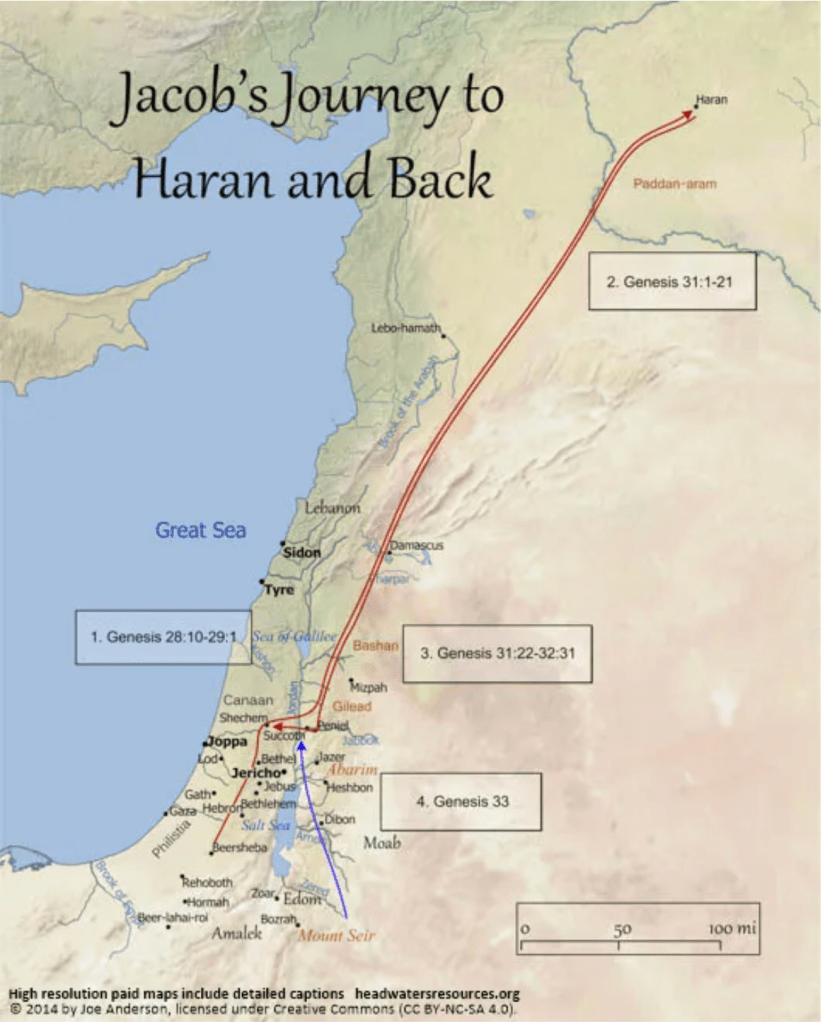
I included map of Jacob’s travels to better visualize his journey from https://headwatersresources.org/map-of-jacobs-journey-to-haran-and-back/

Yisrael יִשְׂרָאֵל – he struggles with God. The name comes from the Hebrew root שָׂרָה (sarah)

Jacob probably now had a permanent limp -hopefully a humbling reminder

When Jacob prepares to meet Esau he puts Leah and her children in front of Rachel and Joseph

Jacob bows 7 times (7 meaning completeness) – we see clay tablets showing that bowing 7 times was how you approach someone higher up than you (specifically Pharaoh)

We see Jacob still being deceitful as he tells Esau he will meet him in Mt Seir but instead heads to Shechem

Jacob builds sukkot in Succoth. The verse foreshadows Israel’s later festival of Sukkot which is a celebration of wandering yet protected pilgrims (we see later in Exodus and Leviticus)

Questions

Does this response reveal faith and bravery or greed? Genesis 30:15-16 Are we not regarded by him as foreigners? For he has sold us, and he has indeed devoured our money. 16 All the wealth that God has taken away from our father belongs to us and to our children. Now then, whatever God has said to you, do.” —– Because then immediately Rachel goes and steals her father’s goods.

Why did Rachel steal the idols? For herself? To prevent her father from having them? Out of fear?

God told Laban not to say anything to Jacob good or bad – what does that mean? He immediately goes and accuses Jacob of a lot of things.

Jacob says he was afraid that Laban would take his daughters by force – could he have?

What did it look like when the angels of God met Jacob in Mahanaim

Jacob wrestles with God: I always have so many questions about this encounter. Did God or Jacob initiate the wrestle? Why wrestle? Why until daybreak? Why did God see that ‘He would not prevail’? Why did He have to pop his hip bone out? Did Jacob ever call for help? Why does he demand a blessing from this ‘random’ man? Why did this all have to happen this way? I’m sure this is not a helpful way to look at this passage that is filled with so much imagery but here are my random questions.

Application
Jacob goes from one struggle to the next: first with Laban, then with Esau (and in both, he played a part in the conflict). Despite everything, God remained with him, offering protection and unexpected grace. Jacob didn’t deserve it, but God kept His promises anyway. That same grace applies to us and God doesn’t abandon us when we’re in the middle of chaos even if it’s partly our fault. He stays faithful and walks with us toward healing and (hopefully) transformation. 
Comments

2 responses to “Genesis 31-33 Jacob Leaves”

  1. Nathaniel Largo Avatar
    Nathaniel Largo

    Genesis 31

    In verse 3, it just strikes me as weird that God is still supporting Jacob after he had been so dishonest. I feel like if we told the story of what Jacob did with the flocks in modern times in the abstract, not naming names or religious affiliations, we would consider this kind of dishonesty to be a pretty huge example of the nature of sin, but here God says to go back home and that He would be with Jacob.

    Is this because God recognizes that Laban was not treating Jacob fairly, and therefore his response was somehow merited? I know I shouldn’t read too much between the lines here, but I’m having a hard time with these concepts early on.

    In verse 10…do we believe that Jacob really had this dream? I really, sincerely hope he would not be making something like this up, because lying to his wives and saying that he had this kind of a dream just to get them to come with him seems like a huge affront to God. However, if this dream is true, then we could potentially believe that it was through God’s hand that the flock flourished rather than Jacob’s deceit. I don’t want my personal feelings regarding Jacob to influence how I am reading these verses, but this is another point where I’m wondering why we weren’t privy to this dream being told to us directly before he told Leah and Rachel about it.

    Genesis 31:19 – “When Laban had gone to shear his sheep, Rachel stole her father’s household gods.”

    Were these idols? I’m curious as to what the Hebrew translation would be here for Rachel stealing these “gods.” This is again where I am confused about people being in the presence of divinity and still not holding to any other ideas. Saying that “I am the God of your father,” rather than saying “I am the God of all.” Laban didn’t want Jacob to leave because he said the Lord had blessed him because of Jacob, so why would he still hold to idols / images of other gods? I am sure the Hebrew will provide more insight to this, but could it be that these are regular treasures that Laban held up as points of worship?

    In verse 29 we have this mention of “the God of your father” again. If Laban does not believe in the divinity of this being, why heed his words? I mean, I guess he didn’t, because God literally said don’t say anything, good or bad, and Laban still launched into his speech, but still.

    I do think that Jacob was mistreated by Laban and deceived in being made to marry Leah and being forced to work for years longer than he originally agreed to, but I just come out of this feeling like no one really looks good in this situation. Rachel flat out lying to her father about having stolen his “gods,” and covering them up during the search of the tents! Jacob and Laban’s covenant seemed odd to me as well. If Jacob’s belief is truly in God and that He will protect him, why is he concerned about making a deal with Laban? I know that he likely doesn’t want to make his father-in-law into a villain in the eyes of his wives, but Jacob being fearful of reprisal suggests a lack of faith in God, in my opinion.

    Genesis 32

    Genesis 31:10a – “I am unworthy of all the kindness and faithfulness you have shown your servant.”

    Maybe the first thing Jacob has said that I’ve totally agreed with.

    Verses 24 – 30. I am sure these are not meant to be taken literally, so I am just throwing out some thoughts. Do you think God was just testing Jacob to see if he would be able to stand up to a force that would try to bring him down? Jacob would not be able to hold up in a battle against a being of God, so I feel like this is a test to see if all the lies and deceit that he engaged in would cause him to give up and run at the first sign of conflict; to see if he was really ready to face Esau’s wrath over stealing their father’s blessing.

    Genesis 33

    Would the meeting of Esau and Jacob have gone differently if Jacob yielded in his battle the night before? I know based on what God told Rebekah when she was pregnant that this has all been foretold and in the making for years, but I feel like you pose a lot of those really great “what if” questions, and I wondered this as I read what happened when Esau met him.

    Like

  2. Nathaniel Largo Avatar
    Nathaniel Largo
    1. Faith and Bravery or Greed?

      I viewed that as a bit of panic. There are multiple instances prior to this where individuals talk about being foreigners in a place where they take up residence, and I guess I felt like Leah and Rachel were realizing that in Jacob’s reported mistreatment by the hands of their father, they were now feeling like their home was no longer their own. Then they kind of panicked and said that if Jacob really had been treated the way he had, they should be entitled to what was otherwise deprived of Jacob, and by proxy, them.

    2. Why steal?

      That ties into what I thought about their panicking in the face of what was to come. Maybe she felt if Laban caught up to them, she could use them to barter for her children’s safety, but then hearing Jacob say that Laban could kill whoever had it, she resorted back to that same panic and (taking a cue from her awesome, awesome husband) lied.

    3. Do not say anything

      I wondered the same thing!

    4. Laban to take back his daughters?

      I wonder if it was some sort of custom in their land, that if they departed on dishonest terms, he could revoke his blessing of the marriage and take them back?

    5. Angels in Mahanaim

      I feel like since it was mentioned so briefly, it was almost like they were greeting him and nothing more. Like images of light and peace indicating that he was somewhere safe, rather than an instance where they came down and treated with him. I could be totally wrong with that, but that’s how I interpreted it.

    6. Jacob wrestles with God

      I wondered about this as well, so I won’t add too much more, but I do like how you phrased your thoughts and questions about this. I do think it was a test to see if Jacob could somehow measure up to be some shadow of Abraham or Isaac, because it really didn’t seem like he was heading that direction based on what we have already learned of him. I am not sure if there was a significance about the length of time, but I think knowing that his meeting with Esau was approaching, it kept Jacob from coming up with a scheme in the night or doing something else that he would have regretted later (or should have regretted, anyway).

      As far as demanding a blessing from him, I am sure that Jacob had to sense that he was in the presence of someone otherworldly throughout the encounter. As dark as it could have been, would the stars have illuminated a silhouette? If not, could he sense that the “person” he was wrestling with did not conform to normal, human standards via not being able to hear panting throughout the battle, not smelling sweat despite it lasting for such a long time, etc. Did Jacob potentially sense that it was Esau that was wrestling with him and getting a blessing meant that he would be saved the battle he thought might be coming?

    Like

Leave a comment