Genesis 37-39 Joseph and Tamar

Thoughts
The Hebrew phrase used to describe Yoseph’s robe is ketonet passim (כְּתֹנֶת פַּסִּים). Ketonet means robe or tunic (a common word for clothing). Passim is less clear and has been translated in different ways. Some think it means colorful or ornate, while others think it means long, like down to the hands or feet. This is why English Bibles say things like “coat of many colors,” “long robe,” or “ornate robe.”

Similar to Joseph’s second dream – Revelation 12:1  A great sign appeared in heaven: a woman clothed with the sun, with the moon under her feet and a crown of twelve stars on her head.

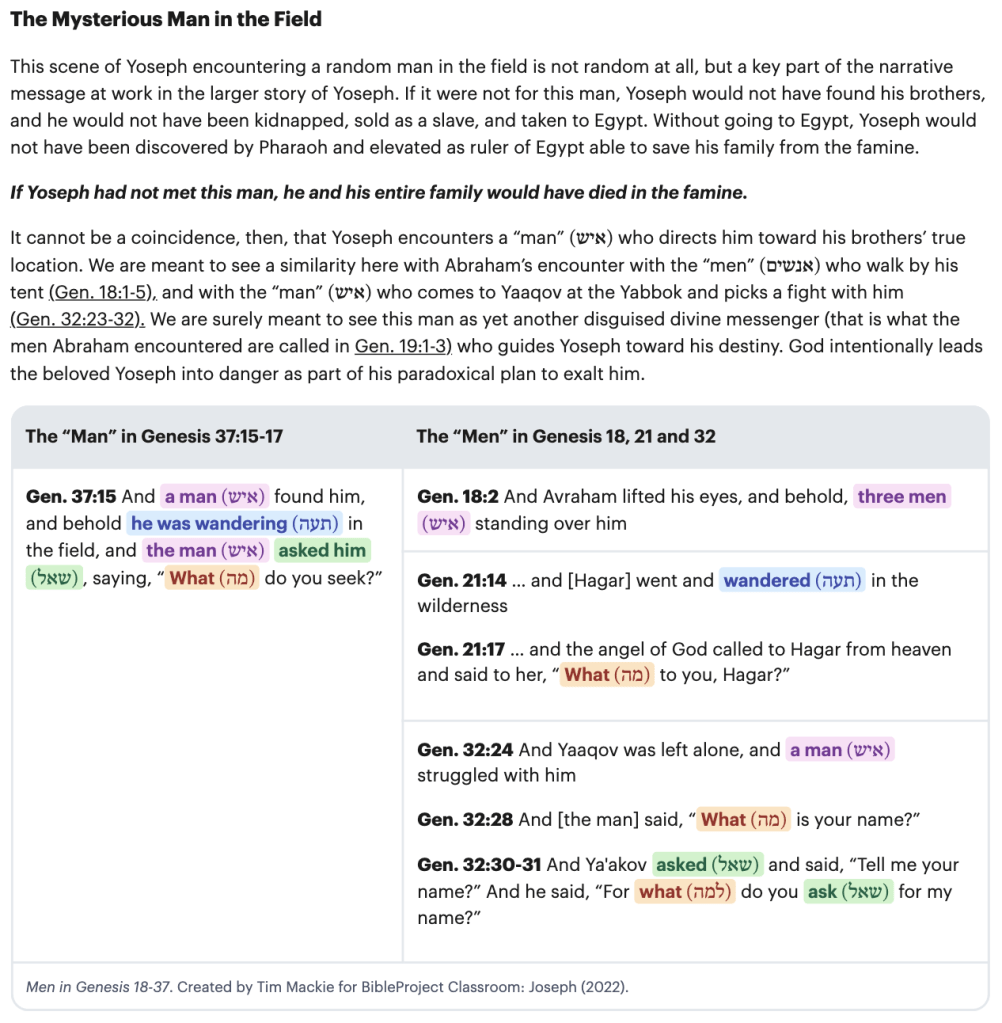
A man found Joseph wandering – the bible project does a whole session on what seems like a quick verse to read https://bibleproject.com/classroom/joseph/sessions/6 (see image below)

Joseph was sold for 20 shekels – a few months wages – also seen in Leviticus 27:5 (ESV): “If the person is from five years old up to twenty years old, your valuation shall be twenty shekels for a male and ten shekels for a female.”

Judah takes a wife from Canaan which his ancestors have been told not to do, and then has a son so wicked God Himself kills him.

On Onan spilling his seed: This passage is sometimes misread as a condemnation of all sexual acts outside procreation (e.g., masturbation or contraception) (In fast masturbation is called onanism!).  Onan’s sin was his intentional refusal to fulfill a sacred duty, but still engage in sexual intercourse. 

Lot’s daughters and Tamar use deception to sleep with their father (in-law). Lot’s daughter has Moab (line of Ruth) and Tamar has twins of whom Perez is the twin who carries the line of Jesus (through Boaz).

I didn’t know what the end of this verse meant “So he left all that he had in Joseph’s charge, and because of him he had no concern about anything but the food he ate.” so I looked it up and its a Hebrew idiom that means Potiphar entrusted everything to Joseph and didn’t concern himself with anything. 

The Hebrew term for Potiphar is סְרִיס פַּרְעֹה (saris Par‘oh) where saris could mean eunuch and some people say this is why is wife was ‘sexually frustrated’ (…or she could just be human).

A big temptation for Joseph who was most likely a virgin, having a high ranking woman asking him daily for sex, and would easily be done in secret (and this happened for months or even YEARS)

Joseph should have been put to death but perhaps Potiphar secretly knew the truth.

Genesis 39 mentions the Lord was with Joseph 5 times (verses 2, 3, 5, 21, 23)

We see deceptive garments in these three chapters – using Joseph’s coat to deceive Jacob, using a veil to hide Tamar, and Potiphar’s wife taking Joseph’s garment.

Questions

Was Joseph humble and truthful in telling on his brothers and bringing to them the dream or was he being a tattle tale and boastful? Seems like some commentaries say that Joseph shouldn’t have said anything about his dream.

Why were brothers pasturing near Shechem after the incident with Dinah? Power move?

I understand there was darkness and a veil but how do men in the Bible keep not recognizing people they have sex with (Jacob/Leah, Judah/Tamar)?

Did Joseph defend himself against Potiphar’s wife or did he stay silent (similar to Jesus being accused)?

Application
“And whatever he did, the Lord made it succeed” Is such a powerful phrase. I wonder if Joseph recognized God’s hand even when he was in the pit, sold into slavery, tempted, and thrown into prison. We get to see the full story unfold in Scripture, but in real time, it must have been hard to trust that God was still in control, although maybe Joseph had unshakable faith. Either way, this verse makes me reflect on my own trials and personal “prisons.” Am I stopping to notice how God is with me in them? Am I trusting that something good is happening or will come from it?
Comments

2 responses to “Genesis 37-39 Joseph and Tamar”

  1. Nathaniel Largo Avatar
    Nathaniel Largo

    Genesis 37

    Not really a shocker that Jacob/Israel is playing favorites with Joseph when he wouldn’t really know any other way having come from the upbringing he received. Interesting though that he came to rebuke him when a dream implied that he (Jacob) may have to bow down to Joseph one day.

    This is my first time reading through the Bible in its entirety, but a lifetime of going to church has obviously given me some insights here and there about what happens in the overarching narrative. I know there are a lot of instances of numbers repeating themselves throughout the Bible, but I was wondering if the 12 sons of Jacob also connected with the 12 tribes that Moses leads out of Egypt? I’m just wondering if there is further significance to be found in the brothers turning on Joseph, and then Reuben and Judah’s push to not kill Joseph as it pertains to the families leading to the tribes. I have heard that Jesus descended from Judah’s family line, so it’s good to see that there is existing mercy within this family!

    Is Genesis 37:34 the first mention of putting on sack cloth? I know this is mentioned again throughout the Bible, but it is mentioned so quickly here, we don’t really see the significance it has with its tie to mourning. Is it to remind one of the pain they are going through, so even clothes can’t be viewed as a comfort?

    Genesis 38

    Genesis 38:7 – “But Er, Judah’s firstborn, was wicked in the Lord ’s sight; so the Lord put him to death.”

    Sometimes I feel like I should just put these passages down and then finish reading the chapter before coming back to them, but this is one where I am writing it out and instantly wondering about it. Why don’t we get details as to what Er did that was wicked in the eyes of God? How was he put to death? Is this the result of Judah marrying among women that Isaac already tried to counsel Jacob against?

    Is Verse 9 the first instance of mentioning the spilling of seed in a manner not intended to create a child as being something that angers God? At least in this sense, we see what Onan did that resulted in his death; still wondering about Er.

    Still struck by the way women were used. Judah saw a woman he suspected to be a prostitute and just said “Hey, sleep with me!”, but then when he hears that Tamar was guilty of prostitution, he called for her to be put to death. So he’s not above using their services, but there can’t be one within his family? Or is it the betrayal that he told her to wait until his other son came of age and she didn’t listen? Curious about this significance tied to which of the babies was born first, and then one of them retreating within the womb and kind of swapping places.

    Genesis 39

    Genesis 39:3-4a – “When his master saw that the Lord was with him and that the Lord gave him success in everything he did, Joseph found favor in his eyes and became his attendant.”

    I know I have wondered this sort of thing a lot in these early reflections, but I am still curious as to how people can see the presence of God in others and not react differently? Are people so set in a polytheistic slant that they see someone that has favor with “a” god, and they just kind of shrug and think “Good for them”? Why isn’t this a bigger deal for Potiphar when he notices that Joseph has favor in the eyes of a god (even if he doesn’t believe it’s the God)? I also know that I have made theories already about people that were born of the union of humans and angels potentially being the source of inspiration behind mythological beings / gods, but it makes me wonder if people would boast that they had the blessings of certain gods over others to the point where it was just common place to see someone people thought to be blessed. And then for the people that see that others are with God and therefore want to be closer to that person, shouldn’t their desire instead to ask the person how they could also become close with God? Just seems like such a bizarre system of belief that all came from the same source, if we trace all life back to the garden.

    I am not sure if I have a well-thought-out point at the end of the chapter, but I find it interesting to see how even in prison, God is with Joseph and puts him in a place of authority over the others in the prison, to the point where the warden put Joseph’s actions out of his mind. I am sure the story will continue to unfold surrounding this, but having everything written out makes me wonder about my own life. How many times have I been spared without knowing I was? We get to see Joseph’s history long after the fact, and we are able to marvel at God’s protection, but what was it like for Joseph in that immediate moment. Did he just have abject faith that everything was going to be okay, or was he worried when he was originally sold as a slave, or put in jail? This is how I’m trying to frame my thinking with my own life. All the things I worry about happening that never do, is that God responding to a prayer of sorts, and I am just too close to see it? Did I have a sour experience with someone in my life that provided distance for a reason; could they have led me down a bad path and they were “removed” for a reason? Just makes me want to practice being more grateful that things have worked out the way they have and the people I have in my life are there for a reason.

    Like

  2. Nathaniel Largo Avatar
    Nathaniel Largo
    1. Humble Joseph

      I wondered the same thing, trying to think if I had that sort of dream if I would ever tell my brothers or my sister. Maybe he was just excited and wanted to share his faith with the others? We know that he was favored by Jacob/Israel over his other brothers, but we don’t know anything else about Joseph beyond that. Maybe he heard his father tell these tales of a present God and he longed to have some sort of proof for himself, and he felt like the dreams were fulfilling that? Again, I don’t think I would have shared these kinds of dreams with my siblings at 17, but I also feel like I can understand why he did.

    2. Shechem adjacent

      That’s how I took it. Maybe that they were holding a claim to a stretch of land to send a message.

    3. Darkness, veils, and male stupidity?

      I don’t have much to say to this in the way of an answer other than I completely agree; it makes no sense how often this seems to happen. I know there are some cultures that do the whole hole-in-a-sheet practice, and that would make a lot more sense to me, but that doesn’t seem to be the case here. Weird.

    4. Joseph’s Defense

      You made a good point in your post before the questions, saying that Joseph likely should have been put to death, but that Potiphar likely knew some version of the truth, and I wonder if this was an element of Joseph’s defense. Maybe he said very little; something along the lines of “You trusted me to take charge of your house for a reason, please use that same trust now when I tell you I would not do this to you.” It’s obviously not for us to know, but I agree that having a better understanding of how he responded would give us more insight into Joseph’s character.

    Like

Leave a comment