
Thoughts
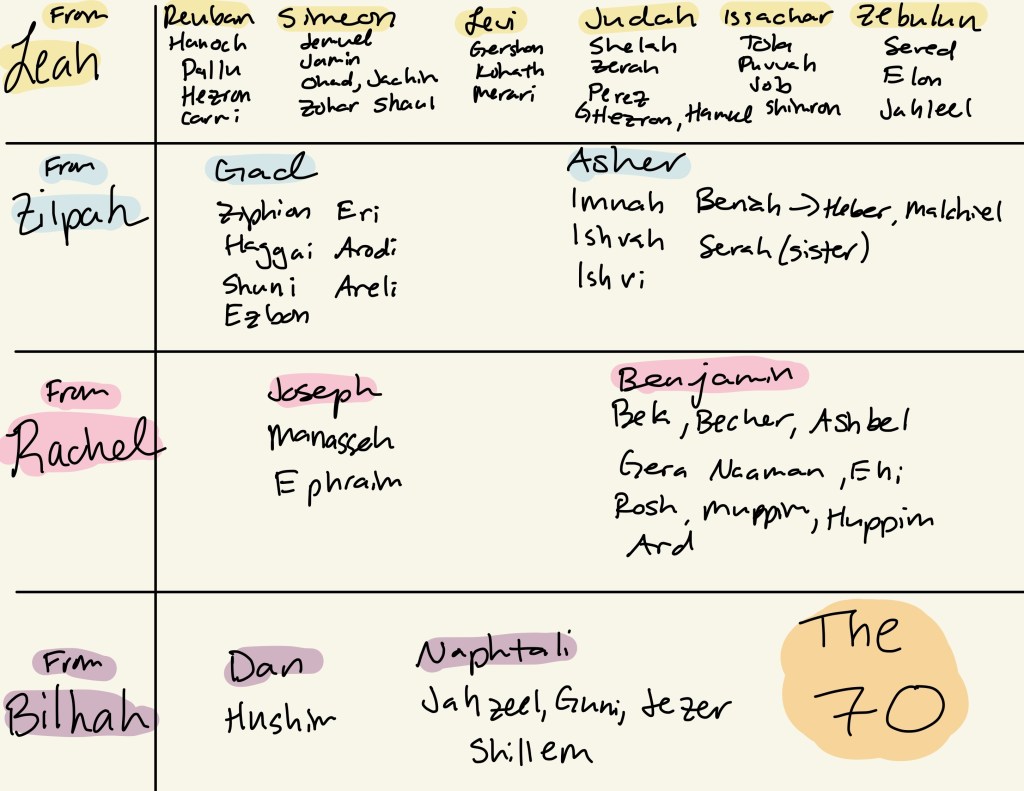
I included visual of Genesis 46 family tree below (70)
Serah (or Serach) bat Asher, the daughter of Asher, is mentioned among the 70 (Genesis 46:17), which is surprising because women are rarely listed in genealogies
In Acts 7:14 Stephen says there are 75 – he is probably including more of Joseph’s sons or grandsons (Septuagint says 75)
Hezron is the current son holding the lineage of Jesus.
Kohath is Moses’ grandfather
From John Sailhamer: “The list of names in these verses appears to have been selected to total ‘seventy’ (46:27). It can hardly go without notice that the number of nations in Genesis 10 is also ‘seventy.’ Just as the ‘seventy nations’ represent all the descendants of Adam, so now the ‘seventy sons’ represent all the descendants of Abraham, Isaac, and Jacob—the children of Israel. Here in narrative form is a demonstration of the theme in Deuteronomy 32:8 that God apportioned the boundaries of the nations (Gen. 10) according to the number of the children of Israel. Thus the writer has gone to great lengths to portray the new nation of Israel as a new humanity and Abraham as a second Adam. The blessing that is to come through Abraham and his seed is a restoration of the original blessing of Adam, a blessing which was lost in the Fall. The picture of God that emerges from these pages is not merely a God who works with his own chosen people for their good alone, but also a God who works with the nations to bring about his plan of salvation and blessing.” (Sailhamer, John H. (1995). The Pentateuch as Narrative: A Biblical-Theological Commentary. Zondervan Academic. 225)
Beersheba plays a significant spiritual role in the lives of Abraham, Isaac, and Jacob. Abraham names the place “Beersheba” after making a treaty with Abimelech and calls on the name of the Lord there (Genesis 21:31–33). Later, Isaac also settles in Beersheba, where God appears to him and reaffirms the covenant made with Abraham(Genesis 26:23–25). Here we see Jacob stopping in Beersheba to offer sacrifices, and God appears to him in a vision(Genesis 46:1–4).
Genesis 46:34 “For every shepherd is an abomination to Egyptians” – Sheep were considered unclean
Interesting that Jacob blessed Pharaoh – who is thought to be a god himself. Seems like Joseph being in the midst of the Egyptians has allowed them to acknowledge God.
Not a Bible thought but learned a new word from chapter 47 – languished!
Jacob was 130 years old when he entered Egypt (Genesis 47:9), and based on the ages of Abraham (75 when he entered Canaan), Isaac (born when Abraham was 100), and Jacob (born when Isaac was 60), we can calculate that the family lived in Canaan for 215 years before moving to Egypt.
The mention of “the land of Rameses” in Genesis 47:11 could be a later editorial update referring to the region that would later be known as the territory of Rameses (or Raamses) and it’s not necessarily referring to Pharaoh Ramses II himself.
Jacob ‘adopting’ Manasseh and Ephraim is why we have 12/13 tribes and Joseph is usually not named (although we do see his name in Revelation 7). 12 is preserved when allotting land because Levi does not get land.
Also remember these two are half Egyptian!
Manasseh (מְנַשֶּׁה) means “God made me forget,” reflecting healing from the past, while Ephraim (אֶפְרָיִם) means “God made me fruitful,” symbolizing blessing in the midst of affliction.
In Genesis 48 Joseph brings his sons Manasseh and Ephraim to Jacob for a blessing, placing Manasseh, the firstborn, at Jacob’s right hand and Ephraim at his left as he is expecting the elder to receive the greater blessing. But Jacob crosses his arms which reflects a recurring theme where the younger is favored over the older: like Abel over Cain, Jacob over Esau, Isaac over Ishmael, Joseph over his older brothers, etc.
Ephraim becomes the dominant tribe in the Northern Kingdom after the nation splits, and “Ephraim” is often used as a symbolic name for all of Israel in books like Hosea and Isaiah. Ephraim also held central territory in the land of Israel, including Shiloh where the Tabernacle was first established.
Joshua will come from the tribe of Ephraim
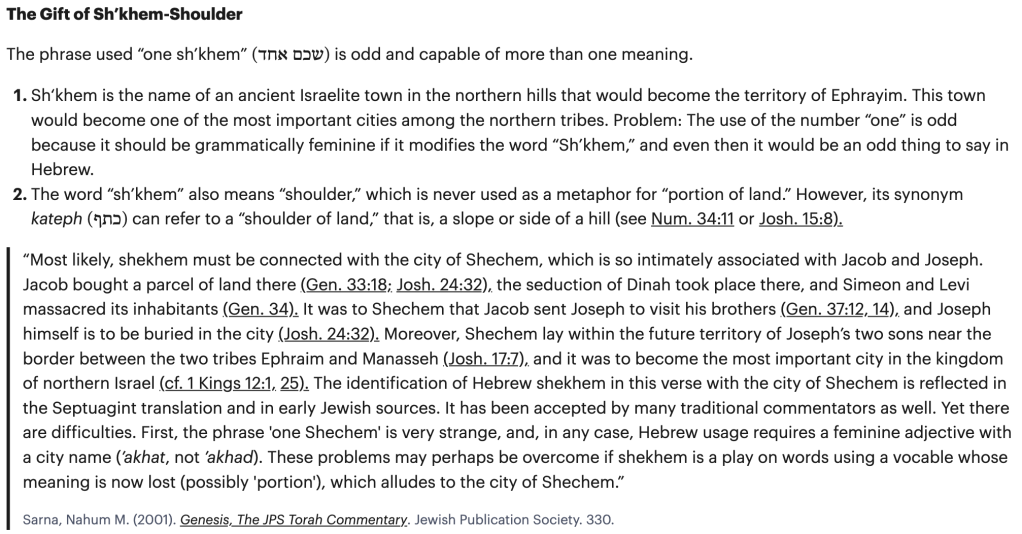
I included the interesting verse Genesis 48:22 word use below from https://bibleproject.com/classroom/joseph/sessions/22 and Sarna, Nahum M. (2001). Genesis, The JPS Torah Commentary Jewish Publication Society. 330.
Questions
Why was Serah included in the 70?
Why is God calling Jacob ‘Jacob’ and not ‘Israel’?
Why is Jacob lamenting over his sad days while he is before someone (Pharaoh!) about to save his family? Was Jacob not blessed?
Did Joseph’s actions (creating a more centralized Egypt) in Genesis 47 set up the stage for the possibility of enslavement of Hebrews (a new Pharaoh rises up who did not know Joseph).
Did God tell Jacob to bless Ephraim over Manasseh?
Application
We see a big shift in what Jacob probably expected for his last years. He was settled in Canaan with his family, and had already come to terms with Joseph’s ‘death’. However, God told him to pack everything up and leave (and also surprise Joseph is ALIVE). However long we have on this earth, God is continually working and I need to remember not to get too comfortable because things can get shaken up at an instant (for both the good and the bad). In another unexpected twist for Joseph, Ephraim was elevated above Manasseh. All these things were part of God’s perfect plan for the imperfection.
 Jo Reads The Bible
Leave a comment