
Thoughts
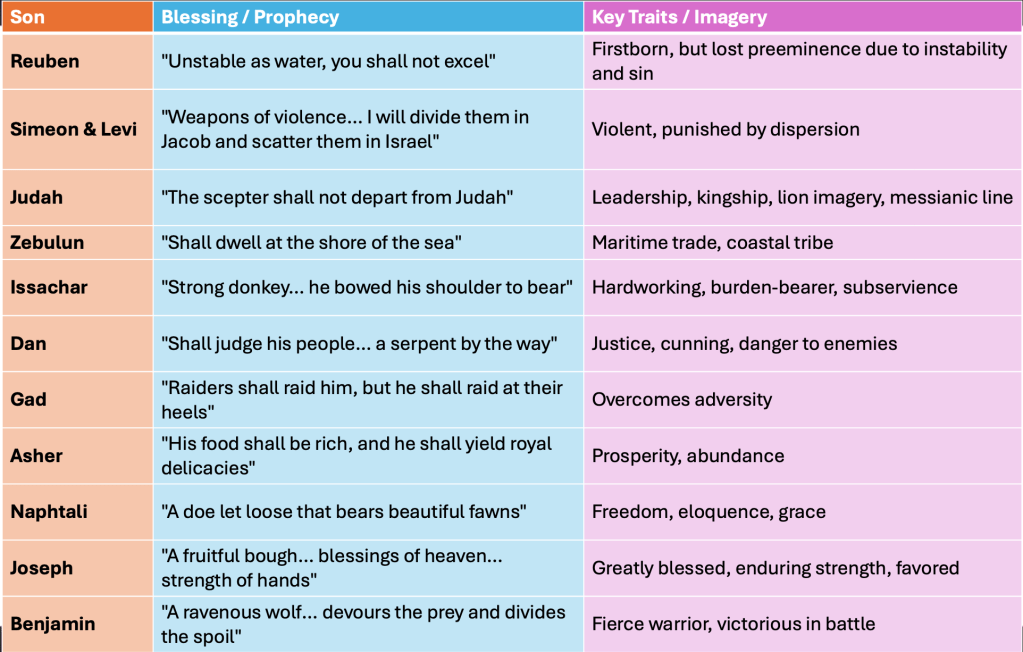
Visual of blessings/prophecies below- I feel like chapter 49 could be a whole study on its own!
This is the first prophecy from a human in the Bible!
Jacob uses both of his names here in verse 1 “Sons of Jacob….Israel is your father”
Once again the eldest (Reuben) is not given the firstborn blessing.
Jacob does not go by birth order but instead by Leah’s, then Bilhah’s and Zilphah’s, then Rachel’s sons last.
Simeon and Levi are scattered but we see a redemptive arc for Levi in Exodus during the golden calf incident where they are blessed by Moses. Simeon however is mentioned in Judges and then barely heard of again.
Genesis 49:10 “The scepter shall not depart from Judah… until Shiloh (שִׁילֹה) comes,” a term understood to mean “the one to whom it belongs” or “the peaceful one,” most likely a reference to the Messiah.
Zebulun was told he would dwell by the sea, but the land given in Joshua is inland (but by the seas). It was also by trade routes leading to the sea.
Dan, the serpent in the way, introduces idolatry in Judges 18 and is omitted from end times Revelation 7 sealed tribes (but mentioned in Ezekiel’s prophecy Ezekiel 48)
Both King Saul and Saul/Paul come from Benjamin (“devours the prey”)
Jacob was embalmed (an Egyptian custom) and mourned for 70 days (similar to royalty mourning in Egypt)m – he was obviously well respected by the people.
There are several steps to Jacob’s burial – Joseph’s personal mourning, the embalming, national mourning of 70 days, a grand funeral procession, more mourning at the threshing floor (7 days), and burial at the Cave of Machpelah.
Joseph asks that his bone be carried back to Canaan. We see this fulfilled in Exodus 13:19.
David Guzik says Egypt served as the womb for Israel to increase in numbers
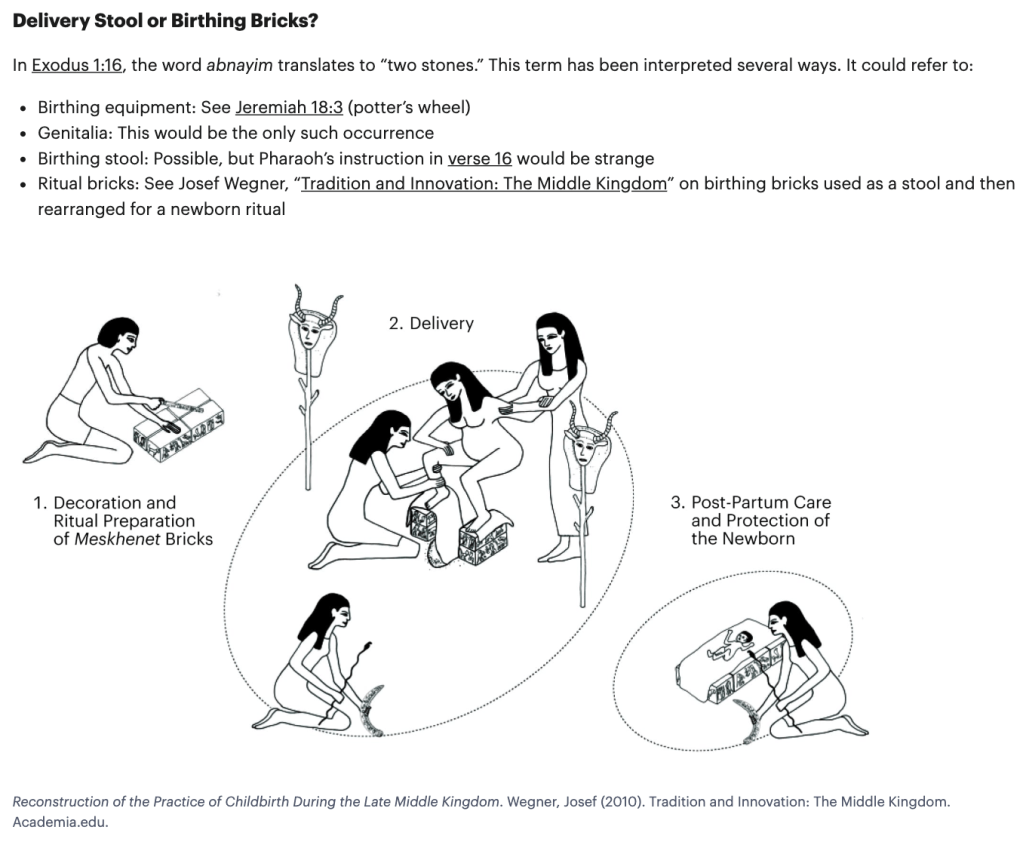
I included a visual on Exodus 1:16 shown in https://bibleproject.com/classroom/exodus-overview-carmen-imes/sessions/3 from Reconstruction of the Practice of Childbirth During the Late Middle Kingdom. Wegner, Josef (2010). Tradition and Innovation: The Middle Kingdom. Academia.edu.
I love how Pharaoh is never named but the midwives, Shipharah and Puah are!
Pharaoh demands to kill all the newborn boys to prevent an army, but it’s the women who end up thwarting him along the way! (I’ll cover more in next post)
Reminder this is a different Pharaoh then the one that starts in Chapter 3 for rest of Exodus.
Questions
Why did Jacob deal so harshly to Simeon and Levi? When he stood by and barely did anything during Dinah’s rape?
Was Jacob the first Hebrew to be embalmed?
The message from ‘Jacob’ to Joseph was made up in Genesis 50 right? Didn’t they see how much Joseph provided for them? Why not just openly confess and apologize on their own account? Were they really sorry or did they do this out of fear?
Couldn’t the Israelites overthrow Egypt by numbers? I know sounds like a dumb question with Egypt having strong military power…but I don’t know. Or why didn’t they join forces? Well I guess then they would lose their slavery.
Application
These chapters begin to set the stage for something massive. The prophecies over the 12 tribes, Israel’s growth in Egypt, and the early signs of Pharaoh’s plan to oppress them all point toward what’s coming: God’s deliverance. But even with God setting everything in motion, it would still be about 470 years before the people entered the Promised Land. That reminds me how easy it is to get discouraged when we only focus on the “now.” God might be working on something far bigger than I can see, moving things piece by piece. I want to stay faithful and trust that His timing is perfect, even when it feels slowwwwwwww.
 Jo Reads The Bible
Leave a comment