
Thoughts
We don’t have to guess how to make our God happy! He tells us upfront His expectations unlike other ‘gods’.
In Hebrew, the Ten Commandments are called Aseret HaDibrot (עֲשֶׂרֶת הַדִּבְּרוֹת), meaning “the Ten Sayings” or “Ten Words,” not “commandments.”
We probably have a different image of the two stone tablets than what they actually looked like. They’re often depicted as large, arched stones with the commandments split between them but in reality, they were likely smaller (biblical Hebrew doesn’t take up much space), and both tablets may have been identical copies of the covenant, as was common in ancient treaty practice.
Do not have any other gods “to my face” is how this verse should be read – so not just keeping God first but removing all other idols.
Do not make images that you will worship – I don’t personally think this means you can’t make artistic images of Jesus, etc unless you intend to use it as worship.
Exodus 20:5 “Visiting the iniquity of the fathers on the children to the third and fourth generations of those who hate Me” Consequences of sins can carry down generations (cycles of abuse, addiction, etc)
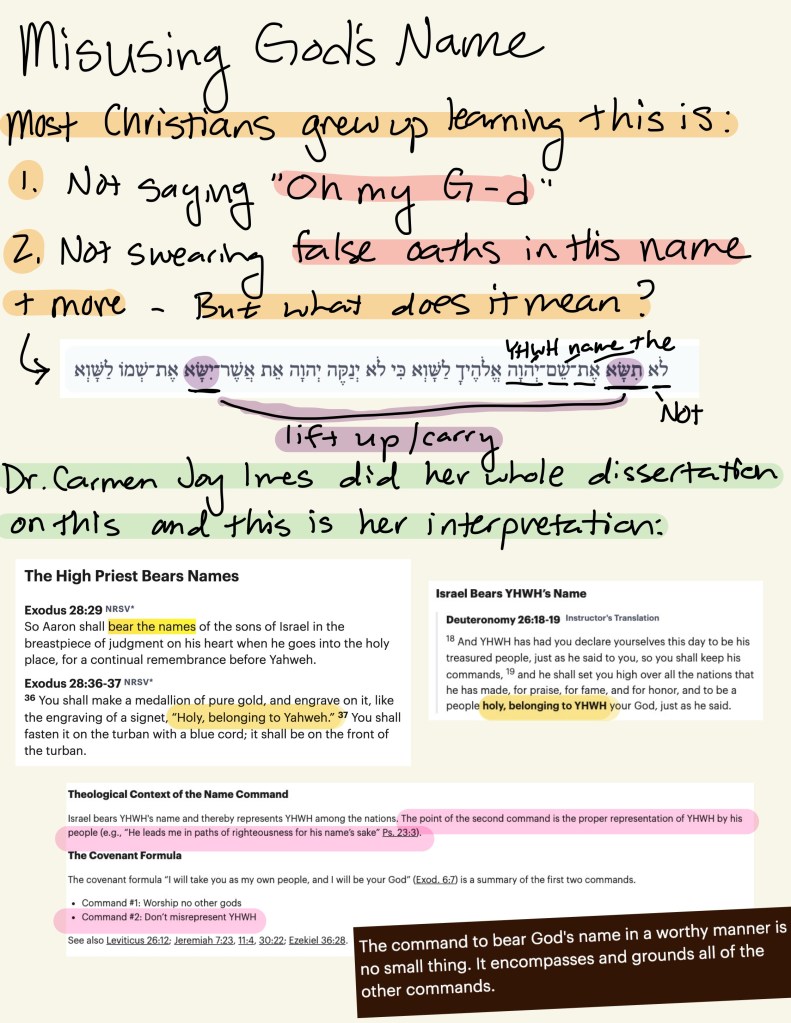
I have an visual below on the 3rd commandment : not taking Lord’s name in vain- many believe this is either saying don’t say “Oh my G-d” or not taking an oath falsely using God’s name. I think it’s bigger than that.
In Catholic and Lutheran traditions, the commandment about not coveting is split into two (coveting your neighbor’s wife vs. neighbor’s goods), while the command about idols is grouped together with “no other gods.” In most Protestant traditions, the command about idols is its own commandment, and the coveting part stays as one….I’m kind of leaning towards the first? I always thought those were one commandment.
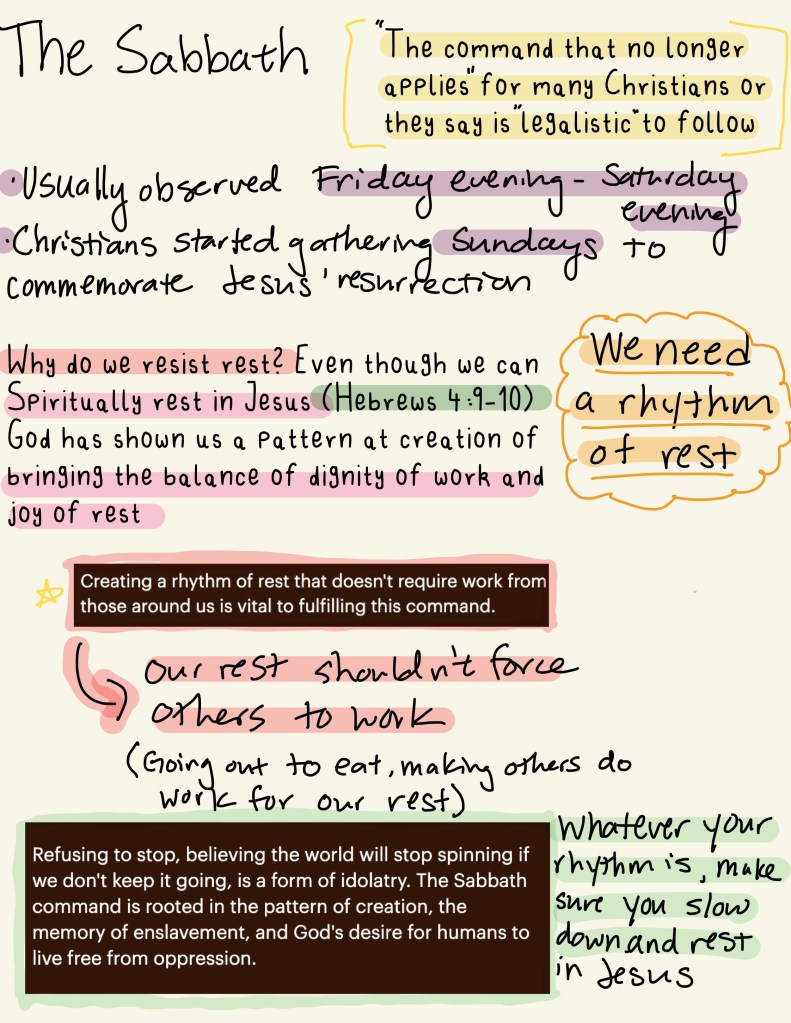
I have a visual on the Sabbath commandment as well – Even with Jesus as our Sabbath fulfillment, I don’t think we should completely disregard it! However, as we are called to rest for 1 day, remember we are called to work for 6.
There are moments in the Bible where God’s presence doesn’t bring comfort but instead it brings fear! We see this here with the Israelites being so terrified by God’s voice and the thunder that they begged Moses to speak to them instead, saying they’d die if God spoke directly. Isaiah, when he saw God in a vision, cried out, “Woe is me!” and Job, after finally hearing from God, repented in dust and ashes. Even Jesus’ disciples fell facedown in fear at the Transfiguration when they heard God’s voice.
Even in worship, God cares about humility and purity as seen here with the altars at the end of Genesis 20
A lot of the slave laws attract negative attention in the Bible. This session does a great job of going into depth on how we can navigate these passages https://bibleproject.com/classroom/exodus-overview-carmen-imes/sessions/20. Some of these laws are meant to prevent exploitation.
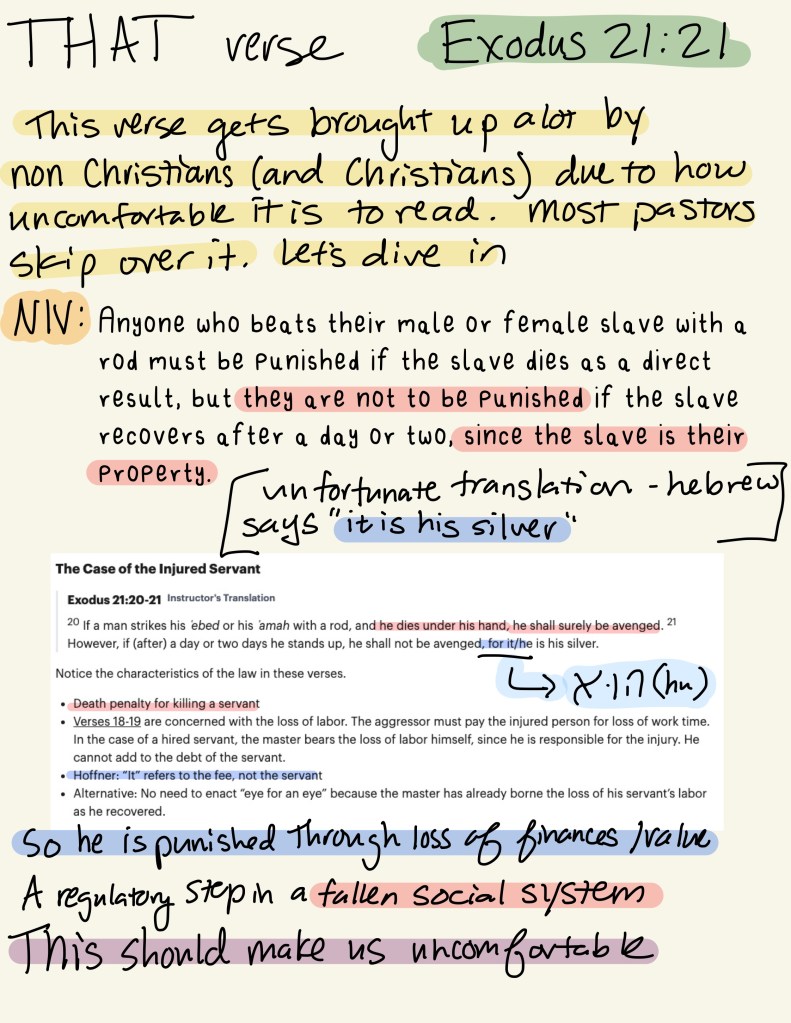
Exodus 21:21 is a verse that makes a lot of Christians anxious and one that pastors usually skip – I included a visual below!
Exodus 21:12–14 distinguishes between reactive aggression (unplanned killing, which allows for mercy through refuge) and proactive aggression (premeditated murder, which results in judgment and death).
Exodus 22 deals with both property damage and social justice, showing that both economic fairness and ethical compassion are important to God. God says He will personally act if widows or orphans are mistreated: “My wrath will burn.”
Although Exodus 22:20 commands death for sacrificing to other gods, it seems that this wasn’t enforced enough?
Exodus 22:28 warns against cursing leaders, which Paul himself honors in Acts 23:5, showing how even New Testament figures upheld the authority of Old Testament civil law.
Questions
What was God intending for the 10 commandments to be? ( 2 or 1 idol command vs 2 or 1 covet command).
Why only eyes and teeth? “When a man strikes the eye of his slave, male or female, and destroys it, he shall let the slave go free because of his eye. 27 If he knocks out the tooth of his slave, male or female, he shall let the slave go free because of his tooth.
What about other animals that gore? “When an ox gores a man or a woman to death….”
This is SO specific…why include it and not other things? “If men fight, and hurt a woman with child, so that she gives birth prematurely…”
Why is it ok to kill a thief at night and not day? Just because you can assess the situation better?
Why mention just sorceresses מְכַשֵּׁפָה – mekhashefah and not sorcerers?
Application
Reading through these laws can feel distant, like they are ancient rules for a different time…what does this have to do with me in 2025? Do I follow the Ten Commandments? Technically, maybe…but even then, not fully. I certainly don’t keep the Sabbath in the way it’s described. But do I practice any kind of rhythm of rest? Then there’s the command to have no other gods. I may not bow to idols, but do I spend more time in front of a screen than in God’s presence? Has my attention, energy, and identity been shaped more by digital media than by truth? Even the civil laws in Exodus 21–22, which seem far removed, show that God cares deeply about justice and protection for the vulnerable….and I hope I live a life showing that as well.
 Jo Reads The Bible
Leave a comment