
Thoughts
Exodus 23
The Sabbath wasn’t just a weekly command but more like a principle of living – here in chapter 23 we see how this can be lived out every 7 years. Israel’s failure to observe the Sabbath years was a key part of the reason and even helped determine the length of the exile (70 years = 70 Sabbath years missed over about 490 years).
Three Festivals mentioned: (More in Leviticus)
- Feast of Unleavened Bread – In spring; remembers the Exodus and leaving Egypt in haste; no leavened bread for 7 days.
- Feast of Harvest (Weeks/Pentecost) – In early summer; celebrates the firstfruits of the harvest; a time of thanksgiving.
- Feast of Ingathering (Tabernacles) – In fall; marks the end of the harvest and God’s provision in the wilderness.
Exodus 23:18 No leftovers showed respect. Sacrifices to God weren’t casual meals; they were sacred, not to be treated like leftovers or common food.
‘You shall not boil a young goat in its mother’s milk.’ has confused people and it is mentioned 3 times in the Torah – to this day kosher law today separates meat and dairy completely – even going so far as having separate kitchens in certain buildings. Some say it was a pagan magical spell.
Here we have another occurrence with the Angel of the Lord.
“Listen for blood”. This is how Dr. Carmen Imes deals with this hard passage in Exodus 23 – which at first reads very much as genocide. But when we slow down and re-read the chapter and “listen for blood” – we don’t see any. We see that they are asked to demolish their ‘gods’.
Here is what who does what in Exodus 23 (from https://bibleproject.com/classroom/exodus-overview-carmen-imes/sessions/21):
What does YHWH’s messenger provide for the Israelites?
- Protection on their journey (Exod. 23:20)
- Guidance to the promised land (v. 20, 23)
- Ongoing instruction (v. 22)
- Leadership in battle (v. 23)
What will YHWH do for the people?
- Oppose Israel’s enemies (v. 22)
- Wipe out Israel’s enemies (v. 23)
- Throw nations into confusion (v. 27)
- Drive out the nations (v. 28-30)
- Establish Israel’s borders (v. 31)
- Give the people into Israel’s hands (v. 31)
What are the Israelites supposed to do?
- Do not let them live in the land (v. 33)
- Do not bow down to or worship their gods (v. 24)
- Demolish the gods and their sacred stones (v. 24)
- Worship YHWH (v. 25)
- Drive out the people from before you (v. 31)
- Make no covenant with them or their gods (v. 32)
Exodus 24
👀👀👀👀👀👀 “All the words that the Lord has spoken we will do.”
The Book of the Covenant refers to the section of laws found in Exodus 20:22–23:33.
How awesome that they got to share a meal with GOD!!!! Or maybe it was a very frightening experience.
Sapphire or lapis lazuli in the Bible symbolizes God’s glory and heavenly presence. Here in Exodus 24:10, it appears beneath God’s feet. Ezekiel 1:26 and 10:1 describe His throne as sapphire-like. Isaiah 54:11 details Jerusalem’s foundations of sapphire, and Revelation 21:19 includes it in the foundations of the New Jerusalem.
Exodus 25
Here we have the first use of the word ‘tabernacle’ or mishkan (מִשְׁכָּן)
It seems that God actually showed Moses instead of just telling Moses what the Tabernacle should look like “According to all that I show you, that is, the pattern of the tabernacle and the pattern of all its furnishings:”
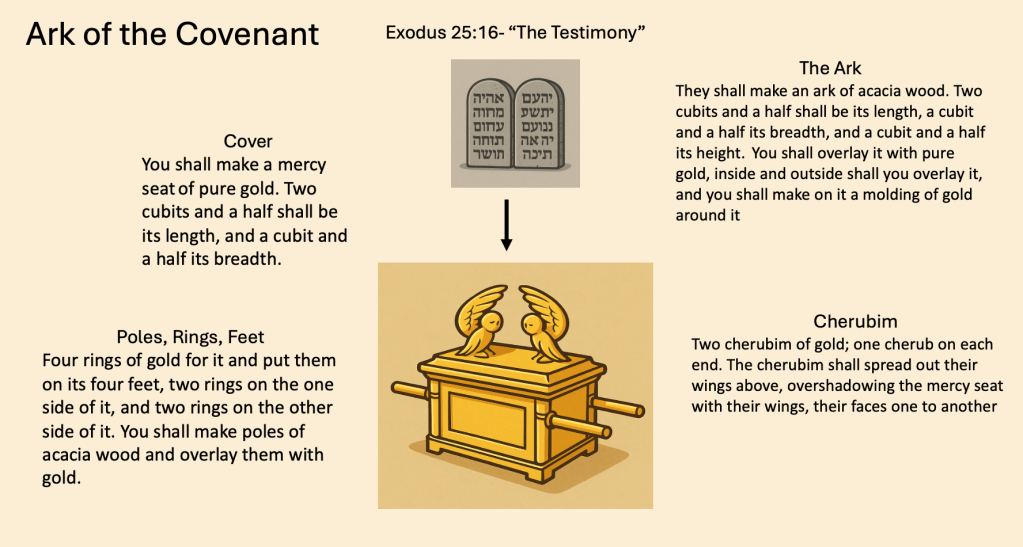
I made a visual below of the Ark of the Covenant and some of the verses that go with it.
“Mercy Seat” and “Atonement Cover” are two different English translations of the same Hebrew word: כַּפֹּרֶת (kappōret)
Showbread is the English translation of the Hebrew “לֶחֶם הַפָּנִים” (lechem ha-panim), which literally means: “Bread of the Presence” or “Bread of the Face”
Almond blossoms in the Bible symbolize new life and renewal. They appear on the lampstand in the Tabernacle seen here, and they bud on Aaron’s rod. In Jeremiah, the prophet sees a shaqed, an almond branch, and God uses a wordplay with shoqed, saying He is watching over His word to make sure it comes true.
The seven lamps in Exodus were part of the menorah in the Tabernacle, symbolizing God’s presence and light among His people. In Revelation, we see the seven lampstands represent the seven churches, showing that God’s light now shines through the church.
Questions
What does ‘You shall not boil a young goat in its mother’s milk’ really mean?
Why can’t they try to convert the Caananites? (Dr. Imes says ‘It’s not a go and tell, but a come and see)
There are 13 tribes but 12 stone pillars are put up – is Levi excluded or are we counting Joseph as one or is it symbolic?
DID THEY ACTUALLY SEE GOD?? or like a manifestation ??
Why did God say “make no likeness of anything in heaven above” (Exodus 20:4) but then later command that cherubim (heavenly beings) be placed on the ark cover (Exodus 25:18)?
Application
Reading these chapters, I see that God genuinely wants us to live well. He builds in patterns of rest, like the Sabbath, not as a burden but as a gift to refresh us. He also desires to be close to His people.Here we see the Israelites had to build a tabernacle and follow very specific steps just to be near His presence. But now, because of Jesus, we don’t need a tent or a priest or a ritual.. we can come to God directly, anytime.
 Jo Reads The Bible
Leave a comment