
Thoughts
Leviticus 22
The Lord reminds the priests of the sacred nature of His Holy Name. There are rules about approaching the holy things of the Lord. If they are unclean they must remember to observe the rituals of becoming clean.
If priests become unclean, it doesn’t remove them of being a priest. They can still become clean. However, if they disobey or treat things carelessly, they could die as a result.
Only priests and members of their household may eat offerings; hired workers may not, but servants bought with money and born in the house may.
Acceptable Sacrifices
- Only freewill or vow offerings from Israelites and foreigners are accepted but must be without defect.
- Prohibited defects in animals ( blind, injured, maimed).
- Rules for young animals: no sacrifice before 8 days old; don’t kill mother and offspring on the same day.
- Peace offerings must be eaten the same day.
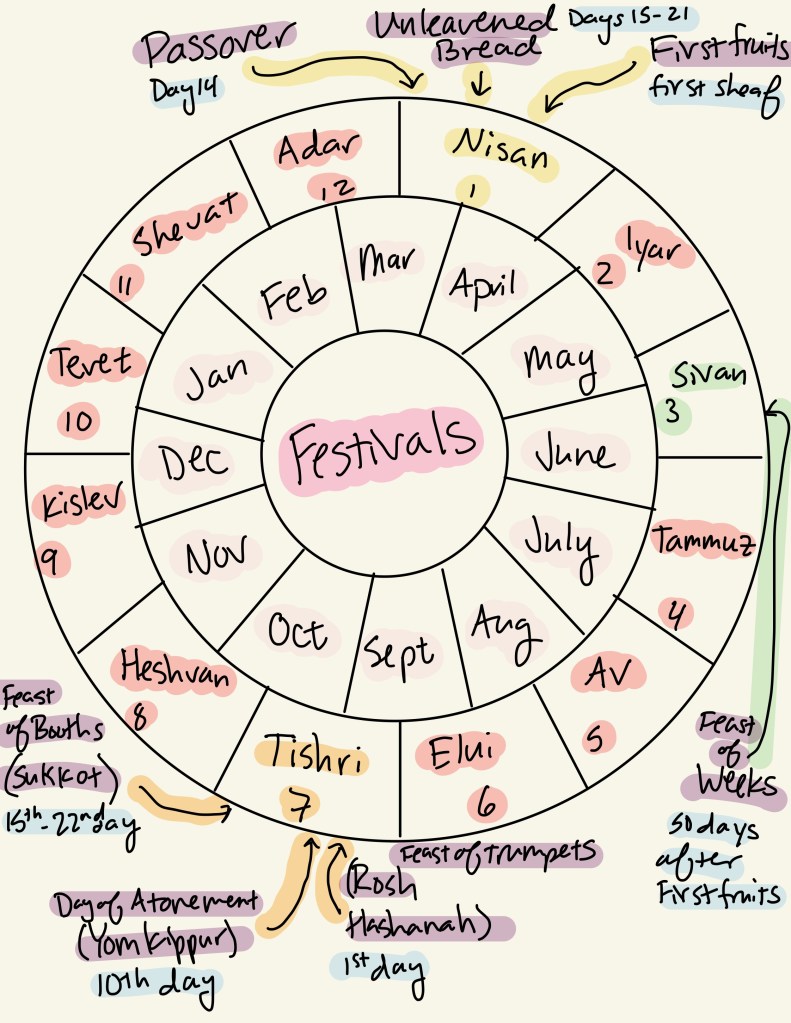
Leviticus 23 Feasts
appointed feasts- mo’edim מוֹעֲדִים – appointments
Sabbath
- Every seventh day is a Sabbath of rest and a holy gathering.
- No work is to be done; it belongs to the LORD.
Annual Festivals
Passover: 14th day of the 1st month at twilight.
Feast of Unleavened Bread: 7 days, starting on the 15th day.
- No leavened bread
- Sacred assembly on day 1 and 7.
Firstfruits: first sheaf of the harvest.
- Priest waves it before the LORD.
- No bread/grain eaten until offering is made.
Feast of Weeks / Pentecost : Count 50 days from Firstfruits.
- Offer new grain (two loaves) and other sacrifices.
- Emphasis on generosity to the poor and foreigner
Feast of Trumpets (Rosh Hashanah): 1st day of the 7th month.
- Day of rest and trumpet blasts.
- Sacred assembly and offering.
Day of Atonement (Yom Kippur): 10th day of the 7th month.
- A day of complete rest and self-denial.
- No work; atonement is made for the people.
Feast of Booths (Sukkot): 15th to 22nd day of the 7th month.
- 7 days of offerings + 8th-day sacred assembly.
- Live in booths to remember Israel’s time in the wilderness.
- Rejoice before the LORD with palm branches, etc.
Leviticus 24
Care of the Lampstand
- The people must bring pure olive oil for the lamp.
- Aaron is to keep the lamp burning continually.
The Showbread
- Twelve loaves of bread are to be arranged in two rows on the table.
- Replaced every Sabbath as a perpetual covenant.
- Only Aaron and his sons may eat it in a holy place.
The Incident of Blasphemy
- A man (son of an Israelite woman and Egyptian father) blasphemes the Name.
- He is brought to Moses and placed in custody awaiting God’s judgment.
- God says the man must be stoned by the community.
- Anyone who blasphemes the Name of the Lord shall bear guilt and be put to death.
Questions
How would someone eat a holy thing unintentionally? I assume it would be set aside so no one could access it…maybe if they had friends over.
Why aren’t the chapters set up by topic (offerings, priest rules, etc) – seems hard to read
There are quotes around God’s words (specifically end of Leviticus 24) so I am assuming this is word for word…is there a study done on they way God talks (lyrically)..like chiasmus..es. But so do authors? But the authors are writing the words of God…
Application
These chapters show the importance of holiness in every part of life. We see the importance of sabbath and rest as well as celebration and remembrance. He gives us days to forever remember all that He has done for us. We also see the repercussions from Leviticus 24 when we do not hold dear to the sacred name of God. We must honor God whether we are resting, working, or celebrating.
 Jo Reads The Bible
Leave a comment