
Ayin (ע)
I have done what is just and right; do not leave me to my oppressors!
Give your servant a pledge of good; let not the insolent oppress me.
My eyes long for your salvation and for the fulfillment of your righteous promise.
- ethical confidence: “I have done what is just and right.”
- “Pledge of good” reflects legal language
Deal with your servant according to your steadfast love, and teach me your statutes.
I am your servant; give me understanding, that I may know your testimonies.
- Knowledge of God’s testimonies is framed as a gift, not an achievement.
- Servanthood (“I am your servant”) is repeated to show dependence not a demand.
It is time for the Lord to act, for your law has been broken.
- a call for divine intervention.
- Reminding God His Instruction has not been upheld
Therefore I love your commandments above gold, above fine gold.
Therefore I consider all your precepts to be right; I hate every false way.
- Love for God’s commands contrast to lawlessness around him.
- Torah is valued above wealth
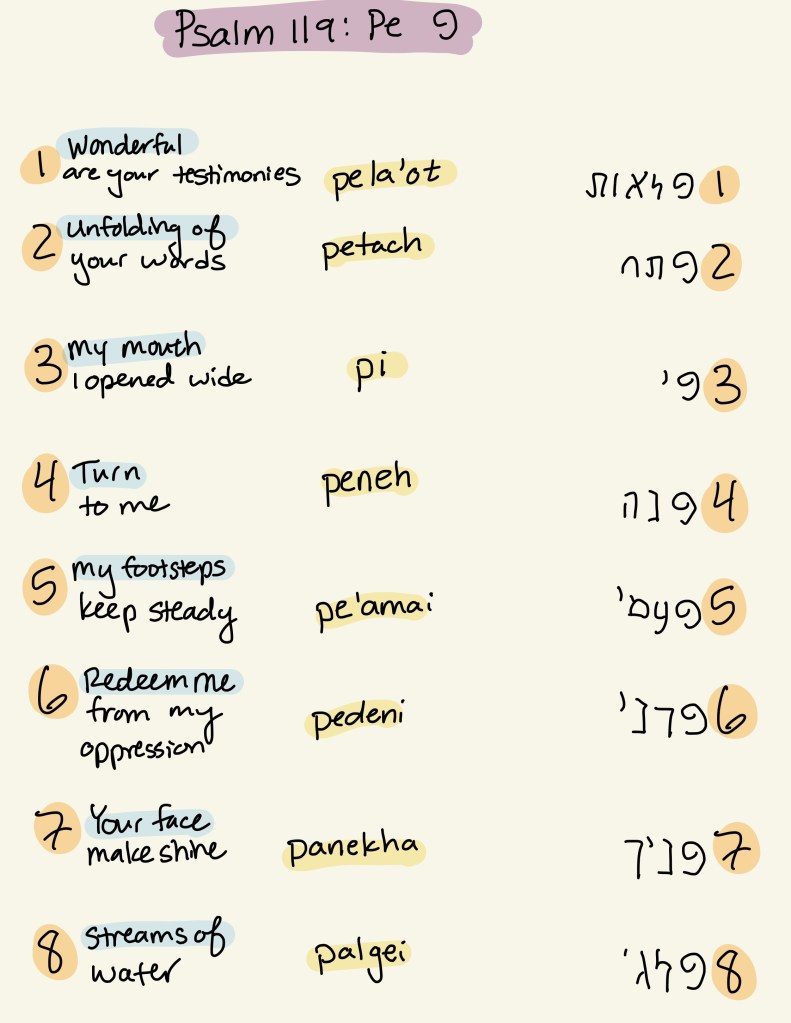
Pe (פ)
Your testimonies are wonderful;
therefore my soul keeps them.
The unfolding of your words gives light;
it imparts understanding to the simple.
- God’s testimonies inspire awe
- Obedience flows from delight
- Light is paired with understanding
I open my mouth and pant,
because I long for your commandments.
- Desire for God’s word is portrayed as physical need, like thirst
- Longing instead of duty
Turn to me and be gracious to me,
as is your way with those who love your name.
Keep steady my steps according to your promise,
and let no iniquity get dominion over me.
- Grace is God’s established way with his people.
- Stability is requested through God’s word.
- Sin is pictured as a potential ruler
Redeem me from man’s oppression,
that I may keep your precepts.
Make your face shine upon your servant,
and teach me your statutes.
- Deliverance is sought
- Echoes the priestly blessing
My eyes shed streams of tears,
because people do not keep your law.
- Love for God’s law produces sadness when ignored
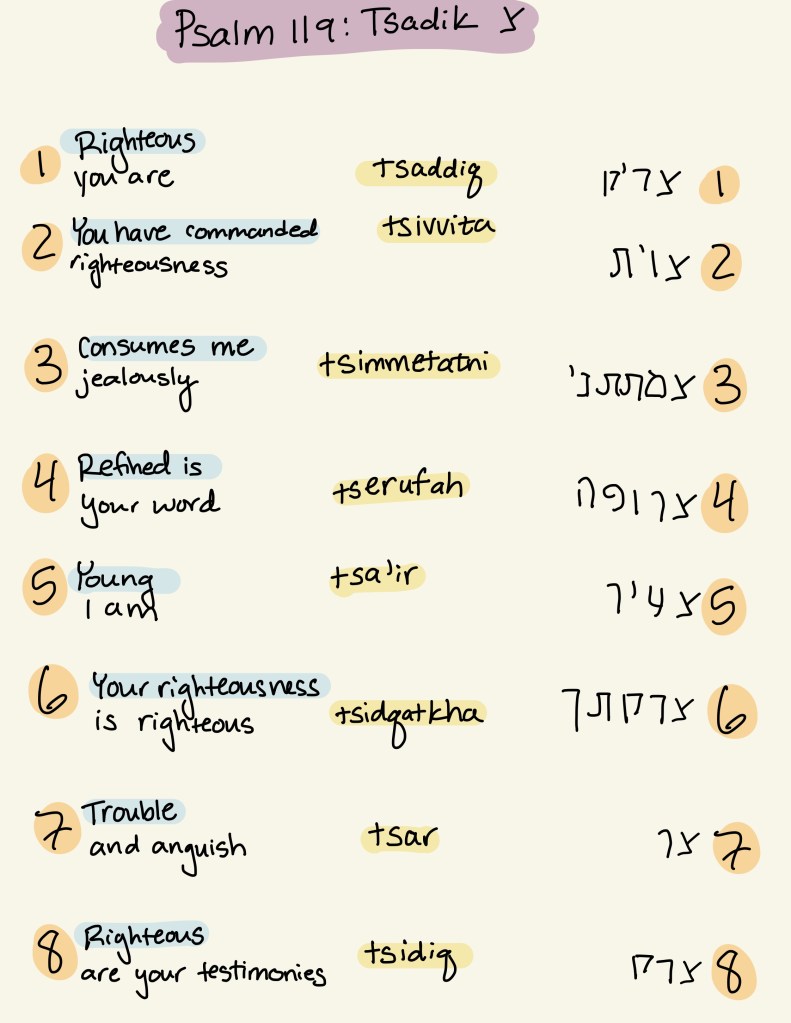
Tsade (צ)
Righteous are you, O Lord,
and right are your rules.
You have appointed your testimonies in righteousness
and in all faithfulness.
- God’s rules are right because God is right
My zeal consumes me,
because my foes forget your words.
- Zeal here is grief mixed with devotion
Your promise is well tried,
and your servant loves it.
- “Tried” here is צְרוּפָה (tserufah) “refined, smelted, purified” . God’s word has been tested and refined, like purified metal.
I am small and despised,
yet I do not forget your precepts.
- Social status and faithfulness are contrasted.
- Obedience is not dependent on honor/power
Your righteousness is righteous forever,
and your law is true.
- Righteousness is eternal, not situational.
Trouble and anguish have found me out,
but your commandments are my delight.
Your testimonies are righteous forever;
give me understanding that I may live.
- Delight does not mean absence of pain and trouble but it can help sustain.
- Understanding is linked directly tolife, not just knowledge.
Application
Ayin teaches us that obedience can coexist with unresolved injustice. Sometimes we have to wait in the sin around us, trusting that God is good. Pe shows us that desire for God’s word becomes physical. We long and pant for the Word, so much so that when others do not it can hurt us. Lastly, Tsade shows us to trust God’s Righteousness when life is not fair. God’s righteousness is constant and steady just like His promises. Anchor yourself in what does not change when the world seems chaotic.

 Jo Reads The Bible
Leave a comment