
The Sacrifice of Isaac
- God uses a test here to reveal Abraham’s faith. God has used tests before including
- Adam and Eve and the tree of the knowledge of good and evil (Genesis 2-3)
- Israel at Marah: After God made the bitter waters sweet, “there the LORD… tested them.” (Exodus 15:25)
- God provided daily manna “that I may test them, whether they will walk in my law or not.“ (Exodus 16:4 )
- God led Israel for forty years “to humble you, testing you to know what was in your heart.” (Deuteronomy 8:2)
- Hezekiah: God temporarily withdrew His special help “to test him and to know all that was in his heart.” (2 Chronicles 32:31)
After these things God tested Abraham and said to him, “Abraham!” And he said, “Here I am.” 2 He said, “Take your son, your only son Isaac, whom you love, and go to the land of Moriah, and offer him there as a burnt offering on one of the mountains of which I shall tell you.”
Mount Moriah מריה = “Mount Vision”) links back to the “oak of Moreh” (מורה) from Genesis 12:6, creating an inclusion around all of Genesis 12-22. Also, Mount Moriah has clear hyperlinks forward to the temple mount where David will later establish the site for the temple.
- I always wondered what happened between verses 2 and 3 – what did Abraham say? What did he think? He just lost Ishmael, was he devastated?
- Why does he say “your only son Isaac” when there is Ishmael? Why didn’t He say “your only son belonging to the covenant?”
- Interesting that God does not say to “kill” or “sacrifice” Isaac, but to “offer him”
3 So Abraham rose early in the morning, saddled his donkey, and took two of his young men with him, and his son Isaac. And he cut the wood for the burnt offering and arose and went to the place of which God had told him. 4 On the third day Abraham lifted up his eyes and saw the place from afar.
- Three days of traveling knowing he would sacrifice his son
5 Then Abraham said to his young men, “Stay here with the donkey; I and the boy will go over there and worship and come again to you.”
- First time we see “worship” in the Bible. Worship in Hebrew is שָׁחָה shachah, which means to bow down.
- Abraham says he and Isaac will return.
6 And Abraham took the wood of the burnt offering and laid it on Isaac his son. And he took in his hand the fire and the knife. So they went both of them together.
- We do not know for sure Isaac’s age here. Most pictures depict him as a young boy. Jewish tradition puts him at 37 (as Sarah dies in the next chapter at 127 years old). Verse 6 says Isaac was able to carry the wood, so he had some strength.
7 And Isaac said to his father Abraham, “My father!” And he said, “Here I am, my son.” He said, “Behold, the fire and the wood, but where is the lamb for a burnt offering?” 8 Abraham said, “God will provide for himself the lamb for a burnt offering, my son.” So they went both of them together.
- God already told Abraham that Isaac would carry his line (Genesis 21:12) so I wonder if Abraham had full faith the lamb would be provided.
- Hebrews 11:17-19 said that Abraham conclud[ed] that God was able to raise him up, even from the dead, from which he also received him in a figurative sense.
9 When they came to the place of which God had told him, Abraham built the altar there and laid the wood in order and bound Isaac his son and laid him on the altar, on top of the wood.
- Did Isaac lay willingly? I assume with Abraham’s age he would have been able to overtake him if he wanted.
10 Then Abraham reached out his hand and took the knife to slaughter his son. 11 But the angel of the Lord called to him from heaven and said, “Abraham, Abraham!” And he said, “Here I am.” 12 He said, “Do not lay your hand on the boy or do anything to him, for now I know that you fear God, seeing you have not withheld your son, your only son, from me.”
- If the angel of the Lord was only speaking from heaven and not physically appearing, why not just say YHWH spoke instead of using the “angel of YHWH” title. The Hebrew word used is מַלְאָךְ (mal’akh) which means “messenger” — so was it the role?
- especially that He is talking about His son
13 And Abraham lifted up his eyes and looked, and behold, behind him was a ram, caught in a thicket by his horns. And Abraham went and took the ram and offered it up as a burnt offering instead of his son. 14 So Abraham called the name of that place, “The Lord will provide”; as it is said to this day, “On the mount of the Lord it shall be provided.”
- So Abraham called the name of that place, “The Lord will provide” or Jehovah Jireh (יְהוָה יִרְאֶה YHWH Yi’reh)
- “Jehovah Jireh” is actually not the original Hebrew pronunciation. Jehovah comes from inserting the consonants of YHWH and the vowels of Adonai = YeHoWaH or Jehovah.
This phrase “mount of Yahweh” (הר יהוה) in is used once for Mount Sinai (Num. 10:33) but elsewhere in the Hebrew Bible always refers to Mount Zion, the temple mount in Jerusalem (see Isa. 2:3, 30:29; Mic. 4:2; Zech. 8:3; Ps. 24:3).
15 And the angel of the Lord called to Abraham a second time from heaven 16 and said, “By myself I have sworn, declares the Lord, because you have done this and have not withheld your son, your only son, 17 I will surely bless you, and I will surely multiply your offspring as the stars of heaven and as the sand that is on the seashore. And your offspring shall possess the gate of his enemies, 18 and in your offspring shall all the nations of the earth be blessed, because you have obeyed my voice.”
- God had already established the covenant with Abraham that he would have many children (Genesis 12,13, 15,17,21) Why does He say “…because you have done this…”
- Does it confirm the faith he already had?
19 So Abraham returned to his young men, and they arose and went together to Beersheba. And Abraham lived at Beersheba.
- As someone with a clinical background, I always wondered about the trauma Isaac probably went through after this….I wonder if this influenced his roles later on.
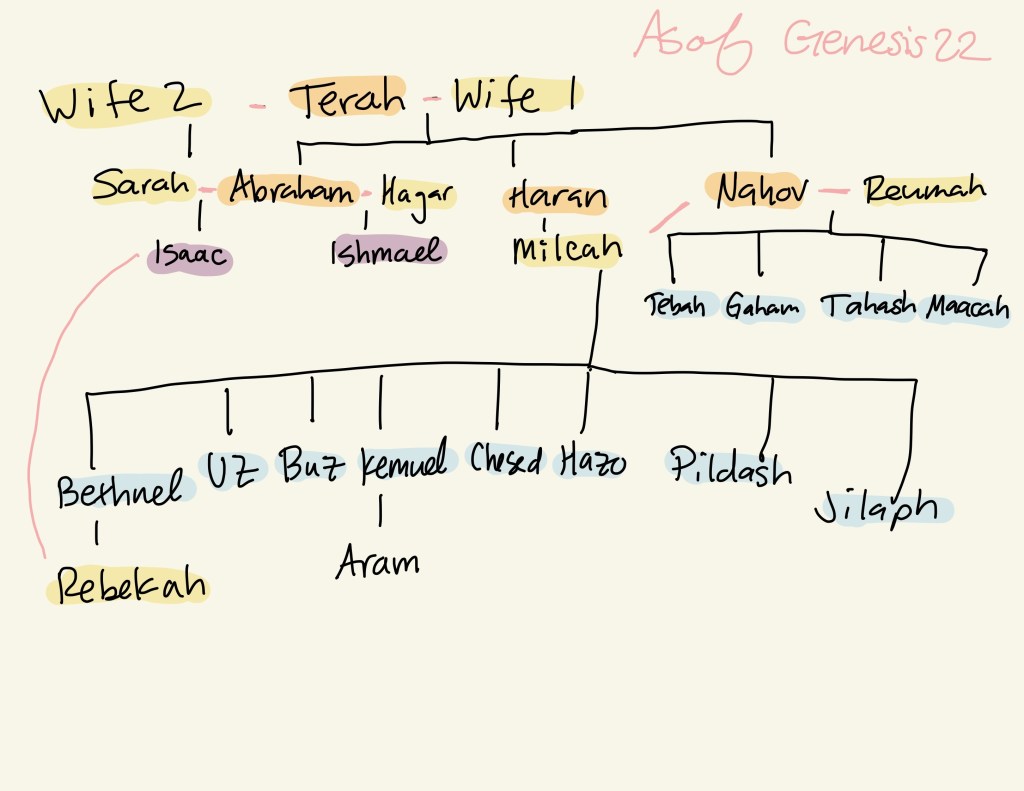
20 Now after these things it was told to Abraham, “Behold, Milcah also has borne children to your brother Nahor: 21 Uz his firstborn, Buz his brother, Kemuel the father of Aram, 22 Chesed, Hazo, Pildash, Jidlaph, and Bethuel.” 23 (Bethuel fathered Rebekah.) These eight Milcah bore to Nahor, Abraham’s brother. 24 Moreover, his concubine, whose name was Reumah, bore Tebah, Gaham, Tahash, and Maacah.
- This genealogy prepares us by introducing Rebekah, who will become Isaac’s wife in Genesis 24.


Leave a Reply