
Israel Increases Greatly in Egypt
1 These are the names of the sons of Israel who came to Egypt with Jacob, each with his household:
- The Hebrew title of Exodus is: וְאֵלֶּה שְׁמוֹת (Ve’elleh Shemot)
- וְאֵלֶּה (ve’elleh) “And these are”
- The “and” connects Genesis to Exodus
- שְׁמוֹת (shemot) “the names”
- וְאֵלֶּה (ve’elleh) “And these are”
- The English title comes through the Greek Septuagint. Eξοδος (Exodus) “departure” or “exit.”
2 Reuben, Simeon, Levi, and Judah, 3 Issachar, Zebulun, and Benjamin, 4 Dan and Naphtali, Gad and Asher. 5 All the descendants of Jacob were seventy persons; Joseph was already in Egypt.
- Exodus begins by repeating the names from Genesis to remind readers that this is not a new story. God is continuing His covenant promises to Abraham, Isaac, and Jacob.
6 Then Joseph died, and all his brothers and all that generation.
- About 400 years have passed between the end of Genesis and the beginning of Exodus (because of Exodus 12:40-41)
7 But the people of Israel were fruitful and increased greatly; they multiplied and grew exceedingly strong, so that the land was filled with them.
- The Hebrew here in vs.7 seems deliberate.
- In Genesis 1:21-22 God tells sea creatures”Be fruitful (פָּרָה parah), multiply (רָבָה rabah), and fill the waters, and let the waters swarm (שָׁרַץ sharats).”
- Similar also to God blessing humans in vs 28
- The Hebrew in verse 7 uses the same 3 Hebrew roots as well
- A fourth verb is this added עָצַם (atsam) become mighty, strong.
Pharaoh Oppresses Israel
8 Now there arose a new king over Egypt, who did not know Joseph. 9 And he said to his people, “Behold, the people of Israel are too many and too mighty for us. 10 Come, let us deal shrewdly with them, lest they multiply, and, if war breaks out, they join our enemies and fight against us and escape from the land.”
- This is a different Pharaoh then the one that starts in Chapter 3 for rest of Exodus.
- At this point the Israelites are still living in Goshen (see map)
- “Come, let us…” similar language to Babel (Genesis 11:7)
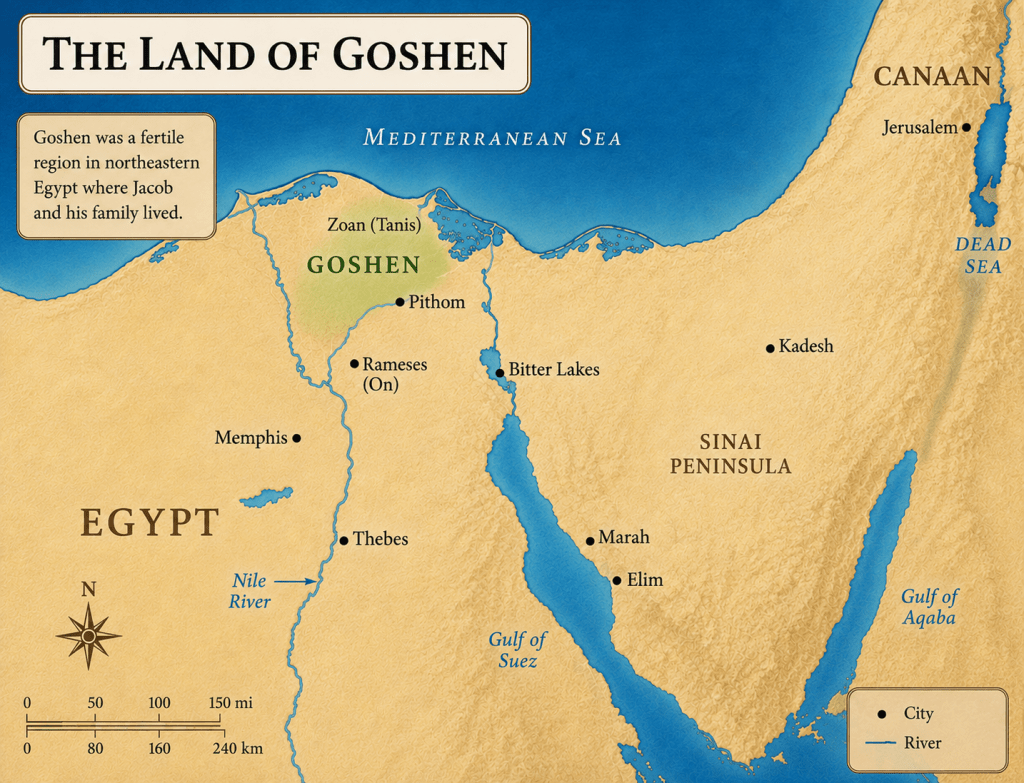
11 Therefore they set taskmasters over them to afflict them with heavy burdens. They built for Pharaoh store cities, Pithom and Raamses. 12 But the more they were oppressed, the more they multiplied and the more they spread abroad. And the Egyptians were in dread of the people of Israel.
- The harder Pharaoh presses, the faster Israel grows. You can’t stop God’s blessing!
13 So they ruthlessly made the people of Israel work as slaves 14 and made their lives bitter with hard service, in mortar and brick, and in all kinds of work in the field. In all their work they ruthlessly made them work as slaves.
- Couldn’t the Israelites overthrow Egypt by numbers? Maybe not with Egypt having strong military power…
- Notice the repetition in these verses of Israel multiplying in numbers, but Egypt responding with ruthless work.
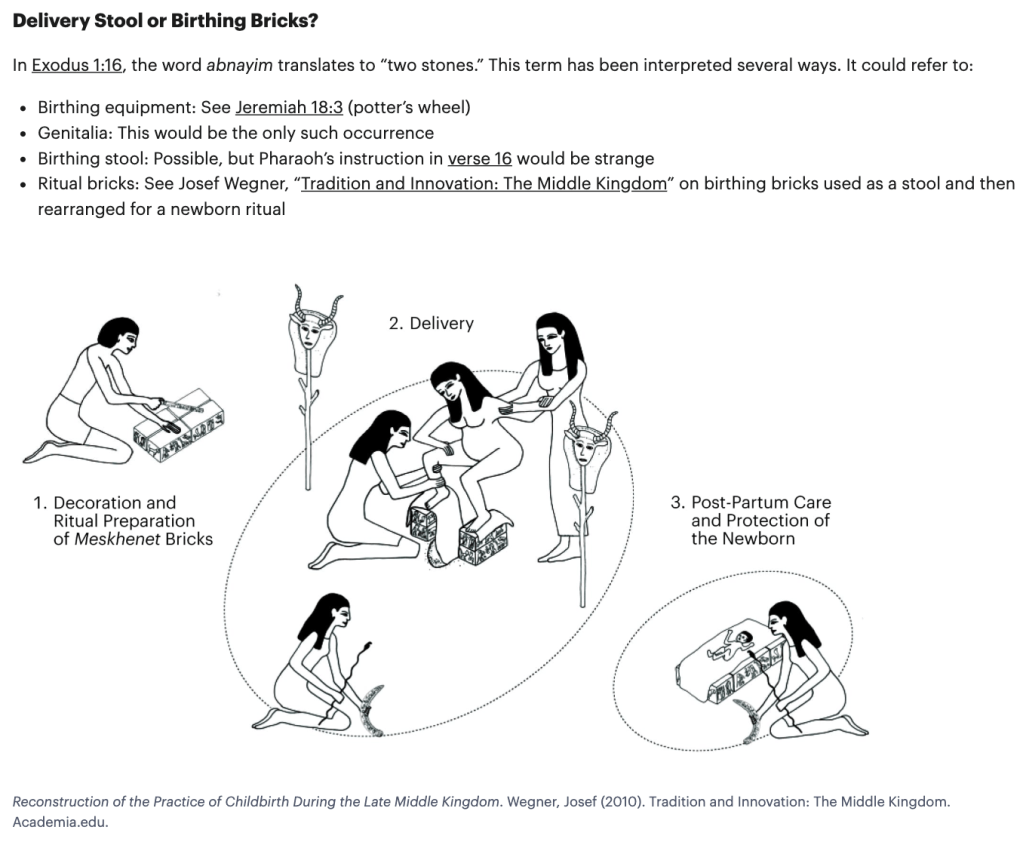
15 Then the king of Egypt said to the Hebrew midwives, one of whom was named Shiphrah and the other Puah, 16 “When you serve as midwife to the Hebrew women and see them on the birthstool, if it is a son, you shall kill him, but if it is a daughter, she shall live.”
- I love how Pharaoh is never named but the midwives, Shipharah and Puah are!
- See visual below on ‘birthstool’
17 But the midwives feared God and did not do as the king of Egypt commanded them, but let the male children live. 18 So the king of Egypt called the midwives and said to them, “Why have you done this, and let the male children live?” 19 The midwives said to Pharaoh, “Because the Hebrew women are not like the Egyptian women, for they are vigorous and give birth before the midwife comes to them.”
- Did the midwives lie? Maybe, maybe not. Either way we know that they were blessed because they ‘feared God’ (v. 21)
20 So God dealt well with the midwives. And the people multiplied and grew very strong. 21 And because the midwives feared God, he gave them families.
- Pharaoh fears Israel but the midwives fear God! boom
22 Then Pharaoh commanded all his people, “Every son that is born to the Hebrews you shall cast into the Nile, but you shall let every daughter live.”
- Pharaoh demands to kill all the newborn boys to prevent an army, but it’s the women who end up thwarting him along the way! (I’ll cover more in next post)
- Pharaoh goes from slavery to midwife killing to throwing children into the Nile. He has a huge fear of Israel’s capability.
- The Nile that Pharaoh uses for death is the same Nile that God preserves Moses.
I included a visual on Exodus 1:16 shown in https://bibleproject.com/classroom/exodus-overview-carmen-imes/sessions/3 from Reconstruction of the Practice of Childbirth During the Late Middle Kingdom. Wegner, Josef (2010). Tradition and Innovation: The Middle Kingdom. Academia.edu.


Leave a Reply