
The Birth of Moses
2 Now a man from the house of Levi went and took as his wife a Levite woman. 2 The woman conceived and bore a son, and when she saw that he was a fine child, she hid him three months.
- Would Moses’ mom not have hid him if he wasn’t ‘a fine child’?
- The Hebrew simply says כִּי־טוֹב הוּא (ki tov hu)“he was good.” This echoes Genesis 1, where God repeatedly declares creation “good.”
- Moses’ parents are not named until later in Chapter 6.
3 When she could hide him no longer, she took for him a basket made of bulrushes and daubed it with bitumen and pitch. She put the child in it and placed it among the reeds by the river bank.
- Moses was hidden in the סוּף (reeds), the same word used for the Yam Suf (יַם-סוּף) often mistranslated as “Red Sea,” but actually “Sea of Reeds.” This is the same sea he will eventually part.
- The word used for Moses’ basket in Hebrew is the same as the word used for Noah’s ark: tevah (תֵּבָה)
- Technically Moses’ mother obeyed Pharaoh by throwing Moses into the Nile…
4 And his sister stood at a distance to know what would be done to him. 5 Now the daughter of Pharaoh came down to bathe at the river, while her young women walked beside the river. She saw the basket among the reeds and sent her servant woman, and she took it.
- In ancient Egyptian mythology, the Nile River was closely associated with Osiris, the god of the fertility. Some people think that Pharaoh’s daughter was bathing outside (because Egypt had indoor baths at this time) because she was infertile.
6 When she opened it, she saw the child, and behold, the baby was crying. She took pity on him and said, “This is one of the Hebrews’ children.”
- We continue the theme of women delivering the deliverer. We have Moses’ mother who saves him from death, Pharaoh’s daughter who rescues him from the river, and Moses’ sister who brings his mother back for nursing.
7 Then his sister said to Pharaoh’s daughter, “Shall I go and call you a nurse from the Hebrew women to nurse the child for you?” 8 And Pharaoh’s daughter said to her, “Go.” So the girl went and called the child’s mother. 9 And Pharaoh’s daughter said to her, “Take this child away and nurse him for me, and I will give you your wages.” So the woman took the child and nursed him.
- A horrible situation indeed, but Moses’ mom still gets to nurse him and get paid to do so
10 When the child grew older, she brought him to Pharaoh’s daughter, and he became her son. She named him Moses, “Because,” she said, “I drew him out of the water.”
- In Hebrew, the name Moshe (מֹשֶׁה) comes from the root mashah (מָשָׁה) meaning “to draw out.” But in ancient Egyptian, ms or Mose, means “born of” or “son of.” Like Rameses (רַעְמְסֵס) “born of Ra.” But unlike those names, Moses is just left unfinished: “born of…”
- Who is he the son of? Is he Hebrew or Egyptian?
- When he encounters God in the bush, God says “I am the God of your father” .
Moses Flees to Midian
11 One day, when Moses had grown up, he went out to his people and looked on their burdens, and he saw an Egyptian beating a Hebrew, one of his people.
- In The Prince of Egypt movie Moses ‘finds out’ to his surprise that he is Hebrew – however, he most likely was raised with Hebrew knowledge as his birth mother nursed him and he knew the man being beaten was one of ‘his people’.
- Hebrews 11:24-26 “By faith Moses… refused to be called the son of Pharaoh’s daughter…”
12 He looked this way and that, and seeing no one, he struck down the Egyptian and hid him in the sand.
- When Moses looks and sees no one, was this saying that he saw no witnesses so he could kill the Egyptian or he saw no one standing up for the Hebrew so he killed the Egyptian?
13 When he went out the next day, behold, two Hebrews were struggling together. And he said to the man in the wrong, “Why do you strike your companion?” 14 He answered, “Who made you a prince and a judge over us? Do you mean to kill me as you killed the Egyptian?” Then Moses was afraid, and thought, “Surely the thing is known.” 15 When Pharaoh heard of it, he sought to kill Moses. But Moses fled from Pharaoh and stayed in the land of Midian. And he sat down by a well.
- We know from Acts 7:23 that Moses was 40 when he fled Egypt.
- Acts 7:23-26 23 “When Moses was forty years old, he decided to visit his own people, the Israelites. 24 He saw one of them being mistreated by an Egyptian, so he went to his defense and avenged him by killing the Egyptian. 25 Moses thought that his own people would realize that God was using him to rescue them, but they did not. 26 The next day Moses came upon two Israelites who were fighting. He tried to reconcile them by saying, ‘Men, you are brothers; why do you want to hurt each other?’
16 Now the priest of Midian had seven daughters, and they came and drew water and filled the troughs to water their father’s flock.
- Perhaps descendants from Abraham’s son Midian (from Keturah)
17 The shepherds came and drove them away, but Moses stood up and saved them, and watered their flock. 18 When they came home to their father Reuel, he said, “How is it that you have come home so soon today?” 19 They said, “An Egyptian delivered us out of the hand of the shepherds and even drew water for us and watered the flock.” 20 He said to his daughters, “Then where is he? Why have you left the man? Call him, that he may eat bread.” 21 And Moses was content to dwell with the man, and he gave Moses his daughter Zipporah. 22 She gave birth to a son, and he called his name Gershom, for he said, “I have been a sojourner in a foreign land.”
- Gershom גֵּרְשֹׁם comes from the word “ger” meaning sojourner (similar to Hagar)
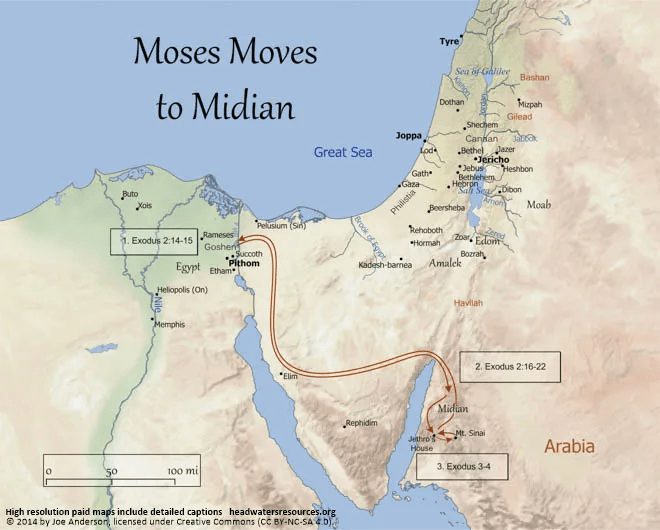
- David Guzik says “If Moses went into the area of Canaan and Syria, he would have found no refuge – there was a treaty between Rameses II and the Hittite king to the effect that fugitives along the northern route to Syria would be arrested and extradited. So, Moses went southeast instead, to Midian. Midian was east of the section of the Red Sea known today as the Gulf of Aqaba, in present day Saudi Arabia.” https://enduringword.com/bible-commentary/exodus-2/
- See map below
God Hears Israel’s Groaning
23 During those many days the king of Egypt died, and the people of Israel groaned because of their slavery and cried out for help. Their cry for rescue from slavery came up to God. 24 And God heard their groaning, and God remembered his covenant with Abraham, with Isaac, and with Jacob. 25 God saw the people of Israel—and God knew.
- God heard, God remembered, God saw, God knew


Leave a Reply