
The Burning Bush
Now Moses was keeping the flock of his father-in-law, Jethro, the priest of Midian, and he led his flock to the west side of the wilderness and came to Horeb, the mountain of God.
- In Exodus 3:1, Moses comes to Horeb, the “mountain of God,” yet later the mountain is called Sinai when the Israelites worship God there.
- Exodus 3:12 links the two, suggesting they are two names for the same location.Horeb may refer to the broader region (Exod. 17:1-7), though it is once called “Mount Horeb” (Exod. 33:6), and may also involve wordplay with hereb (sword, Exod. 32:27).
- Sinai could refer to the wilderness area (Exod. 19:1), be a new name for the mountain, or relate to wordplay with seneh (bush, Exod. 3:2–3).
- (from https://bibleproject.com/classroom/exodus-overview-carmen-imes/sessions/5)
- Moses was 80 years old at the time of the burning bush , having spent 40 years in Egypt and 40 years in Midian before God appeared to him (Acts 7:23, 30; Exodus 7:7).
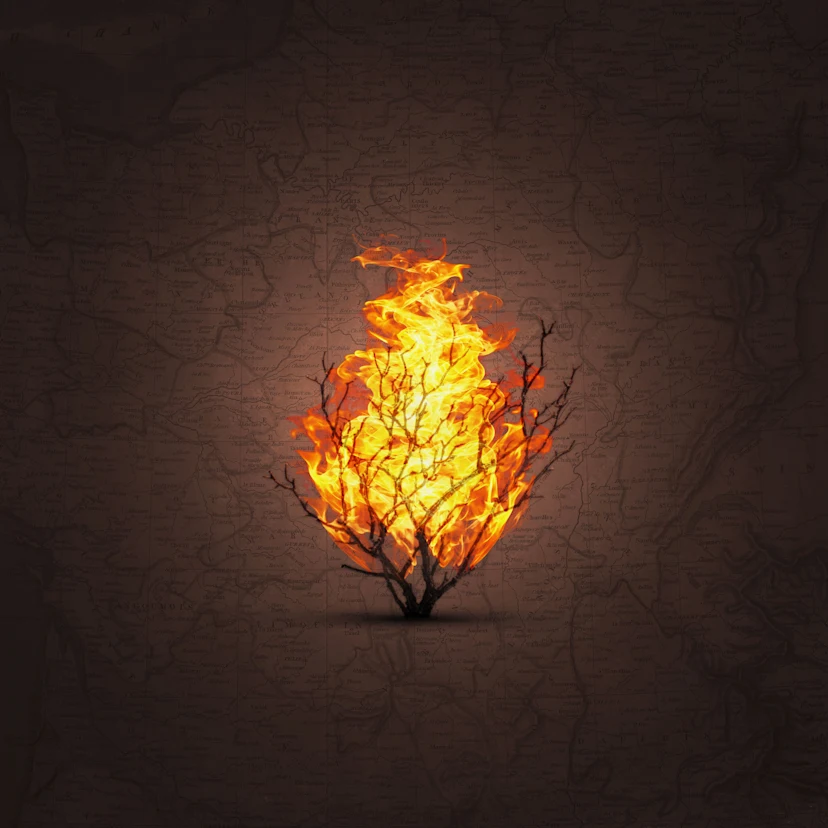
2 And the angel of the Lord appeared to him in a flame of fire out of the midst of a bush. He looked, and behold, the bush was burning, yet it was not consumed.3 And Moses said, “I will turn aside to see this great sight, why the bush is not burned.”
- The “angel of the Lord” (מַלְאַךְ יְהוָה) often appears as God Himself in human or visible form (Genesis 16, Judges 6, Judges 13). But in Exodus 3:2, the angel appears in a flame of fire from within a bush, not as a human figure.
- Reminder that ‘angel’ means ‘messenger’.
- Also interesting that angel of Lord appears to Moses who ends up being one of the only people who gets to see God’s glory later on.
- Some people suggest the burning bush is representative of Israel as it burns but is not consumed – God will deliver them.
4 When the Lord saw that he turned aside to see, God called to him out of the bush, “Moses, Moses!” And he said, “Here I am.” 5 Then he said, “Do not come near; take your sandals off your feet, for the place on which you are standing is holy ground.” 6 And he said, “I am the God of your father, the God of Abraham, the God of Isaac, and the God of Jacob.” And Moses hid his face, for he was afraid to look at God.
- Moses gets the double call (where God repeats a person’s name “Moses, Moses”)
- In Genesis 22:11, the angel of the Lord cries, “Abraham, Abraham!”
- in Genesis 46:2, God speaks in visions to Jacob, saying, “Jacob, Jacob!”
- in 1 Samuel 3:10, the Lord calls, “Samuel, Samuel!”
- Jesus says, “Martha, Martha” in Luke 10:41,
- He warns “Simon, Simon” in Luke 22:31 and
- “Saul, Saul” in Acts 9:4.
- Joshua is also told to take off his sandals when he is on holy ground (Joshua 5:15)
7 Then the Lord said, “I have surely seen the affliction of my people who are in Egypt and have heard their cry because of their taskmasters. I know their sufferings, 8 and I have come down to deliver them out of the hand of the Egyptians and to bring them up out of that land to a good and broad land, a land flowing with milk and honey, to the place of the Canaanites, the Hittites, the Amorites, the Perizzites, the Hivites, and the Jebusites.
- First time we see “flowing with milk and honey” used to describe the Promised Land. We will see this several more times in the Old Testament.
9 And now, behold, the cry of the people of Israel has come to me, and I have also seen the oppression with which the Egyptians oppress them. 10 Come, I will send you to Pharaoh that you may bring my people, the children of Israel, out of Egypt.”
- Both in verse 7 and verse 11 God calls Israel “His people” <3
11 But Moses said to God, “Who am I that I should go to Pharaoh and bring the children of Israel out of Egypt?” 12 He said, “But I will be with you, and this shall be the sign for you, that I have sent you: when you have brought the people out of Egypt, you shall serve God on this mountain.”
- Moses’ Q: Who am I to do this? God answers: I will be with you
- God’s sign does not come before Moses goes out, but instead He says “When you’ve succeeded, you’ll know I sent you.”
- “I will be with you” is a major theme throughout the Bible
- Isaac: Genesis 26:3
- “Sojourn in this land, and I will be with you and will bless you.”
- Jacob: Genesis 28:15, Genesis 31:3, Genesis 46:3-4
- “Behold, I am with you and will keep you wherever you go.”
- “Return to the land of your fathers… and I will be with you.”
- “Do not be afraid to go down to Egypt… I myself will go down with you.”
- Joshua: Joshua 1:5, Joshua 1:9
- “Just as I was with Moses, so I will be with you. I will not leave you or forsake you.”
- “Do not be frightened… for the LORD your God is with you wherever you go.”
- Gideon: Judges 6:16
- “But I will be with you, and you shall strike the Midianites as one man.”
- Jeremiah: Jeremiah 1:8, Jeremiah 1:19
- “Do not be afraid… for I am with you to deliver you.”
- “They will fight against you, but they shall not prevail against you, for I am with you… to deliver you.”
- Jesus (Immanuel): Matthew 1:23
- “They shall call his name Immanuel,” which means “God with us.”
- The Great Commission: Matthew 28:20
- “And behold, I am with you always, to the end of the age.”
- Paul: Acts 18:9-10
- “Do not be afraid… for I am with you.”
- Isaac: Genesis 26:3
13 Then Moses said to God, “If I come to the people of Israel and say to them, ‘The God of your fathers has sent me to you,’ and they ask me, ‘What is his name?’ what shall I say to them?” 14 God said to Moses, “I am who I am.”
- Moses’ Q: Who are you? God answers: I am who I am
And he said, “Say this to the people of Israel: ‘I am has sent me to you.’”
I am who I am.
Exodus 3:14
‘Ehyeh Asher ‘Ehyeh
אֶהְיֶה אֲשֶׁר אֶהְיֶה
15 God also said to Moses, “Say this to the people of Israel: ‘The Lord, the God of your fathers, the God of Abraham, the God of Isaac, and the God of Jacob, has sent me to you.’ This is my name forever, and thus I am to be remembered throughout all generations.
Say to the people of Israel,
Exodus 3:15
יְהוָה (YHWH), the God of your fathers… has sent me to you.”
- There is debate to whether YHWH was used for the first time in Exodus 3
- God says in Exodus 6:3 “I appeared to Abraham, to Isaac, and to Jacob as God Almighty [El Shaddai], but by My name YHWH I was not known to them”
- However, the narrator of Genesis uses it retrospectively (165 times).
- Others say it was shown previously but that YHWH hadn’t been fully revealed until now (the fullness of the name).
- Moses’ mother Jochabed means YHWH is glory
16 Go and gather the elders of Israel together and say to them, ‘The Lord, the God of your fathers, the God of Abraham, of Isaac, and of Jacob, has appeared to me, saying, “I have observed you and what has been done to you in Egypt, 17 and I promise that I will bring you up out of the affliction of Egypt to the land of the Canaanites, the Hittites, the Amorites, the Perizzites, the Hivites, and the Jebusites, a land flowing with milk and honey.”’ 18 And they will listen to your voice, and you and the elders of Israel shall go to the king of Egypt and say to him, ‘The Lord, the God of the Hebrews, has met with us; and now, please let us go a three days’ journey into the wilderness, that we may sacrifice to the Lord our God.’ 19 But I know that the king of Egypt will not let you go unless compelled by a mighty hand.20 So I will stretch out my hand and strike Egypt with all the wonders that I will do in it; after that he will let you go. 21 And I will give this people favor in the sight of the Egyptians; and when you go, you shall not go empty, 22 but each woman shall ask of her neighbor, and any woman who lives in her house, for silver and gold jewelry, and for clothing. You shall put them on your sons and on your daughters. So you shall plunder the Egyptians.”
- Moses is commanded to : 1. Go to the Hebrew elders, 2. Go to Pharaoh, 3. watch God strike Egypt with plagues. 4. Plunder Egyptians. He is given a full preview of what is to come in this book.
- YHWH appears 7 times in this chapter!


Leave a Reply