
The Tabernacle
- The tabernacle (מִשְׁכָּן mishkan) would become the dwelling place of YHWH amongst the Israelites.
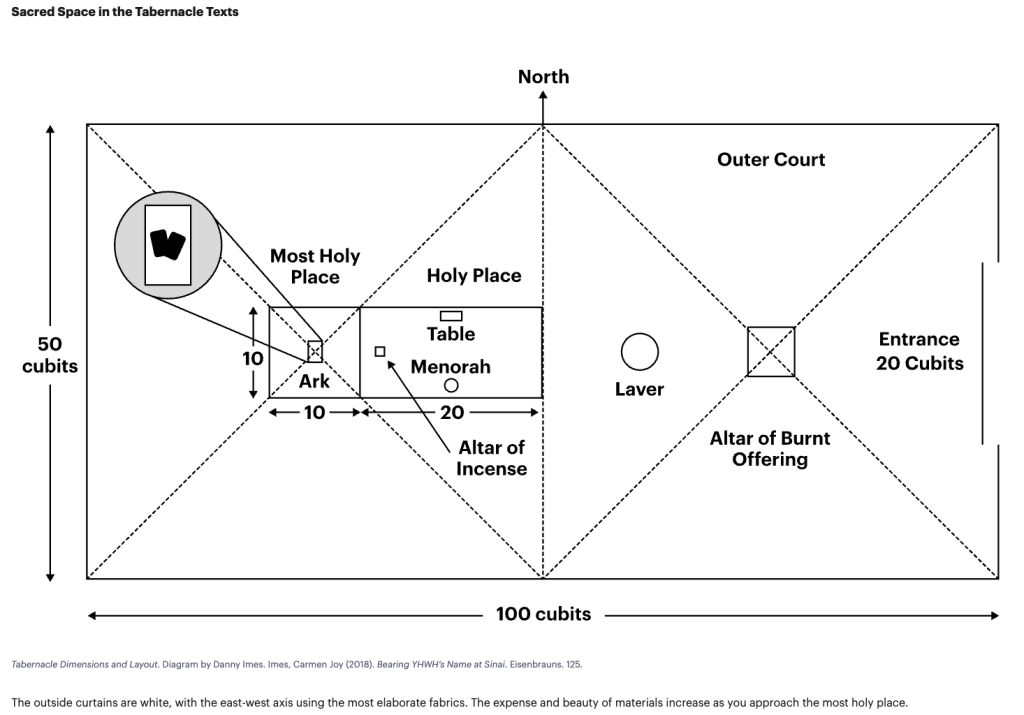
- It would look like a rectangle tent with curtains overlaying it, and various areas inside.
- It would have an outer court as well that was gated.
- See image below
- There are a lot of instructions in this chapter so I have summarized each part for easier follow.
“Moreover, you shall make the tabernacle with ten curtains of fine twined linen and blue and purple and scarlet yarns; you shall make them with cherubim skillfully worked into them.
- I mentioned this in last chapter but the purple used in the Tabernacle likely came from the murex sea snail, which produced a rare and expensive dye called Tyrian purple.
- Extracting the color took thousands of snails and was a slow process. It takes about 10,000 murex snails to produce just one gram of Tyrian purple dye!
- Cherubim are first mentioned in Genesis 3, where God places the cherubim to guard the Garden of Eden. There will be about 90 more references to them in the Bible. We will go more into that later in Ezekiel.
- How did they know what cherubim looked like?
2 The length of each curtain shall be twenty-eight cubits, and the breadth of each curtain four cubits; all the curtains shall be the same size. 3 Five curtains shall be coupled to one another, and the other five curtains shall be coupled to one another. 4 And you shall make loops of blue on the edge of the outermost curtain in the first set. Likewise you shall make loops on the edge of the outermost curtain in the second set. 5 Fifty loops you shall make on the one curtain, and fifty loops you shall make on the edge of the curtain that is in the second set; the loops shall be opposite one another. 6 And you shall make fifty clasps of gold, and couple the curtains one to the other with the clasps, so that the tabernacle may be a single whole.
- Summary of Inner Curtains
- Make 10 curtains of fine linen, blue, purple, and scarlet yarn and embroider cherubim into them.
- Each curtain is the same size and sewn into two large sets of 5.
- Use blue loops and gold clasps to join them together into one big piece.
7 “You shall also make curtains of goats’ hair for a tent over the tabernacle; eleven curtains shall you make. 8 The length of each curtain shall be thirty cubits, and the breadth of each curtain four cubits. The eleven curtains shall be the same size. 9 You shall couple five curtains by themselves, and six curtains by themselves, and the sixth curtain you shall double over at the front of the tent. 10 You shall make fifty loops on the edge of the curtain that is outermost in one set, and fifty loops on the edge of the curtain that is outermost in the second set.
11 “You shall make fifty clasps of bronze, and put the clasps into the loops, and couple the tent together that it may be a single whole. 12 And the part that remains of the curtains of the tent, the half curtain that remains, shall hang over the back of the tabernacle. 13 And the extra that remains in the length of the curtains, the cubit on the one side, and the cubit on the other side, shall hang over the sides of the tabernacle, on this side and that side, to cover it. 14 And you shall make for the tent a covering of tanned rams’ skins[b] and a covering of goatskins on top.
- Summary of Outer Curtains:
- 11 curtains made of goat hair to cover over the inner linen curtains.
- Then add three more layers for weather protection:
- Ram skins dyed red and another leather covering
15 “You shall make upright frames for the tabernacle of acacia wood. 16 Ten cubits shall be the length of a frame, and a cubit and a half the breadth of each frame. 17 There shall be two tenons in each frame, for fitting together. So shall you do for all the frames of the tabernacle. 18 You shall make the frames for the tabernacle: twenty frames for the south side; 19 and forty bases of silver you shall make under the twenty frames, two bases under one frame for its two tenons, and two bases under the next frame for its two tenons; 20 and for the second side of the tabernacle, on the north side twenty frames, 21 and their forty bases of silver, two bases under one frame, and two bases under the next frame. 22 And for the rear of the tabernacle westward you shall make six frames. 23 And you shall make two frames for corners of the tabernacle in the rear; 24 they shall be separate beneath, but joined at the top, at the first ring. Thus shall it be with both of them; they shall form the two corners. 25 And there shall be eight frames, with their bases of silver, sixteen bases; two bases under one frame, and two bases under another frame.
- Summary of Wooden Frames
- Use acacia wood boards to make vertical frames (each about 15 feet tall and 2¼ feet wide).
- The boards have two pegs each and are placed in silver bases.
- Arrange 20 boards on the south side, 20 on the north, and 6 on the west end, with 2 extra corner boards.
- If you take the measurements of the frame and curtains, The Most Holy Place is generally reconstructed as a perfect cube (approximately 10 × 10 × 10 cubits).
- Later on we see in Solomon’s Temple that its Most Holy Place was a 20 × 20 × 20 cubit cube (1 Kings 6:20).
- Ezekiel ‘s temple vision ( Ezekiel 41:4) hints at a cube (only mentions 20 x 20 cubits)
- John is told in Revelation 21:16 that New Jerusalem has “Its length and width and height are equal.”
26 “You shall make bars of acacia wood, five for the frames of the one side of the tabernacle, 27 and five bars for the frames of the other side of the tabernacle, and five bars for the frames of the side of the tabernacle at the rear westward. 28 The middle bar, halfway up the frames, shall run from end to end. 29 You shall overlay the frames with gold and shall make their rings of gold for holders for the bars, and you shall overlay the bars with gold. 30 Then you shall erect the tabernacle according to the plan for it that you were shown on the mountain.
- Summary of Crossbars and Rings
- Use 5 horizontal crossbars on each side to hold the boards together with one long bar runs through the middle.
- Everything is overlaid with gold
- Verse 30 is quoted in Hebrews 8:5
31 “And you shall make a veil of blue and purple and scarlet yarns and fine twined linen. It shall be made with cherubim skillfully worked into it. 32 And you shall hang it on four pillars of acacia overlaid with gold, with hooks of gold, on four bases of silver. 33 And you shall hang the veil from the clasps, and bring the ark of the testimony in there within the veil. And the veil shall separate for you the Holy Place from the Most Holy.
- Summary of Inner Curtain (Veil)
- Beautiful veil (like the inner curtains with linen, blue, purple, scarlet, cherubim).
- Hang it on gold hooks supported by four gold-covered acacia pillars.
- This veil separates the Most Holy Place (Holy of Holies) from the rest.
34 You shall put the mercy seat on the ark of the testimony in the Most Holy Place. 35 And you shall set the table outside the veil, and the lampstand on the south side of the tabernacle opposite the table, and you shall put the table on the north side.
36 “You shall make a screen for the entrance of the tent, of blue and purple and scarlet yarns and fine twined linen, embroidered with needlework. 37 And you shall make for the screen five pillars of acacia, and overlay them with gold. Their hooks shall be of gold, and you shall cast five bases of bronze for them.
- Summary of Outer Curtain (Screen)
- Curtain for the entrance to the tent also made with colorful linen, but no cherubim.
- Hang it on five wooden pillars with bronze bases and gold hooks.
This Bible project session says: The outside curtains are white, with the east-west axis using the most elaborate fabrics. The expense and beauty of materials increase as you approach the most holy place.
- Notice how you move inward you go from bronze to gold as you get closer to the Most Holy Place


Leave a Reply