
The Bronze Altar
“You shall make the altar of acacia wood, five cubits long and five cubits broad. The altar shall be square, and its height shall be three cubits. 2 And you shall make horns for it on its four corners; its horns shall be of one piece with it, and you shall overlay it with bronze. 3 You shall make pots for it to receive its ashes, and shovels and basins and forks and fire pans. You shall make all its utensils of bronze. 4 You shall also make for it a grating, a network of bronze, and on the net you shall make four bronze rings at its four corners. 5 And you shall set it under the ledge of the altar so that the net extends halfway down the altar. 6 And you shall make poles for the altar, poles of acacia wood, and overlay them with bronze. 7 And the poles shall be put through the rings, so that the poles are on the two sides of the altar when it is carried. 8 You shall make it hollow, with boards. As it has been shown you on the mountain, so shall it be made.
- Summary of The Bronze Altar (v. 1-8)
- Square altar made of acacia wood, 7.5 feet wide and 4.5 feet high.
- Cover it with bronze, including the horns on each corner.
- Make tools for it: pots, shovels, bowls, forks, firepans: all in bronze.
- Add a grate of bronze below the top edge (like a grill).
- Put rings on the sides to carry it and use poles made of acacia wood covered in bronze to carry it.
- Altar in Hebrew is (מִזְבֵּחַ) mizbe’ah or “slaughter place”
- God is called the “horn of [my] salvation” (Psalm 18:2 and 2 Samuel 22:3)
- In case you read different versions and you see different words for “bronze”
- Copper is a naturally occurring metal.
- Bronze is primarily copper and tin.
- Brass (usually KJV) is primarily copper and zinc.
- The Hebrew is נְחֹשֶׁת nechoshet. Deuteronomy 8:9 has the same word but usually translates as “copper”
The Court of the Tabernacle
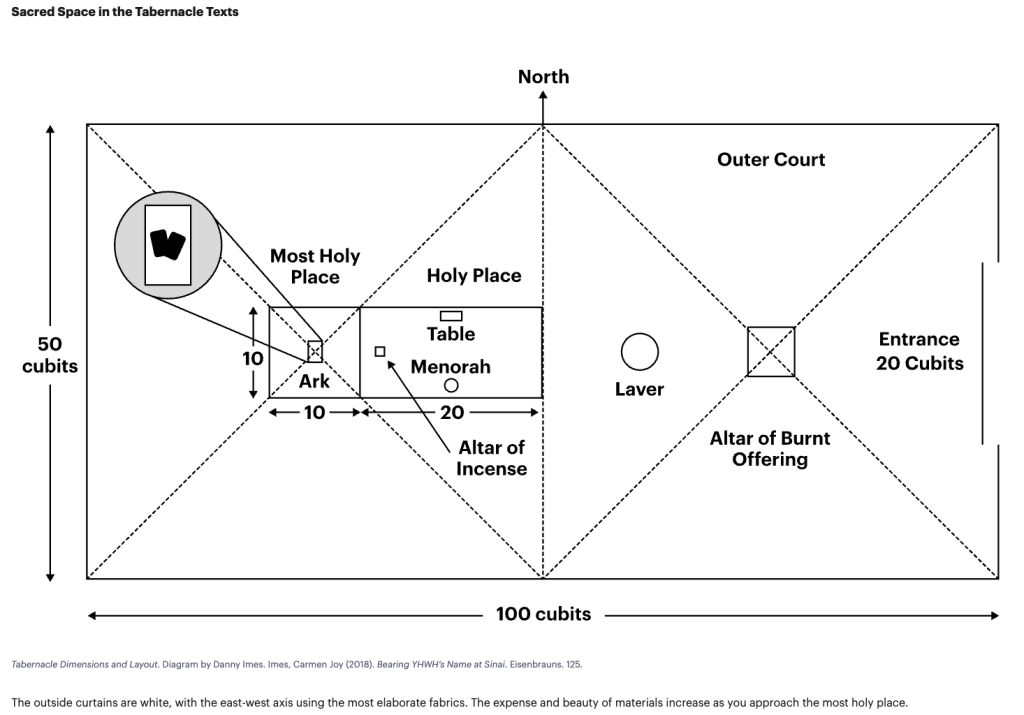
9 “You shall make the court of the tabernacle.
- “As the Tent itself took up only about one-fifteenth [about 7%] of the area of the courtyard, there was plenty of room.”
- Cole, R. Alan Exodus, An Introduction and Commentary (London: Inter-Varsity Press, 1973)
On the south side the court shall have hangings of fine twined linen a hundred cubits long for one side. 10 Its twenty pillars and their twenty bases shall be of bronze, but the hooks of the pillars and their fillets shall be of silver. 11 And likewise for its length on the north side there shall be hangings a hundred cubits long, its pillars twenty and their bases twenty, of bronze, but the hooks of the pillars and their fillets shall be of silver. 12 And for the breadth of the court on the west side there shall be hangings for fifty cubits, with ten pillars and ten bases. 13 The breadth of the court on the front to the east shall be fifty cubits. 14 The hangings for the one side of the gate shall be fifteen cubits, with their three pillars and three bases. 15 On the other side the hangings shall be fifteen cubits, with their three pillars and three bases. 16 For the gate of the court there shall be a screen twenty cubits long, of blue and purple and scarlet yarns and fine twined linen, embroidered with needlework. It shall have four pillars and with them four bases. 17 All the pillars around the court shall be filleted with silver. Their hooks shall be of silver, and their bases of bronze. 18 The length of the court shall be a hundred cubits, the breadth fifty, and the height five cubits, with hangings of fine twined linen and bases of bronze. 19 All the utensils of the tabernacle for every use, and all its pegs and all the pegs of the court, shall be of bronze.
- Summary of The Courtyard (v. 9-19)
- Set up a fenced courtyard around the Tabernacle.
- South and north sides: 150 feet long, made with white linen curtains on 20 bronze posts with silver hooks.
- West side: 75 feet, 10 posts.
- East side (entrance): also 75 feet, but split:
- Two side sections: 22.5 feet each with 3 posts.
- The gate in the middle is 30 feet wide, with a colorful linen curtain (blue, purple, scarlet).
- All posts have bronze bases and silver hooks/caps.
- The courtyard is 7.5 feet tall.
Oil for the Lamp
20 “You shall command the people of Israel that they bring to you pure beaten olive oil for the light, that a lamp may regularly be set up to burn. 21 In the tent of meeting, outside the veil that is before the testimony, Aaron and his sons shall tend it from evening to morning before the Lord. It shall be a statute forever to be observed throughout their generations by the people of Israel.
- Summary of The Oil for the Lamp (v. 20-21)
- Israelites must bring pure olive oil for the lamp which is to burn continually.
- Aaron and his sons (the priests) are responsible to keep it going every night inside the Tabernacle, before the veil.


Leave a Reply