
Thoughts
We continue the theme of women delivering the deliverer. We have Moses’ mother who saves him from death, Pharaoh’s daughter who rescues him from the river, and Moses’ sister who brings his mother back for nursing.
In ancient Egyptian mythology, the Nile River was closely associated with Osiris, the god of the fertility. Some people think that Pharaoh’s daughter was bathing outside (because Egypt had indoor baths at this time) because she was infertile.
Moses was hidden in the סוּף (reeds), the same word used for the Yam Suf (יַם-סוּף) often mistranslated as “Red Sea,” but actually “Sea of Reeds.” This is the same sea he will eventually part.
In Hebrew, the name Moshe (מֹשֶׁה) comes from the root mashah (מָשָׁה) meaning “to draw out.” But in ancient Egyptian, ms or Mose, means “born of” or “son of.” Like Rameses (רַעְמְסֵס) “born of Ra.” But unlike those names, Moses is just left unfinished “born of…” Who is he the son of? Is he Hebrew or Egyptian? When he encounters God in the bush, God says “I am the God of your father” .
The word used for Moses’ basket in Hebrew is the same as the word used for Noah’s ark: tevah (תֵּבָה)
Technically Moses’ mother obeyed Pharaoh by throwing Moses into the Nile..
In The Prince of Egypt Moses ‘finds out’ to his surprise that he is Hebrew – however, he most likely was raised with Hebrew knowledge as his birth mother nursed him and he knew the man being beaten was one of ‘his people’.
We know from Acts 7:23 that Moses was 40 when he fled Egypt.
David Guzik says “If Moses went into the area of Canaan and Syria, he would have found no refuge – there was a treaty between Rameses II and the Hittite king to the effect that fugitives along the northern route to Syria would be arrested and extradited. So, Moses went southeast instead, to Midian. Midian was east of the section of the Red Sea known today as the Gulf of Aqaba, in present day Saudi Arabia.” https://enduringword.com/bible-commentary/exodus-2/
In Exodus 3:1, Moses comes to Horeb, the “mountain of God,” yet later the mountain is called Sinai when the Israelites worship God there. Exodus 3:12 links the two, suggesting they are two names for the same location.Horeb may refer to the broader region (Exod. 17:1–7), though it is once called “Mount Horeb” (Exod. 33:6), and may also involve wordplay with hereb (sword, Exod. 32:27).Sinai could refer to the wilderness area (Exod. 19:1), be a new name for the mountain, or relate to wordplay with seneh (bush, Exod. 3:2–3). (from https://bibleproject.com/classroom/exodus-overview-carmen-imes/sessions/5)
The “angel of the Lord” (מַלְאַךְ יְהוָה) often appears as God Himself in human or visible form (Genesis 16, Judges 6, Judges 13). But in Exodus 3:2, the angel appears in a flame of fire from within a bush, not as a human figure. Reminder that ‘angel’ means ‘messenger’.
Also interesting that angel of Lord appears to Moses who ends up being one of the only people who gets to see God’s glory later on.
Moses gets the double call (where God repeats a person’s name “Moses, Moses”) which we see when there is urgency or divine commissioning. In Genesis 22:11, the angel of the Lord cries, “Abraham, Abraham!”, in Genesis 46:2, God speaks in visions to Jacob, saying, “Jacob, Jacob!”, in 1 Samuel 3:10, the Lord calls, “Samuel, Samuel!”, the New Testament, Jesus gently says, “Martha, Martha” in Luke 10:41, He warns “Simon, Simon” in Luke 22:31 and “Saul, Saul” in Acts 9:4.
Some people suggest the burning bush is representative of Israel as it burns but is not consumed – God will deliver them.
Moses was 80 years old at the time of the burning bush (Exodus 3), having spent 40 years in Egypt and 40 years in Midian before God appeared to him (Acts 7:23, 30; Exodus 7:7).
There is debate to whether YHWH was used for the first time in Exodus 3 (usually off of the verse Exodus 6:3 “I appeared to Abraham, to Isaac, and to Jacob as God Almighty [El Shaddai], but by My name YHWH I was not known to them”? and the narrator of Genesis uses it retrospectively (165 times). Others say it was shown previously but that YHWH hadn’t been fully revealed until now (the fullness of the name).
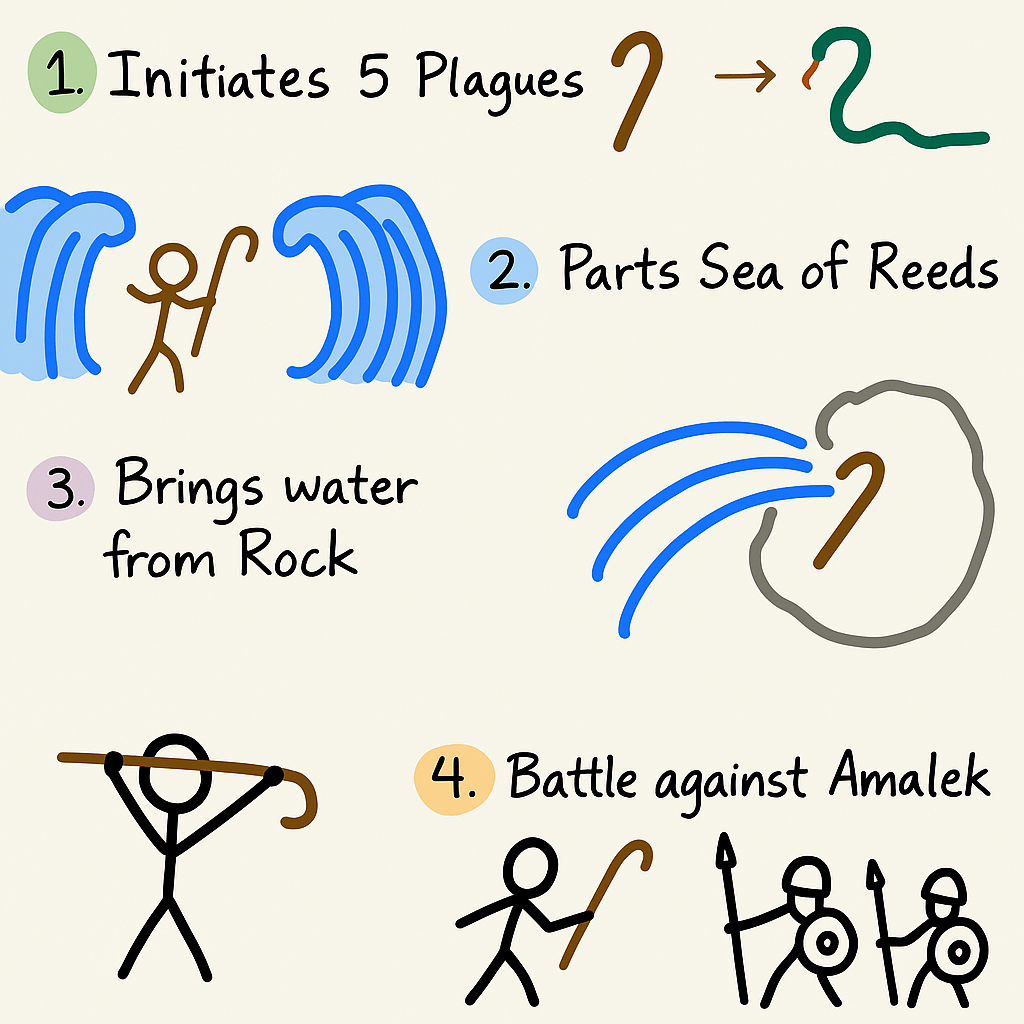
Visual of Moses’ staff below
I never caught the part that Moses actually runs from the snake.
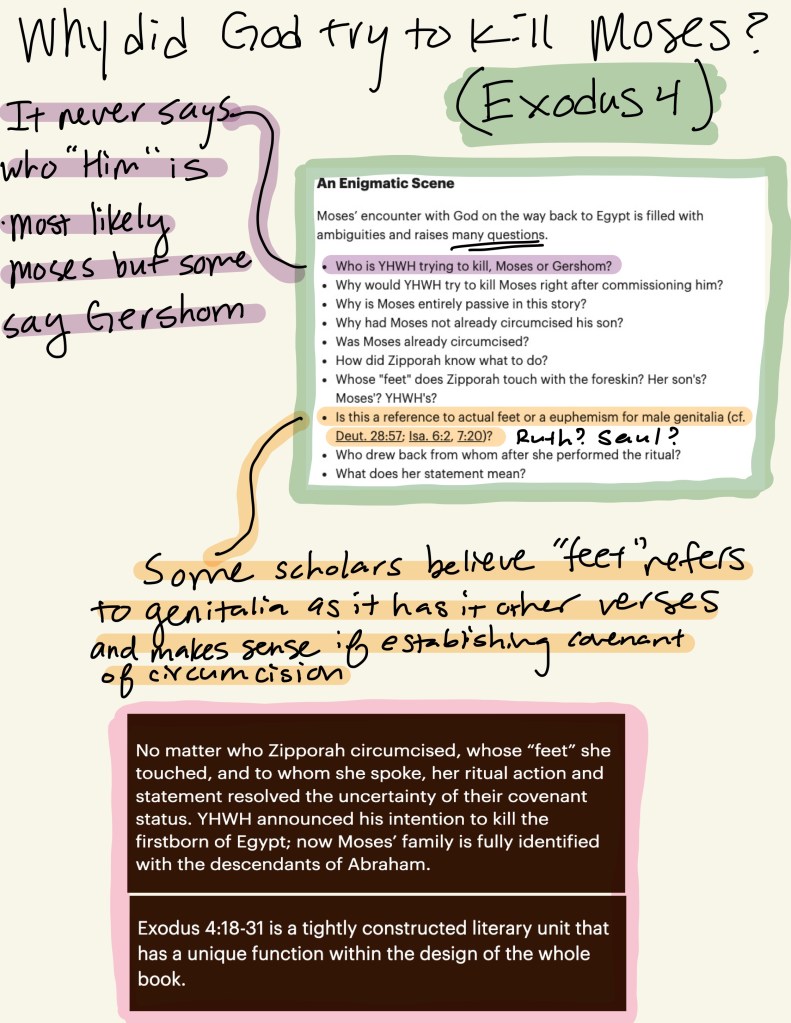
In one of the most confusing passages – God tries to kill Moses in Chapter 4. I included a visual on it below.
Questions
Would Moses’ mom not have hid him if he wasn’t ‘a fine child’?
When Moses looks and sees no one in chapter 2 – was this saying that he saw no witnesses so he could kill the Egyptian or he saw no one standing up for the Hebrew so he killed the Egyptian?
Was YHWH used for the first time in Exodus 3? (see above)
Why didn’t Moses do the leprosy sign in Egypt? Or did he?
Was God’s original plan to just send Moses (not Aaron)? How would this have affected Aaron’s role? He does end up being a source of some problems (golden calf, drama against Moses).
Why does Moses tell Jethro he is wanting to see if his brethren are alive instead of what happened?
Which deity is Jethro a priest for? Probably not YHWH since grandson not circumcised? Zipporah knew what to do so either they were not following the rules or was not their custom.
Application
Like Joseph, Moses’ story takes a long time to really come together. What stands out to me is that moment at the burning bush when Moses is talking with God. He keeps asking questions “Why me?”, “What if they don’t believe me?”, “What should I say Your name is?” and God doesn’t get mad. Instead, He answers each one patiently. It’s only when Moses says, “Please send someone else,” that God finally gets angry. It’s interesting, God isn’t upset by our doubts or questions, just the unwillingness. God can handle our fears and insecurities, but what He really wants is our trust and obedience, even when we don’t feel ready.
 Jo Reads The Bible
Leave a comment