
Thoughts
Chapter 5 is a picture of the reality of following God’s plan. It isn’t always going to be rainbows and sunshine right away, in fact it might get very worse before it gets better.
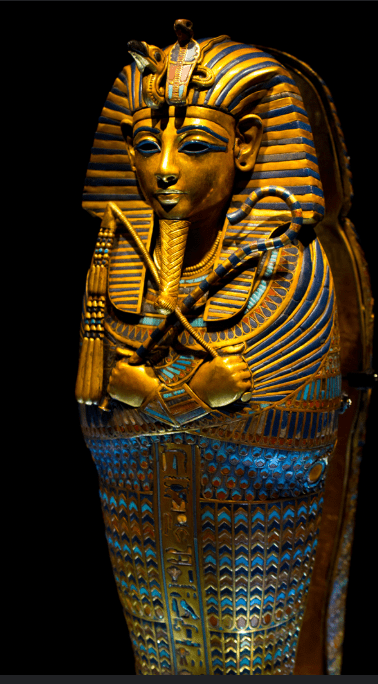
Interestingly if you look at images of Pharaohs, they are usually pictured with a staff and whip. The staff is called a heqa scepter and can represent Pharaoh as a protector of his people (similar to shepherd). I found this interesting because Egyptians saw shepherds as unclean and an abomination. Also cool duality of Moses and his staff representing the shepherd of Israel vs Pharaoh the shepherd of Egypt. (see image below) (Image credit: Dmitry Denisenkov, CC Attribution Share-Alike 2.0 Generic.)
Pharaoh making the Hebrews gather their own straw could be seen as a psychological tactic by making them so weak and tired they had no hope to rebel.
Exodus 5:1 serves as the first prophetic announcement “Thus says YHWH” (even though prophecies have already happened).
I talked about this a little bit but 6:3 is a bit confusing where God says “I appeared to Abraham, to Isaac, and to Jacob, as El Shaddai, but by my name YHWH I did not make myself known to them.” Since it is used in Genesis, it could be it was retrospectively put in and they did not know the name YHWH, or it could be that they did not KNOW the name YHWH and the full impact/meaning of His name.
In Exodus 6:6–8, God makes seven “I will” covenant promises to the Israelites, saying: “I will bring you out from under the burdens of the Egyptians, I will deliver you from slavery to them, I will redeem you with an outstretched arm and with great acts of judgment, I will take you to be my people, I will be your God, and you shall know that I am the Lord your God who has brought you out from under the burdens of the Egyptians. I will bring you into the land that I swore to give to Abraham, to Isaac, and to Jacob; I will give it to you for a possession. I am the Lord.”
Cool insight from Guzik: There is a strong contrast with the later five I will statements of Satan in Isaiah 14:13-15. The great difference is that Satan was powerless to make any of his “I wills” come to pass. God is more than able to fulfill each of His promises. https://enduringword.com/bible-commentary/exodus-6/
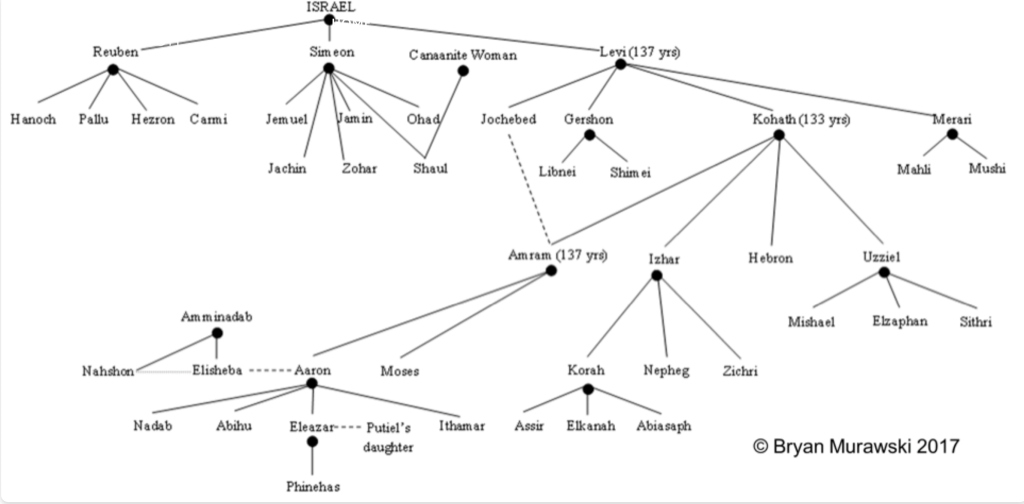
Genealogy from chapter 6 below (from https://www.bethanybiblechurch.com/2017/01/exodus-6-fun-with-genealogies/)
The genealogy of the Levites in Exodus 6:16–25 highlights some foundational figures of Israel’s priestly line. Aaron’s sons Nadab and Abihu would later die for offering unauthorized fire, while Eleazar would go on to succeed Aaron as high priest. Eleazar’s son, Phinehas, is also mentioned; he becomes notable for defending God’s holiness and receives a lasting covenant of peace (Numbers 25).
Moses is told that he is the representation of God to Pharaoh in chapter 7, much like we are to represent Christ to the world.
God ‘hardened Pharaoh’s’ heart’ could be that he gave Pharaoh up to his own evil desires.
We seen in chapter 7 that Moses is 80, starting the second part of his 3 40-year interval life. (40 when left Egypt, 80 when he returns to Pharaoh, 120 when he dies).
I always thought it was Moses who turns his staff into a snake, but that is only at the burning bush – Aaron does it in front of Pharaoh.
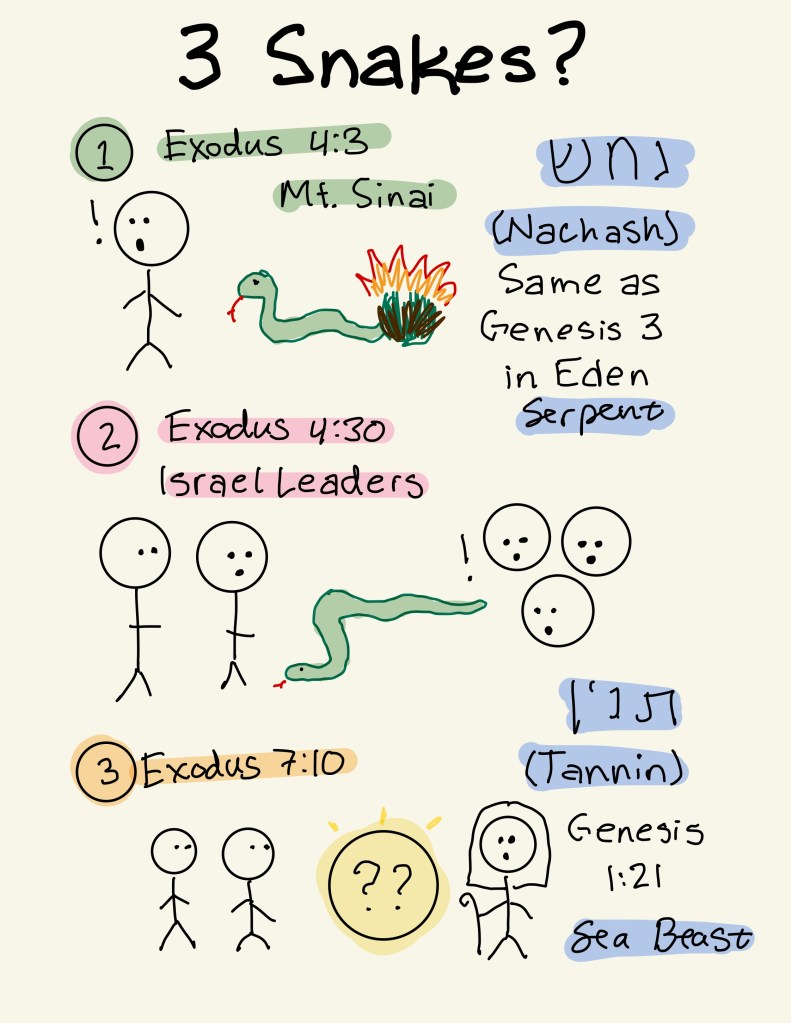
3 snakes? Check out my interesting….visual below –
When Moses turns his staff into a serpent before God at the burning bush (Exodus 4:3), the Hebrew word used is נָחָשׁ (nachash), a general term for snake; when Aaron does the same sign before the Israelite leaders (Exodus 4:30), the word is implied to be the same (נָחָשׁ); however, when Aaron throws down his staff before Pharaoh (Exodus 7:10), the word changes to תַּנִּין (tannin), which often means a large reptile, dragon, or sea monster.
The Nile was like a ‘god’ to the Egyptians, and had many deities associated with it. The first plague brought them all down low.
I always saw the first plague as just the Nile turning to blood – but didn’t think about “And there shall be blood throughout all the land of Egypt, both in buckets of wood and pitchers of stone.’”
Questions
What would have been the plan if Pharaoh allowed the 3 day journey to festival?
Pharaoh said he did not know of YHWH but he is surrounded by Israel who worships Him. Is it that he did not know the name or had so little care for the Hebrews that he didn’t even know who they worshipped? Or was he rejecting the authority of YHWH?
Why is the genealogy in chapter 6 limited to first 3 tribes? Why not just mention Levi then?
Why isn’t Moses’ wife mentioned? Because she wasn’t Hebrew? Because he ‘sent her home’?
Were the magicians using tricks or true demonic power? Also what good was it to make more bloody water? Wouldn’t it be more impressive to turn the water clean?
Application
Moses listens to God and tells Pharaoh to let God’s people go, but immediately after everything gets worse. There was more work and more beatings even though Moses was following God’s command. Obedience to God can increase the spiritual battle we are always in. Moses shows discouragement at the end of chapter 5 but by the beginning of chapter 6 we see God reassure him. But even after reassurance, Moses goes out to talk to Israel and they did not trust him. This is just the start of the ups and downs to come! The roller coaster of spiritual battles can be so exhausting, but there is peace knowing YHWH is on your side.
 Jo Reads The Bible
Leave a comment