
Thoughts
Some people speculate plagues were done against an Egyptian deity (god of the Nile, goddess depicted as a frog, eventually leading to Pharaoh a ‘god’ of Egypt).
Frogs were seen as sacred because of Heqet the goddess of fertility (frog head), so they could not be killed.
Some have also said that the plagues were done ‘naturally’. For example, the swarm of frogs happened after the Nile turned to blood as it was inhabitable. And then the rotting frog carcasses lured in gnats and flies, which lead to disease of the cows, etc. Sure this could have happened, but didn’t really make sense as it was 7 days later and the frogs SWARMED the land. Either way there was divine intervention for sure.
Again, wouldn’t the magicians want to bring the frogs out of Egypt instead of multiply them?
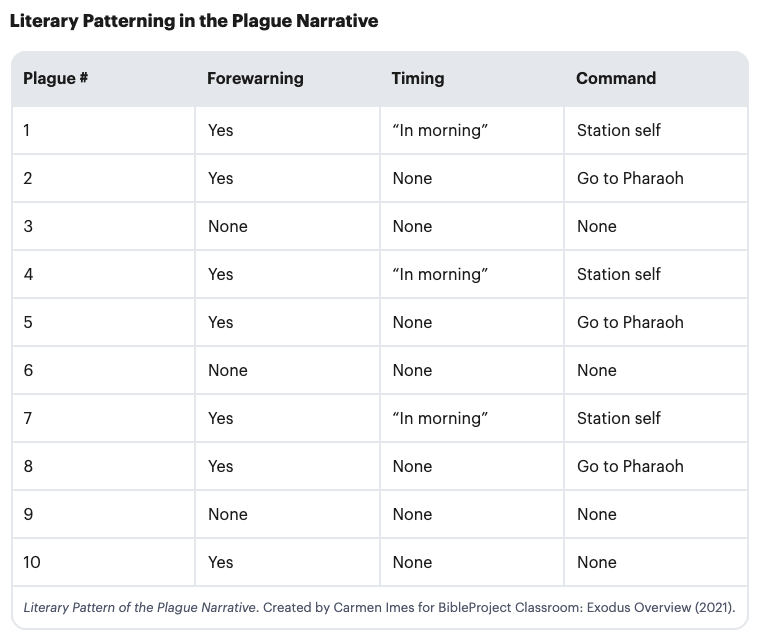
The plagues come with a pattern of 3 – 3, 6, and 9 were unannounced; 1, 4, and 7 were in the morning; 2, 5, and 8 were done talking to Pharaoh
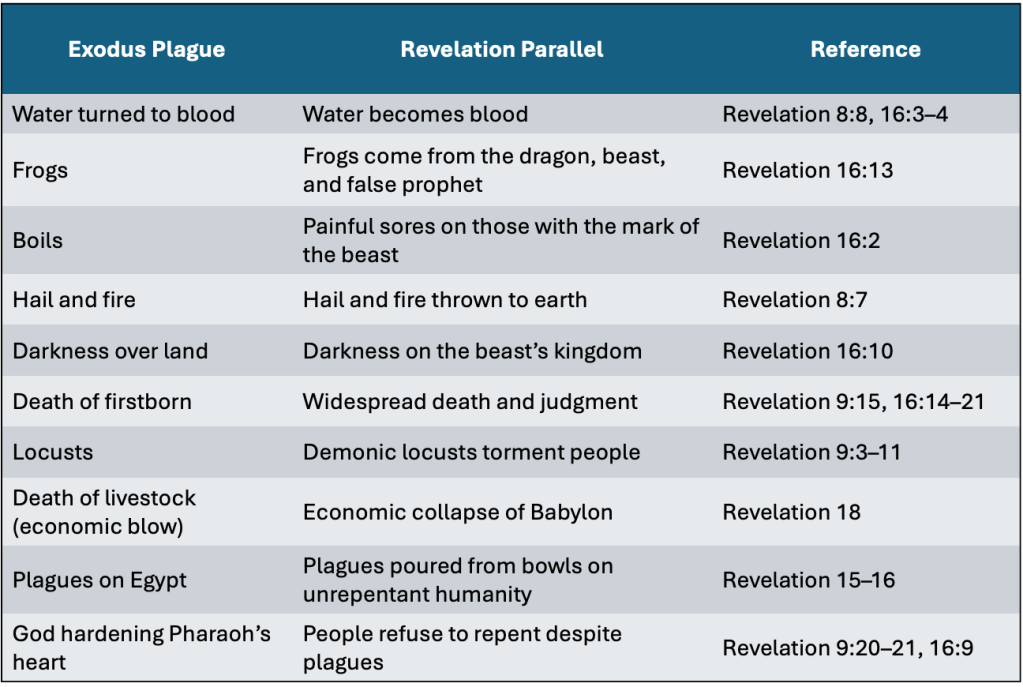
There are a lot of parallels in Revelation- visual below
The word for plague 3 is כִּנִּים (kinnim) which most likely means tiny biting insect. Older traditions view that word as ‘lice’ but more recent as ‘gnats’. Could be midges.
In Exodus 8:22 God said that Goshen (where the Israelites lived) would be spared from plague #4 – this leaves many to wonder if they were spared from #1-3?
The word for plague 4 is עָרֹב (arov) which means ‘swarm’ or ‘mixture’. We usually take this to mean flies (and what it is translated to) but some people think it could be scorpions, snakes, or even wild beasts!
Exodus 8: 26 “But Moses said, “It would not be right to do so, for the offerings we shall sacrifice to the Lord our God are an abomination to the Egyptians”. This refers to animals the Egyptians considered sacred or taboo to kill like bulls, rams, and sheep.
We see more of the phrase ‘But the Lord hardened the heart of Pharaoh” in the later plagues.
When Pharaoh hardens his own heart, the verb most often used is כָּבֵד (kaved), meaning “to be heavy” or “insensitive.” However, when the LORD hardens Pharaoh’s heart, the text typically uses חִזֵּק (chizzeq), meaning “to strengthen” or “make firm.” This doesn’t necessarily mean God forced Pharaoh to become evil but that He reinforced something that already existed.
Fire and hail being thrown down together truly supernatural. Mixed with thunder this trio is echoed as well in Revelation.
Finally by plague 8 we have the servants telling Pharaoh to listen to Moses. In Exodus 9:34 it says even their hearts were hardened!
I never realized how intense this darkness was in plague 9 – that it could be felt. And that there was possibly a paralyzing fear? It says “nor did anyone rise from his place for three days”
Questions
How could magicians turn a staff into a snake and bring forth blood and frogs but not bugs?
There are a couple of times Pharaoh agrees to let people leave, but once plague ends he hardens his heart. Why didn’t Moses/ God have plagues removed once the Israelites had left instead of before?
I wonder how many times Moses thought, OK is this it? Are we done? He knew about the possibility of the firstborn dying from Exodus 4.
Is Exodus 9: 31-32 “The flax and the barley were struck down, for the barley was in the ear and the flax was in bud. But the wheat and the emmer were not struck down, for they are late in coming up” giving us a time stamp or telling us there was more to be ruined (setting up plague 8)
Why does Pharaoh only want the men to leave in chapter 10?
During the extreme darkness could they use artificial light? I assume no?
Application
How many of us are like Pharaoh? God comes to us with His plan, yet we turn away from Him again and again. How often have we suffered because of sin, closing our ears to those who speak the truth? How many times have we tried to bargain with God when He gives us direction, thinking we know better? And how much more serious is it when we do this as Christians: people who know God and have a relationship with Him?
 Jo Reads The Bible
Leave a comment