
Thoughts
This post looks a little different as I am trying to visualize and break down these instructions
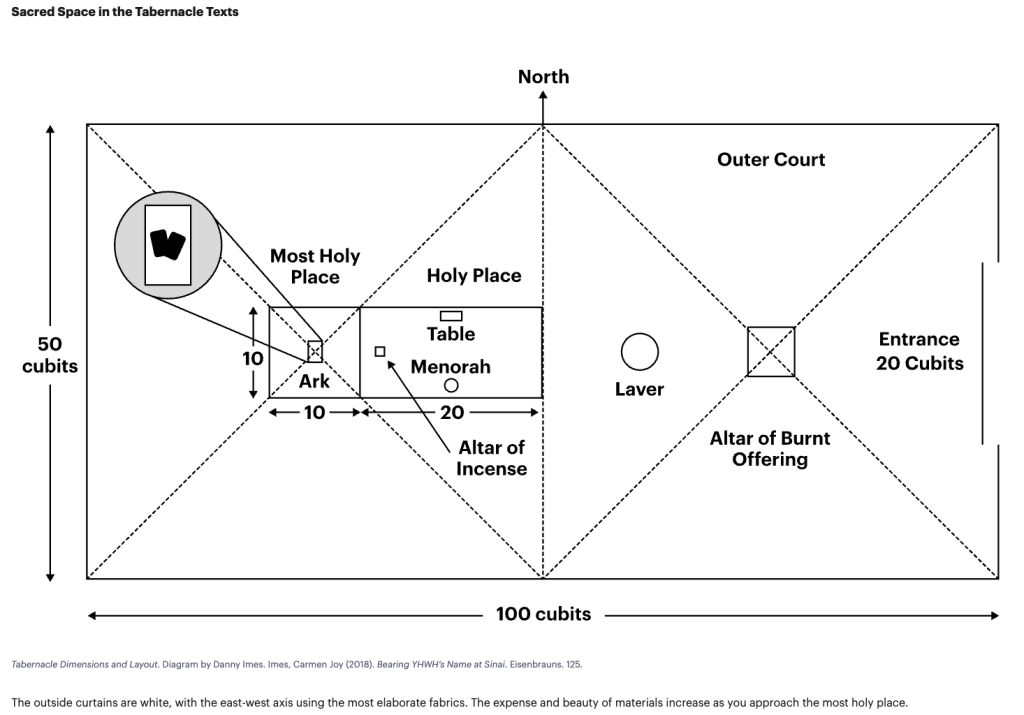
Floorplan of tabernacle from https://bibleproject.com/classroom/exodus-overview-carmen-imes/sessions/23
Same session says: The outside curtains are white, with the east-west axis using the most elaborate fabrics. The expense and beauty of materials increase as you approach the most holy place.
Exodus 26
The purple used in the Tabernacle likely came from the murex sea snail, which produced a rare and expensive dye called Tyrian purple. Extracting the color took thousands of snails and was a slow process. It takes about 10,000 murex snails to produce just one gram of Tyrian purple dye!
I need a visual to break this chapter down. First we have:
**4 Curtains/Coverings**
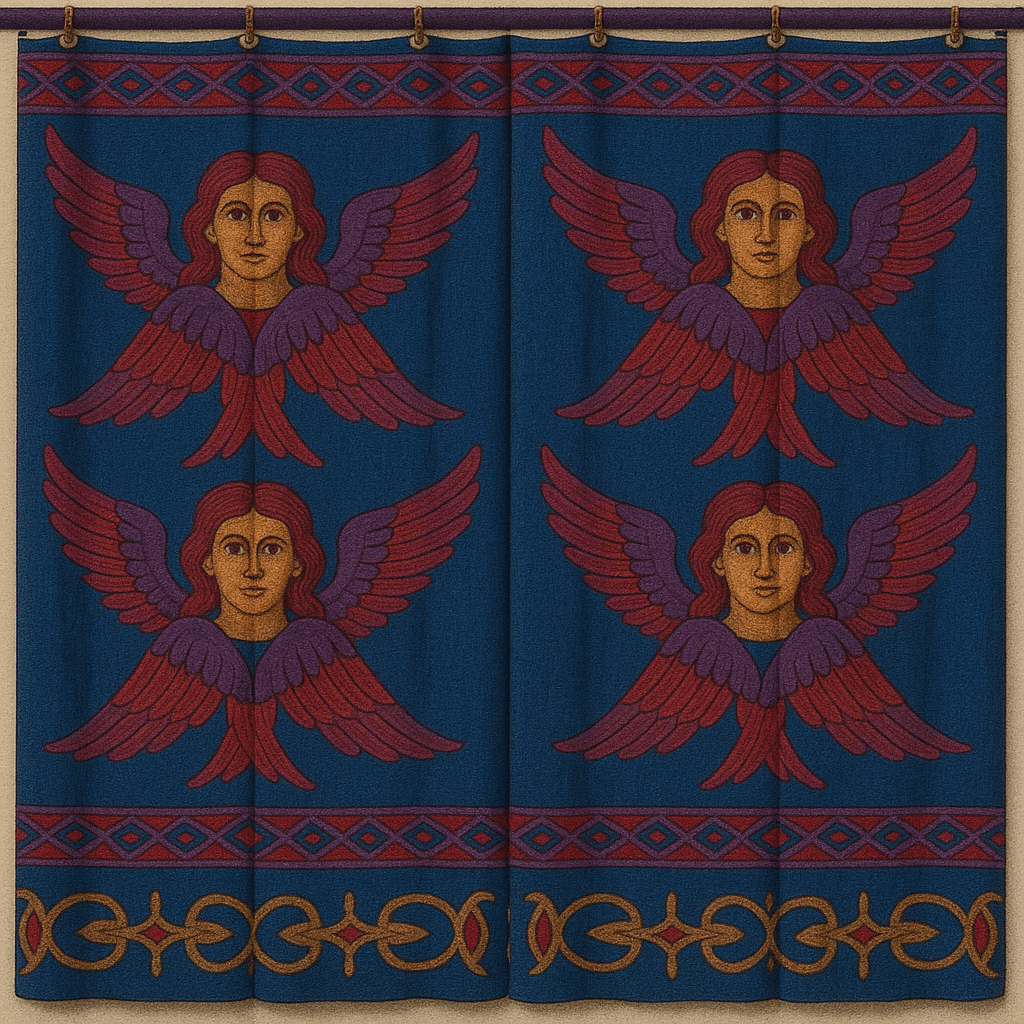
1. The Inner Curtains (v. 1–6)
- Make 10 curtains of fine linen, blue, purple, and scarlet yarn and embroider cherubim (angels) into them.
- Each curtain is the same size and sewn into two large sets of 5.
- Use blue loops and gold clasps to join them together into one big piece.
2. The Outer Tent Coverings (v. 7–14)
- 11 curtains made of goat hair to cover over the inner linen curtains.
- Then add three more layers for weather protection:
- Ram skins dyed red and another leather covering
3. The Inner Curtain (Veil) (v. 31–33)
- Beautiful veil (like the inner curtains with linen, blue, purple, scarlet, cherubim).
- Hang it on gold hooks supported by four gold-covered acacia pillars.
- This veil separates the Most Holy Place (Holy of Holies) from the rest.
4. The Outer Curtain (Screen) (v. 36–37)
- Curtain for the entrance to the tent also made with colorful linen, but no cherubim.
- Hang it on five wooden pillars with bronze bases and gold hooks.
**Other**
The Wooden Frames (v. 15–30)
- Use acacia wood boards to make vertical frames (each about 15 feet tall and 2¼ feet wide).
- The boards have two pegs each and are placed in silver bases.
- Arrange 20 boards on the south side, 20 on the north, and 6 on the west end, with 2 extra corner boards.
.Crossbars and Rings (v. 26–30)
- Use 5 horizontal crossbars on each side to hold the boards together with one long bar runs through the middle.
- Everything is overlaid with gold
Exodus 27
The Bronze Altar (v. 1–8)
- Square altar made of acacia wood, 7.5 feet wide and 4.5 feet high.
- Cover it with bronze, including the horns on each corner.
- Make tools for it: pots, shovels, bowls, forks, firepans: all in bronze.
- Add a grate of bronze below the top edge (like a grill).
- Put rings on the sides to carry it and use poles made of acacia wood covered in bronze to carry it.
The Courtyard (v. 9–19)
- Set up a fenced courtyard around the Tabernacle.
- South and north sides: 150 feet long, made with white linen curtains on 20 bronze posts with silver hooks.
- West side: 75 feet, 10 posts.
- East side (entrance): also 75 feet, but split:
- Two side sections: 22.5 feet each with 3 posts.
- The gate in the middle is 30 feet wide, with a colorful linen curtain (blue, purple, scarlet).
- All posts have bronze bases and silver hooks/caps.
- The courtyard is 7.5 feet tall.
The Oil for the Lamp (v. 20–21)
- Israelites must bring pure olive oil for the lamp which is to burn continually.
- Aaron and his sons (the priests) are responsible to keep it going every night inside the Tabernacle, before the veil.
Exodus 28
I like in verse 3 how God says he has given them the spirit of skill/wisdom – reminding them that even when crafting, it can be done for God and by God.
Here we learn about the Urim and Thummim. They are said to mean “Light and Truth” or “Light and Perfections”. We see them mentioned in Numbers 27:21, 1 Samuel 28:6, Ezra 2:63 and Nehemiah 7:65. Some say they were stones, and God was able to speak through them. Possibly one represented “yes” and one “no”.
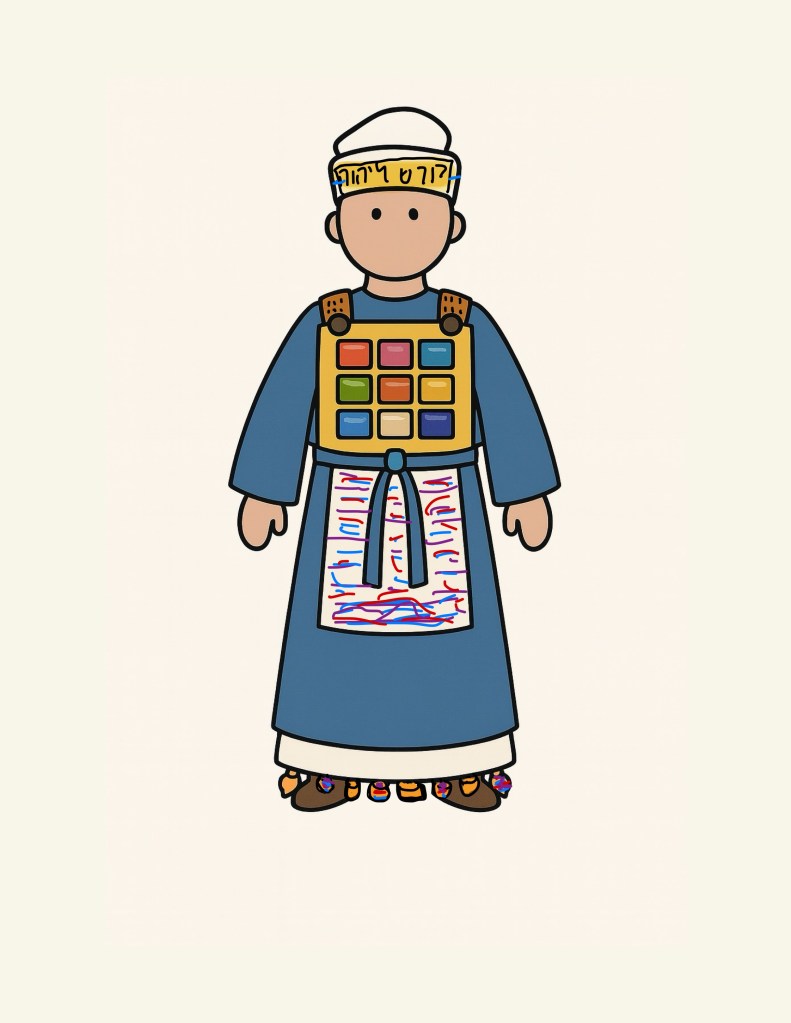
Priest’s Garments
Ephod (v 6–14)
- A sleeveless vest worn over the robe made of gold, blue, purple, and scarlet yarns, and fine linen.
- Two onyx stones on the shoulders engraved with the names of the 12 tribes of Israel (6 names per stone).
- Attached by shoulder pieces and held by a skillfully woven waistband.
Breastpiece of Judgment (v 15–30)
- A square pouch attached to the ephod (same materials)
- Set with 12 precious stones (one for each tribe, engraved with the names).
- Contains the Urim and Thummim
- Worn over the heart
Robe of the Ephod (v 31–35)
- A long blue robe worn under the ephod.
- Had pomegranates made of blue, purple, and scarlet yarn along the hem with golden bells between the pomegranates.
Tunic (v 39)
- A long-sleeved white linen garment worn under the robe made of fine linen
Sash (v 39)
- A belt tied around the tunic made of fine linen with embroidered work.
Turban (v 36–38, 39)
- A headpiece made of fine linen with a gold plate engraved with “Holy to the LORD” tied to the turban with blue cord.
Linen Undergarments (v 42–43)
- Linen shorts worn under the tunic.
Questions
How did they know what cherubim looked like?
What is the Urim and Thummim!
Why those 12 stones?
Application
While reading through all of these instructions from God, and noting the amount of expensive items (purple dye, gold, fine linens, etc.) I first thought, ‘ Wow, that is going to be so difficult to obtain in a desert.’ But then I realized it had already been given to them by God (from Egypt). He also doesn’t just tell them to build a grand temple but instead gives detailed instructions (down to a pattern visual from God – what did that look like!). Even when God calls us to do difficult things, He usually provides the framework and tools- He just needs our obedience.
 Jo Reads The Bible
Leave a comment