
Ezekiel 38 Gog
Prophecy against Gog.
“Notice that twice it is stated (Ezekiel 38:17; 39:8) that former prophets foretold this invasion (Psalm 2:1-3; Isaiah 29:1-8; Joel 2:20; 3:9-21; Zechariah 12:1 ff.; Zechariah 14:2-3).” (Feinberg)
- Gog comes from the land of Magog.
- Repeated in Revelation 20:7-9
- Gog is said to rule Meshech and Tubal.
- He leads a coalition of nations including:
- Persia
- Cush
- Put
- Gomer
- Beth-togarmah
A large international army gathers.
Gog prepares for war.
- Israel is described as:
- living securely
- unwalled villages
- peaceful people
The invaders hope to plunder the land.
God declares: “I will bring you against my land.” This invasion ultimately serves God’s purpose so the nations will recognize His power.
God intervenes with:
- massive earthquake
- confusion among armies
- pestilence
- torrential rain
- hailstones
- fire and sulfur
Ezekiel 39
Gog’s Final Defeat
- God brings Gog to the mountains of Israel.
- The invading army falls in battle.
- The land will recognize God’s power.
Israel gathers the enemy weapons and burns them for seven years.
A valley becomes the burial place of Gog’s forces.
- The burial process lasts seven months.
- The place is called the Valley of Hamon-Gog (הֲמוֹן גּוֹג multitude of Gog)
Birds and animals gather to consume the army.
The nations will recognize that Israel’s earlier exile happened because of sin.
God promises:
- restoration of Jacob
- compassion on Israel
- His Spirit poured out on His people
Ezekiel 40
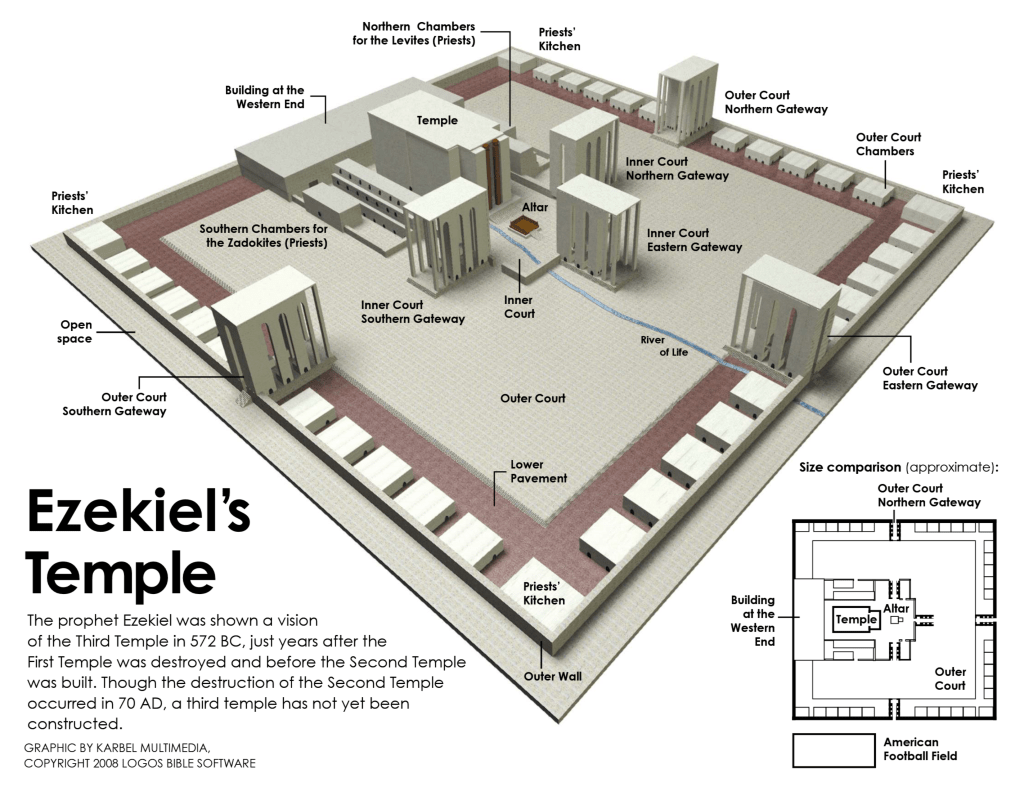
From: https://thebiblerecap.podbean.com/e/day-252-ezekiel-40-42-year-4/
This chapter begins the final section of Ezekiel (40-48) describing the future temple.
Ezekiel is transported in a vision to Israel. A man with a measuring rod appears. Ezekiel is instructed to carefully observe and report everything.
- appearance like bronze
twenty-fifth year of our exile, at the beginning of the year, on the tenth day of the month, in the fourteenth year after the city was struck down
The Outer Wall and East Gate
- A large wall surrounds the temple complex.
- Detailed measurements of the east gate are recorded. I might include those next round.
- Guardrooms and thresholds are described.
The Outer Court
- Courtyards surrounding the temple.
- Pavements and chambers.
- Gates facing different directions.
The Inner Court Gates
- Additional gates leading to the inner courtyard.
- Precise architectural measurements.
Rooms for Sacrifices
- Tables for preparing offerings.
- Areas designated for temple service.
Chambers for Priests
Rooms assigned for priestly service.
The Temple Vestibule
The entrance to the temple building itself. This begins the detailed description of the temple structure that continues for several chapters.
from dhttps://enduringword.com/bible-commentary/ezekiel-40/
i. In his commentary, John B. Taylor listed four different interpretive approaches to these chapters:
· Literal prophetic: Ezekiel 40-48 describes a temple that he expected would be built by the returning exiles in their restoration to the land. For example, Adam Clarke believed that Ezekiel simply gave the plan of Solomon’s temple from memory, and set it here as an encouragement to the exiles that they would in fact be restored to Jerusalem and the temple would be rebuilt.
· Symbolic Christian: Ezekiel 40-48 symbolically describes the Christian church. Smith described this perspective: “The best approach is to see these chapters as illustrative of spiritual truths. The main points thus symbolized in these chapters are these: God would provide for his people a Temple, a priesthood and a worship system related to, but different from, that which they had formerly known. A united people, including Gentiles, would occupy the inheritance which God had promised to their forefathers.”
· Dispensationalist: Ezekiel 40-48 describes a temple of features of a coming millennial age. This future temple belongs not so much to the eternal age (as in Revelation 21:22) but to the period of a literal thousand-year reign of Jesus over this earth. Especially for the Jewish people in the millennium, Ezekiel’s temple will bring to remembrance and memorialize God’s gracious work for Israel and the rich types and ceremonies that looked forward to the perfect work of the Messiah, Jesus Christ. This view “declares that the prediction speaks of the restoration and establishment of the people of Israel in their own land in the last days of their national history, their conversion to the Lord through faith in their long-rejected Messiah, and the manifest presence and glory of the Lord in their midst.” (Feinberg)
· Apocalyptic: Ezekiel 40-48 present symbolic and fantastic images of a coming age, connected to images and ideas popular in the pagan world of that day. “Ezekiel 40–48 replace the conventional prophecies of Ezekiel 33–37 with imagery that is primarily mythic. The prophet chooses to speak about Jerusalem’s future by recasting imagery deriving from the ancient Near Eastern mythic motif of the ‘cosmic mountain.’” (Vawter and Hoppe)
Application
Even when powerful nations oppose God’s people, God remains fully in control and He ultimately defeats every enemy.


Leave a Reply